Quick Answer
Start with the motherboard form factor confirmation: your E-ATX board must fit within the case's stated maximum width, which varies from 265mm to 330mm depending on the chassis. Then map component clearances in order: GPU length, CPU cooler height or AIO radiator size, PSU length, and drive count.
Choosing the Right Spacious Mid-Tower for E-ATX 🖥️
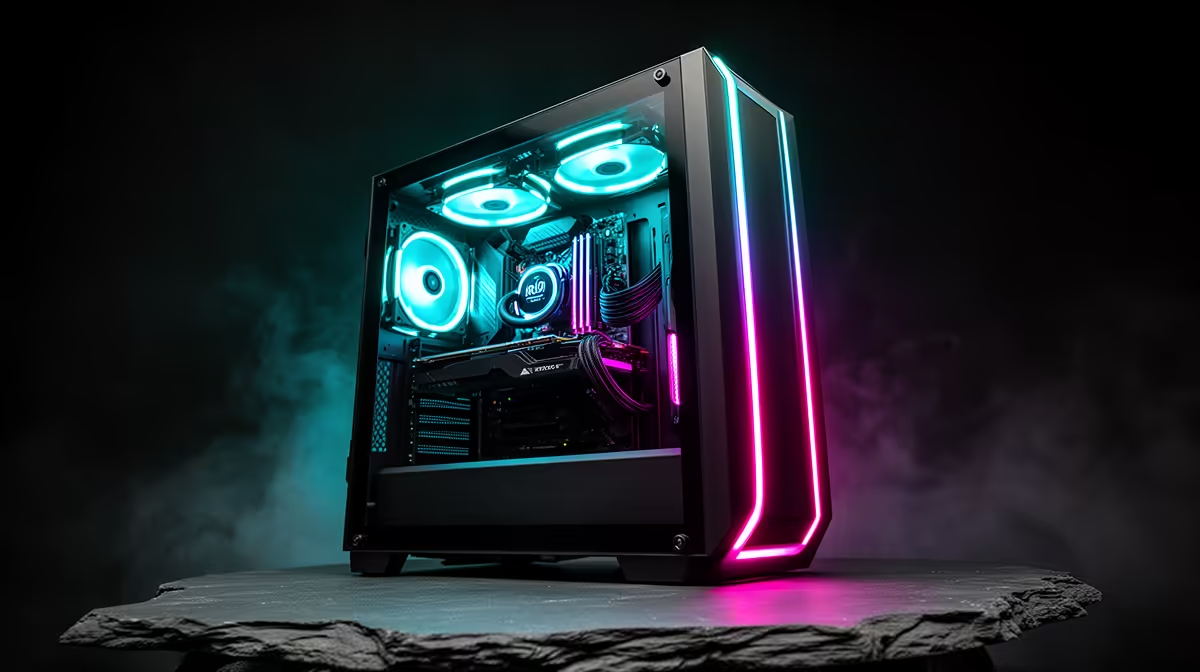
Not all mid-towers that claim E-ATX support are created equal. True spacious mid-towers designed for E-ATX give you at least 280mm of board width support, 380mm or more of GPU length clearance, and room for a 360mm or 420mm radiator.
For a high-end gaming build anchored by components like an RTX 5090 and a Ryzen 9 9950X or Core Ultra 9 285K, prioritise cases with side-mounted GPU riser brackets or vertical GPU display options. These distribute the weight of cards that can reach 2.2kg more evenly and reduce motherboard slot stress over time.
Mapping Component Clearances Before You Buy 📏
Work through this sequence before finalising your case choice. First, confirm the E-ATX board width against the case maximum. Second, check GPU length: an RTX 5090 triple-fan reference card measures around 336mm, while partner models stretch to 380mm. Third, CPU cooling: if running a 360mm AIO, verify front or top mounting support and whether it conflicts with RAM height. DDR5 kits with tall heatspreaders can interfere with AIO pump heads on some boards.
Fourth, check PSU length. A high-end 1000W to 1200W modular PSU typically measures 180mm to 220mm in length. Some mid-towers tighten the PSU bay to 180mm, which eliminates certain PSU options. Fifth, count drive bays: if you run a pair of 2TB NVMe SSDs plus additional 2.5-inch drives, confirm the case has enough mount points.
Cable Management and Cooling Layout 🔧
E-ATX builds generate significant heat from large power-hungry components. Plan the airflow path before building: front mesh intakes feeding cool air across the GPU, top exhaust pulling hot air from CPU and VRMs. A 360mm or 420mm front-mounted AIO works well here, pulling ambient air into the case directly over the radiator before the fans exhaust heat out the top.
Cable management becomes more complex in E-ATX builds because 24-pin ATX cables, dual EPS connectors, and multiple PCIe power cables all need routing. Choose a fully modular PSU rated at 1000W to 1200W (around R2,000 to R3,500 locally) and route cables behind the motherboard tray using the case's tie-down points. A clean cable run improves airflow measurably and makes future upgrades far faster.
Plan Your Build Order ⚡
Install the CPU, RAM, and M.2 SSDs on the motherboard before placing it in the case. E-ATX boards are large and maneuvering inside a mid-tower to access M.2 slots post-installation can be genuinely difficult, especially around the lower PCIe slot area.
FAQ
What is the minimum PSU wattage for a high-end E-ATX gaming build?
For a build with an RTX 5090 and a Ryzen 9 9950X or Core Ultra 9 285K, a quality 1000W to 1200W 80 Plus Gold or Platinum PSU is the appropriate range. Undersizing the PSU on a high-draw system leads to instability under full GPU and CPU simultaneous load.
Can I fit a 420mm radiator in an E-ATX mid-tower?
Yes, several E-ATX mid-towers support 420mm radiators in the front panel. Confirm the case spec sheet explicitly lists 420mm support, then check whether GPU clearance is reduced when the radiator is front-mounted. Some builds route the 420mm AIO to the top instead to preserve full GPU length clearance.
How much does a complete high-end E-ATX gaming build cost in South Africa?
A system built around an RTX 5090, Ryzen 9 9950X, 64GB DDR5, 2TB NVMe SSD, quality 1200W PSU, and a premium E-ATX case runs approximately R65,000 to R90,000 in 2026. Mid-tier variants with an RTX 5080 and Ryzen 9 9900X land around R45,000 to R60,000 depending on case and cooling choices.
Planning a high-end E-ATX gaming build?
Explore the full range of E-ATX-compatible cases, components, and cooling hardware at Evetech, with local stock and nationwide delivery.