Quick Answer
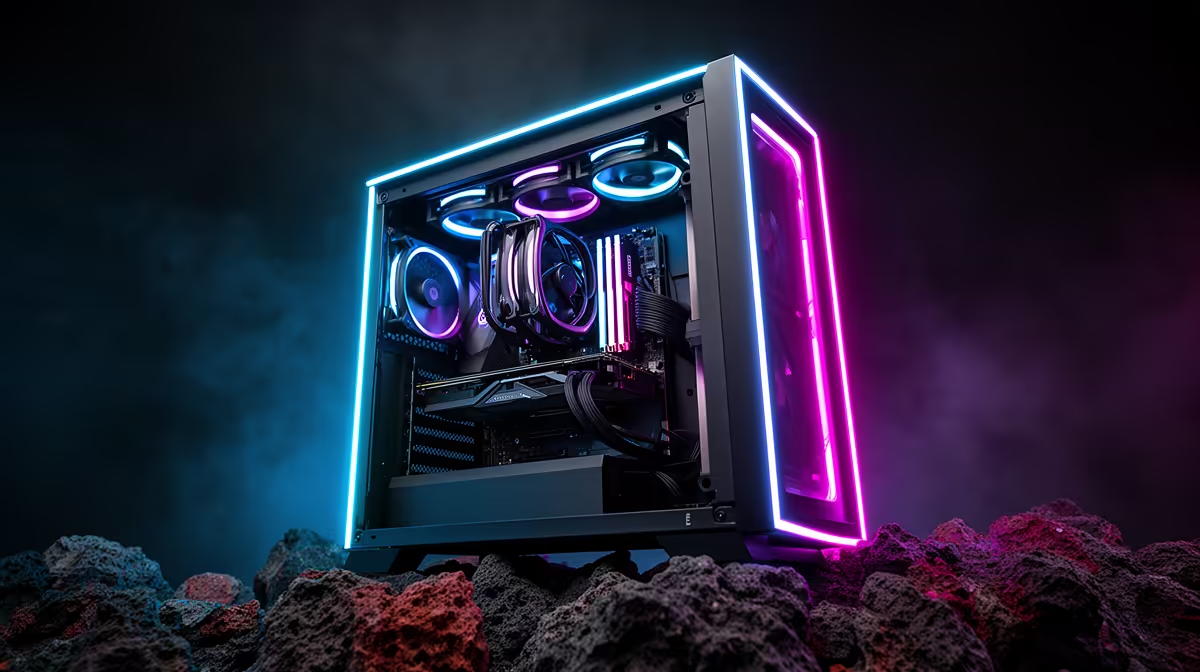
To plan an ATX gaming case build with both 360mm radiator support and 430mm GPU clearance, confirm the case specifications explicitly list both dimensions (not all ATX cases support both simultaneously), map your radiator and GPU positions before ordering, and verify motherboard tray clearance for large VRM heatsinks. Leading ATX mid-tower cases in this spec class currently sit between R2,000 and R5,000 in South Africa.
Understanding the Dimensional Conflict Between Radiators and GPUs 🔧
The 360mm radiator and 430mm GPU clearance combination is tighter than it appears.
The 430mm GPU clearance measurement must be taken from the GPU power connector on the PCIe slot to the case's front panel internal obstruction. Some cases list 430mm GPU support with the drive cage removed, meaning you lose 3.5-inch HDD bays to achieve that clearance. Confirm in reviews or product Q-and-A whether the 430mm clearance is available with the standard drive configuration or only after modification.
Planning the Layout: Radiator and GPU Positions 💡
For a 360mm radiator plus 430mm GPU build, the front-mounted radiator is generally the superior thermal choice. Front intake radiators pull cool room-temperature air directly into the case, using it for radiator cooling before any heat from other components warms it. Top-mounted 360mm radiators work well too but pull slightly warmer air in configurations where the CPU generates significant ambient heat inside the case.
With the radiator front-mounted, confirm the GPU will seat fully without contacting the radiator or its fans on the opposite side.
Cable Management and Airflow Considerations 🎮
In a high-clearance ATX build, cable routing becomes more complex. A modular PSU is strongly recommended because unused cables can be omitted entirely, reducing the cable volume that competes with airflow in the bottom PSU chamber and the main chamber above it. In South Africa where ambient temperatures in Gauteng can hit 32 to 35 degrees Celsius in summer, airflow quality directly affects CPU and GPU sustained boost performance.
For the 360mm AIO, confirm the pump head orientation after installation.
Measure Twice: Verify GPU Clearance With Fans Installed ⚡
After mounting your 360mm radiator with fans attached, physically measure from the front fan faces to the back of the PCIe slot with a ruler before inserting the GPU. GPU clearance listed in case specs does not always account for fan frame thickness on the radiator side. An extra 5 to 10mm of fan frame protrusion is enough to prevent a long GPU from seating correctly.
FAQ
Do all ATX mid-tower cases support 360mm radiators and 430mm GPU clearance simultaneously?
No. Many ATX mid-towers list 360mm radiator support in the front but only 380mm to 400mm GPU clearance when the radiator is installed. The 430mm-with-360mm-radiator combination is a feature of larger mid-towers and full-tower cases specifically designed for high-clearance builds. Always check reviews that test both simultaneously rather than relying on the spec sheet alone.
Can I use an air cooler instead of a 360mm AIO in a case built for radiator support?
Yes. Choosing an air cooler in a case with 360mm front support simply frees up the front mounting positions for additional case fans, often improving overall airflow. Large tower air coolers like the Noctua NH-D15 or be quiet! Dark Rock Pro 5 fit in most high-clearance ATX cases and perform comparably to 240mm AIOs.
What PSU length is compatible with a 430mm GPU clearance case?
Most ATX cases with 430mm GPU clearance use a separate PSU shroud at the bottom that does not affect GPU space. Standard ATX PSUs up to 200mm length fit without restriction. Longer PSUs (above 200mm) should be verified against the case's spec sheet PSU length rating, which is usually 220mm to 250mm in this case class.
Planning a high-clearance ATX build with a 360mm radiator and long GPU?
Evetech stocks ATX gaming cases, 360mm AIO coolers, and RTX 50-series GPUs. Get every component matched and ready from one SA source.