Quick Answer
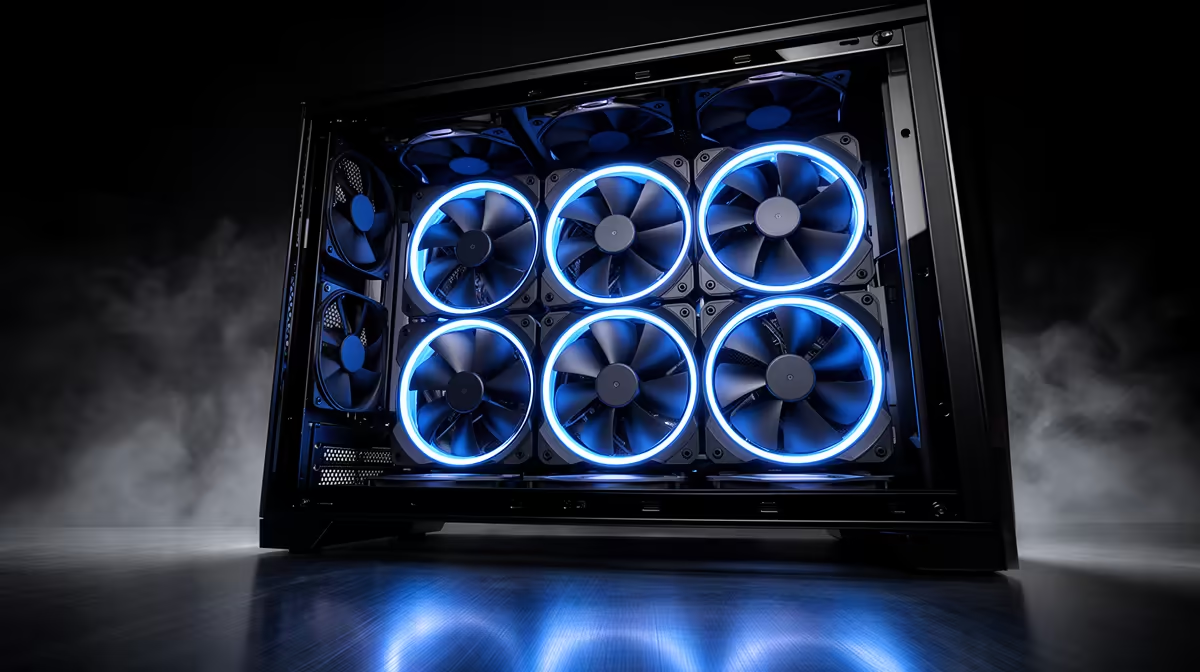
With four 140mm fans pre-installed and support for up to ten additional 120mm fans, place the four 140mm units as front intakes and rear or top exhausts first, then use the 120mm positions to supplement airflow around the GPU and top exhaust. This layout handles flagship-tier hardware drawing over 700W total with temperatures staying within sustained boost clock ranges.
Understanding the Pre-Installed 140mm Fan Positions 🌬️
Cases that ship with four 140mm fans typically mount two at the front as intakes and two at the top as exhausts. This baseline configuration delivers strong positive pressure that keeps dust directed toward filtered vents. The front pair pulls cool air directly past the GPU before it rises to the top exhausts, the most efficient thermal path for a GPU drawing 300W to 575W.
Before adding any 120mm fans, confirm the direction each pre-installed fan is oriented. The sticker or label side of a fan faces the air source direction. Front intake fans have the sticker facing the front panel. Top exhaust fans have the sticker facing inward. A case from a retailer sometimes has fans oriented incorrectly, so verify before first power-on.
Planning the 120mm Fan Positions for Maximum Effect 🔧
With the 140mm foundation established, the ten 120mm positions let you tailor airflow for specific hardware. The highest-priority positions for a high-wattage gaming rig are the bottom intake (if the case has bottom fan mounts) and the rear exhaust. A bottom intake fan directed upward improves direct airflow to the GPU's underside, reducing hotspot temperatures by 3 to 6 degrees Celsius on cards with bottom-facing heat sink fins.
For a Ryzen 9 9950X paired with an RTX 5090 in a full-tower, a practical layout is: four 140mm fans (two front, two top), one 120mm rear exhaust, and optionally two 120mm bottom intakes. This seven-fan configuration covers all critical airflow paths without spending money on positions offering diminishing returns.
Noise Management With a 14-Fan-Capable Case 🎯
Running ten to fourteen fans requires a fan controller or a motherboard with sufficient system fan headers. Most gaming motherboards include four to six system fan headers, enough for six case fans plus a three-fan AIO. For a fully populated case, a dedicated fan hub accepting a single PWM header and splitting to eight or ten outputs keeps the setup manageable.
Set all fans to a shared temperature-responsive PWM curve targeting 900 RPM at 50 degrees Celsius and 1,400 RPM at 80 degrees Celsius. At 900 RPM, fourteen fans of this size are virtually inaudible in a closed room. At 1,400 RPM under full gaming load, combined airflow noise stays below typical GPU fan noise.
Fan Hub vs Splitter Cable ⚡
A PWM fan hub powered by a SATA connector delivers consistent voltage to every connected fan regardless of how many are in the chain. A splitter cable divides available current and can cause fans to spin inconsistently or report incorrect RPM readings in monitoring software. For builds with more than four case fans, use a powered hub rather than a splitter.
FAQ
Should I run all ten 120mm fan positions at once?
Not necessarily. Two bottom intakes and one rear exhaust alongside the four pre-installed 140mm fans is a strong configuration for most builds. Adding more fans beyond seven total delivers progressively smaller temperature improvements.
Can I mix 140mm and 120mm fans on the same hub?
Yes, a PWM hub accepts any fan with a 4-pin PWM connector regardless of size. The 140mm fan will move more air at the same RPM, which is the desired behaviour when using 140mm units as primary intakes.
How much do extra 120mm fans cost at Evetech?
Individual quality 120mm fans with PWM support range from R120 to R350 at Evetech, with ARGB variants at the higher end. Sets of three or six fans are more economical than buying individually.
Building a high-fan-count cooling setup?
Evetech stocks individual case fans, fan hubs, and multi-fan kits compatible with full-tower cases supporting 120mm and 140mm fan positions across all mounting locations.