Quick Answer
To plan independent CPU and GPU cooling zones, choose a case with a full-length PSU shroud or an internal divider, mount your CPU cooler or AIO at the front or top for a dedicated cool-air supply, and rely on the GPU's own axial fans drawing from the lower case volume while case exhaust removes its hot air. Done correctly, neither component's thermal load should meaningfully raise the other's intake temperature.
Mapping the Airflow Zones Before You Build 🗺️
Zone planning starts on paper before hardware is ordered. Sketch the case interior as two horizontal regions: the upper zone covering the CPU socket and above, and the lower zone covering the GPU and PSU. For the upper zone, the goal is a direct cool-air path from the front intake fans to the CPU cooler, then out through the top or rear exhaust. For the lower zone, the GPU's axial fans pull from air entering under the case through a bottom vent and exhaust out the rear PCIe bracket slots. Cases with a physical shelf or extended PSU shroud covering most of the lower interior act as the zone boundary.
Choosing the Right Fan Configuration for Each Zone 🌬️
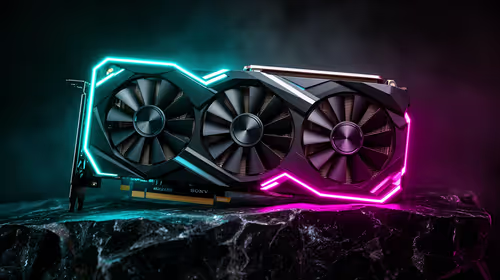
For the CPU zone, three 120mm fans at the front intake plus one 140mm exhaust at the rear is a proven configuration for air-cooled builds. For AIO-cooled builds, the 240mm or 360mm radiator itself acts as the intake, drawing fresh air through its fins before delivering it to the CPU block. For the GPU zone, adding a single 120mm bottom-mounted fan blowing upward directly under the GPU creates a dedicated air supply. GPU junction temps typically drop by 5 to 8 degrees Celsius with this bottom intake addition compared to relying solely on ambient case air.
Component Selection and Case Compatibility 🛠️
For a high-performance build with a Ryzen 9 9950X and RTX 5080, budget R4,000 to R7,500 for a quality dual-zone ATX case stocked at Evetech with a full-length PSU shroud and bottom fan mount support. Pair this with a 360mm AIO and the CPU zone is handled entirely by liquid cooling. For a budget-conscious build around a Ryzen 5 7600 and RTX 5060 Ti, a quality R2,500 to R3,500 case with a solid PSU shroud and three pre-installed fans achieves effective zone separation at lower cost. SA builders in warmer inland regions should add a bottom fan as a priority upgrade since the ambient temperature differential between zones widens during summer months.
Verify Zone Separation With a 30-Minute Stress Test ⚡
After completing your build, run Prime95 small FFTs and FurMark simultaneously for 30 minutes. Log CPU package temp and GPU hotspot temp in HWiNFO64. If GPU hotspot exceeds 95 degrees Celsius while CPU temps remain stable, the lower zone needs more exhaust capacity. Adding one rear 120mm exhaust fan or opening the bottom vent filter resolves most cases.
FAQ
Does a CPU AIO cooler automatically create zone separation?
An AIO cooler removes the CPU's thermal load from the air-cooling equation entirely, meaning chamber air is not heated by the CPU. This effectively creates passive zone separation: the GPU is the primary heat source in the remaining air volume, and case fans manage only GPU exhaust.
Should the bottom case fan blow into or out of the case for GPU cooling?
Blow inward, upward toward the GPU. The GPU's axial fans draw air down and through the heatsink fins, so a bottom fan adding fresh ambient air from below the card supplements this intake naturally. A bottom exhaust fan would work against the GPU cooler's own airflow direction.
How many fan headers does this kind of setup require?
A full dual-zone setup with three front intake fans, one rear exhaust, one top exhaust, and one bottom GPU intake fan needs six fan headers or a fan hub. Most mid-to-high-end motherboards provide four to six headers, and cases with an integrated fan hub consolidate control to one header.
Need a case that supports split cooling zones?
Evetech stocks ATX mid-tower and full-tower gaming cases with PSU shrouds, bottom fan mounts, and AIO compatibility for multi-zone thermal setups. Browse the full case range at Evetech.