


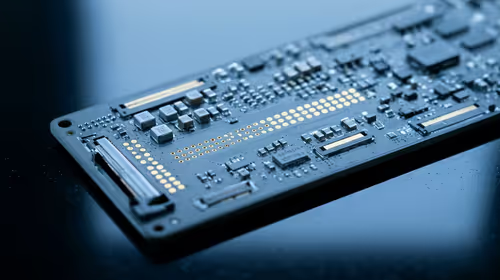
Hot-Swappable PCB Architecture in Modern Keyboards: Guide
Learn hot-swappable PCB architecture in modern keyboards—what it is, how sockets and traces work, and how to pick the right board. Speed up swaps, reduce risk, and upgrade faster 🔧⚡
Read moreA 1200W PSU is necessary in SA builds running an RTX 5080 or 5090 paired with high core count CPUs and overclocks. It covers SA pricing, local availability at Evetech, and warranty support for buyers across Johannesburg, Cape Town, and Durban.
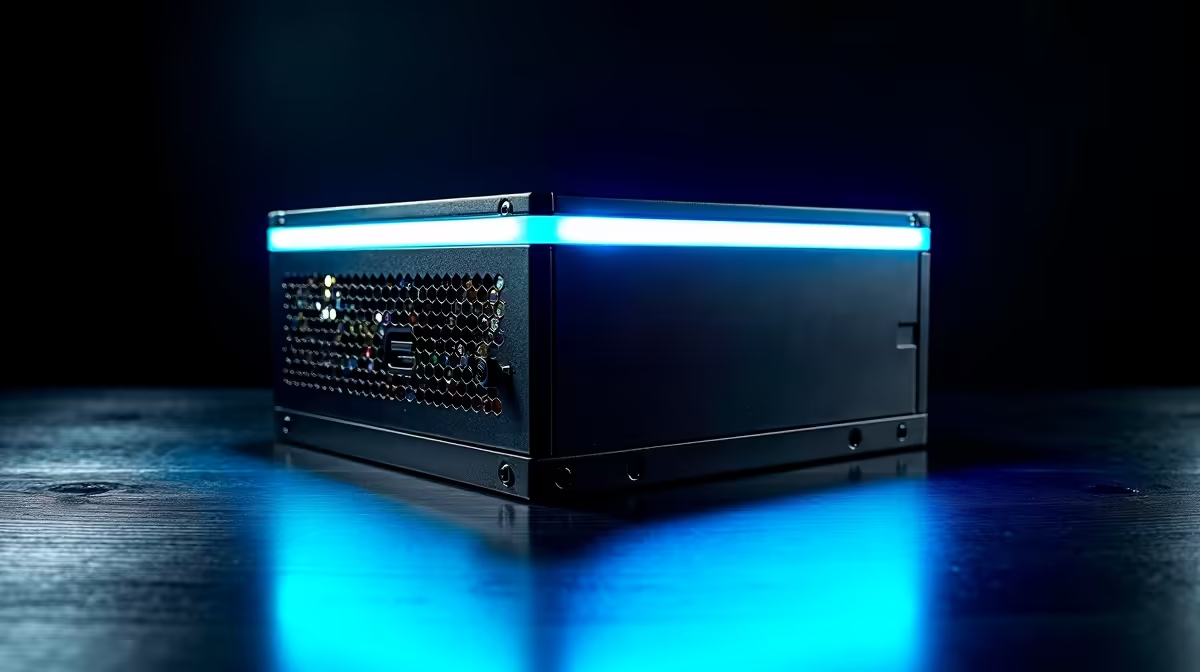
A 1200W power supply is necessary if your build includes an RTX 5090 paired with a high-end CPU like the Ryzen 9 9950X or Core Ultra 9 285K, where combined sustained draw can reach 750 to 850W with transient spikes above 1,000W. For builds centred on an RTX 5080 or lower, a quality 1000W ATX 3.1 unit provides sufficient headroom in most configurations.
The RTX 5090 has a listed TDP of approximately 575W. In peak transient moments the GPU alone spikes above 700W. Combined with a Ryzen 9 9950X drawing 200W under full CPU load, plus DDR5, NVMe drives, and fans adding 40 to 60W more, a high-end SA build draws 800 to 850W sustained during combined gaming and CPU-intensive tasks. A 1000W unit at 85 percent capacity runs hotter and ages faster than a 1200W unit at 71 percent capacity delivering the same wattage. The thermal margin matters: 1200W at 71 percent load runs cooler than 1000W at 85 percent load even accounting for the 1200W unit's higher absolute heat generation at full rated power. For SA gamers planning five-to-seven-year ownership cycles, the extra R800 to R1,000 for 1200W over 1000W in the same quality tier is reasonable insurance against thermal-related ageing. Locally, 1200W Gold ATX 3.1 units are stocked at Evetech from approximately R4,200 to R6,000.
An RTX 5080 paired with a Ryzen 7 9800X3D draws around 500 to 580W sustained under gaming load, with transient spikes reaching 700 to 750W. A 1000W ATX 3.1 unit handles this at 50 to 60 percent capacity, the efficiency sweet spot for Gold-rated units. Spending R800 to R1,200 more for a 1200W unit in this configuration buys wattage headroom the build will never meaningfully use. The exception is future-proofing: if you plan to upgrade to an RTX 6000-series card within the PSU's lifespan, buying 1200W now avoids a PSU upgrade later. For South African builders who hold components longer due to premium import costs on each upgrade cycle, the future-proofing argument is more relevant than in markets where annual GPU upgrades are common.
Input your CPU TDP, GPU TDP, RAM count, SSD count, and fan count into a PSU wattage calculator before deciding between 1000W and 1200W. If the result is under 750W sustained, the 1000W unit is the smarter choice. If the result sits between 750W and 900W, 1200W is worth the premium. This five-minute step prevents both overspending and underpowering.
No. PSU power draw scales with load, not rated capacity. Both a 1200W and an 850W Gold unit powering the same 80W idle system will draw approximately 88W from the wall at 91 percent efficiency. Rated wattage describes the maximum available output, not the operating draw.
For pure gaming, an 850W draw is typical, making 1000W the minimum and 1200W a comfortable choice. 1200W is not overkill: it operates the unit at a thermally efficient load point with transient headroom. Overkill would be a 1600W unit for this configuration.
If the PSU is ATX 3.1 compliant, it handles transient spikes above rated wattage for up to 100 microseconds without cutting power. For sustained draw above rated capacity, overcurrent protection triggers and the system loses power immediately. Matching PSU wattage to sustained draw with at least 15 to 20 percent headroom is the fundamental sizing rule.
Not sure whether your build needs 1000W or 1200W? Evetech stocks both tiers with full ATX 3.1 compliance and Gold or Platinum efficiency. Browse the power supply section and use the wattage filter to find units suited to your component combination.
Learn hot-swappable PCB architecture in modern keyboards—what it is, how sockets and traces work, and how to pick the right board. Speed up swaps, reduce risk, and upgrade faster 🔧⚡
Read more
Mechanical switch lifespan explained—what the 50 million keystroke rating really means, plus tips to extend switch life and reduce double-press issues 🔧⌨️
Read more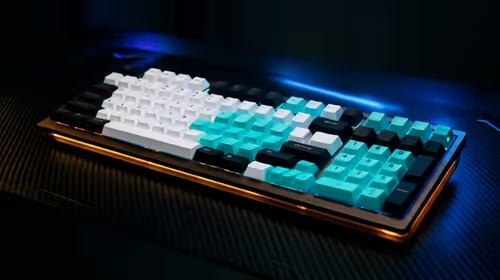
60-percent vs full-size mechanical keyboard layouts—learn what each layout includes, who it suits, and how to choose the right fit 🧩⌨️ for typing, gaming, and productivity.
Read more
Double injection keycaps last far longer than standard printed keycaps in most setups. Learn typical lifespan ranges, what shortens them, and how to maximize durability for smoother daily typing and gaming 😊⌨️
Read more
Full-key anti-ghosting: does it stop missed inputs during fast-paced gaming? We break down latency, polling, and key matrix limits so you can buy smarter 🎮⚡
Read more
Protect mechanical keyboard switches from South African dust and summer humidity with practical cleaning and storage habits. Keep your switches smooth, reduce failures, and extend lifespan. 🌬️💧
Read more
Wondering if a TKL wireless mechanical keyboard is worth it for everyday productivity? We break down latency, battery life, comfort, and workflow gains for real work. ⚡⌨️

Maximise battery life on a fanless 15-inch laptop using efficiency core architecture. Cut idle drain, tune power profiles, and improve thermals for longer runtime. 🔋⚙️
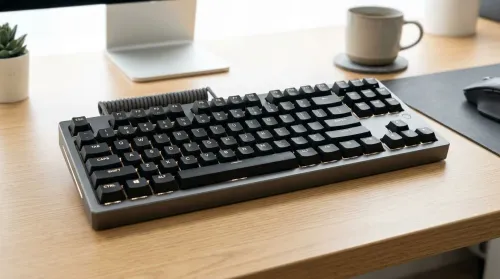
Learn how to reduce desk clutter with a TKL wireless keyboard using fewer cables, smart placement, and tidy essentials. Get a faster, calmer workspace with better ergonomics. ✅🧼
RGB keyboard lighting too distracting? Learn how to manage backlight modes, set brightness, and reduce distraction for focus and productivity 😌🖱️
Are themed gaming keyboards worth the extra cost? Compare build quality, switch options, features, and resale value to find the best fit for your setup 🎮⌨️
Full-Size vs Tenkeyless mechanical keyboards for gaming: find out if a smaller layout truly improves aim, speed, and comfort. We break down layout, desk space, latency-feel, and keybinds 🎮⌨️

Dedicated media rollers vs function key shortcuts: learn which setup gives you better workflow control, faster media access, and fewer mistakes. 🖱️🎧
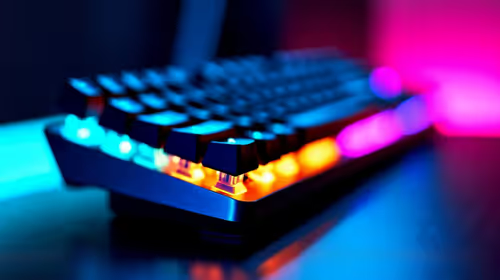
Best Mechanical Switch Type for Gaming: Clicky vs Linear vs Tactile. Find your feel, speed, and noise balance with practical guidance for FPS, MOBA, and productivity 😄🎮
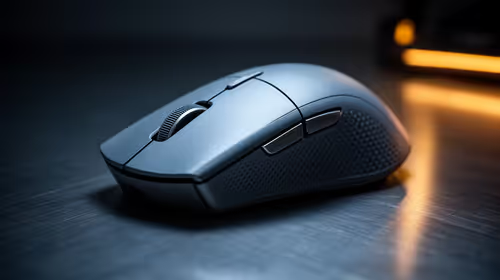
Direct mouse answer: Mouse not keeping up with your work? Everything that matters about dual-mode 2.4GHz + BT 5.0: DPI behaviour, channel switching, battery curves and per-app button mapping. Covers when 2.4GHz USB wins (low-latency desk) and when BT 5.0 wins (laptop, d
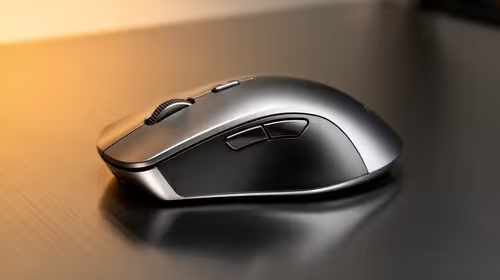
Plain wireless mouse guide: Mouse not keeping up with your work? Everything that matters about wireless productivity mouse: DPI behaviour, channel switching, battery curves and per-app button mapping. Includes DPI tuning tips, channel switch shortcuts, and ZAR-aware fea
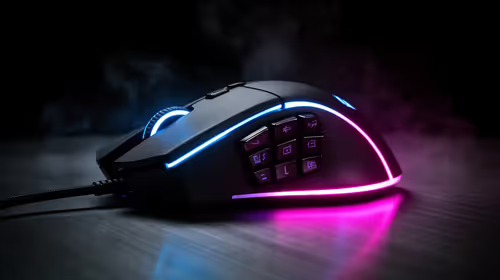
Real productivity numbers: Set up your wireless mouse in this order: everything that matters about wireless productivity mouse: DPI behaviour, channel switching, battery curves and per-app button mapping. Includes DPI tuning tips, channel switch shortcuts, and ZAR-aware
Pen not feeling like paper? Stylus lag and skipping usually trace to old drivers, dirty nibs, or display refresh mismatches, not the pen itself. Covers pressure curve tuning, tilt thresholds, nib swap timing, and SA pricing brackets.