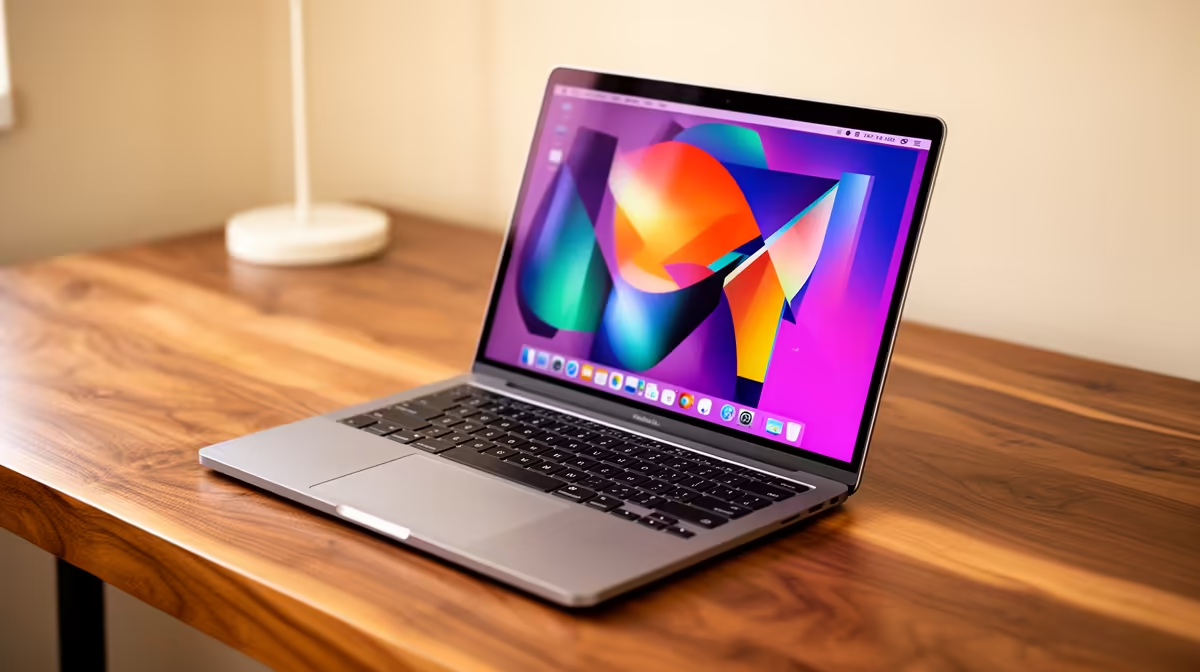
Sound familiar? For a South African creative, the struggle is real. Choosing the right tool isn't just about specs; it's about finding a reliable partner for your hustle. This guide cuts through the noise to help you find the perfect laptop for graphic design that can handle your workflow, from logo concepts in Cape Town to 3D renders in Jozi.
Core Specs for a Graphic Design Laptop
Forget confusing jargon. Let's break down what actually matters when you're hunting for a machine that can keep up with your creativity. A powerful laptop for graphic design balances three key areas: processing power, graphical muscle, and memory.
The Processor (CPU): Your Creative Engine
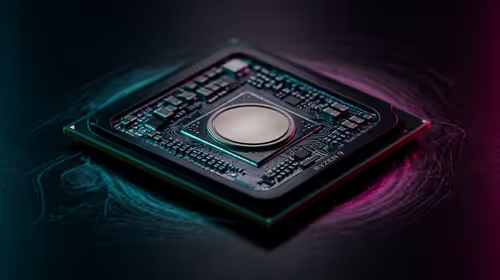
The Central Processing Unit (CPU) is the brain of your laptop. For design work—especially running multiple Adobe Creative Cloud apps at once—you need a modern, multi-core processor. It handles everything from applying filters in Photoshop to exporting vectors in Illustrator.
In South Africa, the choice usually comes down to two teams: Intel and AMD.
- Intel Core: Known for strong single-core performance, which is great for tasks in apps like Photoshop and Illustrator. Look for Core i5 for entry-level work, but a Core i7 or i9 from a recent generation is the sweet spot for professionals. You can browse a wide variety of powerful Intel laptops on special to see the latest options.
- AMD Ryzen: Often offers more cores for your Rand, making them fantastic for multi-threaded tasks like video rendering in Premiere Pro or 3D modelling. A Ryzen 7 or Ryzen 9 processor is a true workhorse for any creative. Check out the latest deals on versatile AMD laptops to compare performance and pricing.
The Graphics Card (GPU): The Visual Powerhouse ⚡
While a CPU does the thinking, the Graphics Processing Unit (GPU) does the drawing. For graphic design, a dedicated (or discrete) GPU is non-negotiable. It accelerates visual tasks, smooths your canvas when zooming and panning complex files, and is essential for 3D work, motion graphics, and GPU-accelerated effects.
This is where a secret weapon comes in: gaming laptops. They are built with powerful NVIDIA GeForce RTX or AMD Radeon GPUs, high refresh-rate screens, and excellent cooling systems... all features that are perfect for demanding design software. Don't be put off by the RGB lighting; the performance-per-Rand is often unbeatable. The best gaming laptop deals often hide the most capable graphic design laptops.
Pro Tip: Keep Your SSD Speedy 🚀
Adobe apps create massive cache files that can slow down your SSD over time. To keep your laptop for graphic design running smoothly, regularly clear the Media Cache in Photoshop, Premiere Pro, and After Effects. Navigate to Edit > Preferences > Media & Disk Cache and click "Clean." It can free up gigabytes of space and restore that snappy feeling.
RAM and Storage: Your Digital Workspace
RAM (Random Access Memory) is your laptop's short-term memory. It's where your active projects and applications live. 8GB is the absolute minimum, but 16GB is the recommended starting point for any serious designer. If you work with large-format print files, complex 3D scenes, or 4K video, 32GB will ensure a lag-free experience.
Storage (SSD): Your days of waiting for files to load are over. A Solid-State Drive (SSD) is essential. It's dramatically faster than an old-school Hard Disk Drive (HDD). Aim for at least a 512GB NVMe SSD to house your operating system, software, and current projects.
The Screen: Colour-Accuracy is King 🎨
What good is a powerful machine if the colours on your screen don't match the final print? When choosing a laptop for graphic design, the display is just as important as the components inside.
Look for these key features:
- Colour Gamut: Aim for a screen that covers at least 90-100% of the sRGB colour space. For print-focused work, look for high coverage of the Adobe RGB or DCI-P3 gamuts.
- Resolution: A Full HD (1920x1080) screen is the baseline. However, a QHD (2560x1440) or 4K display will give you much sharper details and more screen real estate to work with.
- Brightness: A brighter screen (measured in nits) is easier to see in different lighting conditions. Aim for 300 nits or more.
Finding the right balance of power, portability, and price is the final step. A top-tier graphic design laptop is an investment in your career, enabling you to work faster, take on bigger projects, and bring your vision to life without technical limits.
Ready to Find Your Perfect Match?
Whether you're a freelancer on a budget or a power user needing the best, the right machine is waiting. For maximum power, choice, and value in South Africa, a high-performance laptop is hard to beat. Explore our massive range of laptop specials and find the perfect machine to conquer your creative world.