



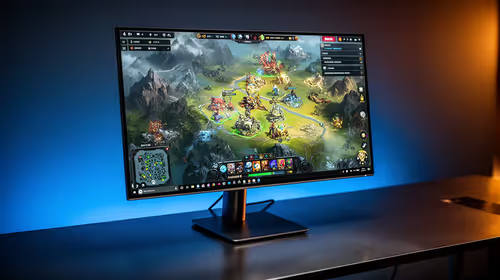
IPS vs VA for Strategy and Sim Games in SA
IPS vs VA for strategy and sim games should be judged by fit, not a single winner. Compare compatibility, latency, capacity, upgrade path, cost planning, and South African setup needs.
Read moreFor m5 vs m5 pro vs m5 max for local llms, the M5 Max at 614 GB/s and 128GB unified memory is the clear winner for large coding models -- M5 Pro tops at 64GB and 307 GB/s, half the bandwidth, making 70B models inaccessible on that chip.
Pick the wrong Apple silicon tier for local AI and you do not get a slow model, you get a model that will not load at all. The gap between M5 Pro and M5 Max is not a few percent of speed, it is the difference between a chip that caps at 64GB of memory and one that reaches 128GB, and between 307 GB/s of bandwidth and roughly double that. For anyone running large coding models on a MacBook Pro, that decides everything.
The M5 Max with up to 128GB of unified memory and up to 614 GB/s of bandwidth is the chip to buy for serious local LLM work. The M5 Pro tops out at 64GB and about 307 GB/s, which keeps the heaviest 70B-and-up coding models out of reach. The base M5 maxes at 32GB and is fine only for small models.
A language model has to fit its weights in memory before it can run a single token. That is the wall most people hit first. A quantised 70B-class model wants somewhere in the region of 40 to 50GB just for weights, and you still need headroom for the operating system, your apps, and the model's context. On a 64GB M5 Pro that is uncomfortably tight, and the largest models simply do not fit. The 128GB M5 Max gives you room to load a big coding model and keep working in your editor, browser and terminal at the same time.
Once a model fits, memory bandwidth sets how quickly it generates text. Every token forces the chip to read the entire active set of weights from memory, so for inference the speed you feel is closely tied to how fast memory can be read. The M5 Max's top configuration reaches about 614 GB/s on the 40-core GPU part, with a 460 GB/s tier on the 32-core version, while the M5 Pro sits near 307 GB/s. That is roughly half. In practice the M5 Max does not just run bigger models, it runs the models you both share at a noticeably higher token rate.
The base M5 offers up to 32GB and around 153 GB/s, which suits small 7B-to-13B assistants and quick local tasks. The M5 Pro lifts that to 64GB and about 307 GB/s, comfortable for mid-size models in the 13B-to-32B range. The M5 Max stretches to 128GB and up to 614 GB/s, the only tier that runs the largest local coding models smoothly, with Apple positioning the 128GB part as capable of handling models well above 100 billion parameters.
In March 2026, Apple unveiled the M5 Pro and M5 Max. Both use the Fusion Architecture, which bonds two dies into a single package, in contrast to the base M5's single-die design. That packaging approach is part of what allows the M5 Max to scale bandwidth and memory capacity so far beyond the base chip.
The M5 Pro uses up to a 14-core CPU with up to 20 GPU cores. The M5 Max doubles the GPU core count to up to 40 cores and scales the memory bus accordingly, which is where the bandwidth jump comes from. For local LLM inference, the extra GPU cores matter less than the wider memory interface, but longer context windows and multi-model setups do benefit from the higher compute headroom.
For a Llama-class 70B model at Q4_K_M quantisation, M5 Max configurations with 128GB typically deliver somewhere in the 12 to 15 tokens per second range in real-world testing. That is slower than a discrete NVIDIA GPU on smaller models, but it is the only Apple silicon tier that runs a full 70B model at all. The M5 Pro at 64GB can just about hold a heavily compressed 70B model but with almost no context headroom left. The base M5 at 32GB cannot fit a 70B model at any practical quantisation.
For mid-size 13B to 32B models, the M5 Max's bandwidth advantage over the M5 Pro translates into a noticeably faster token rate on the models both chips can hold. That matters day to day when a coding assistant is firing completions constantly.
The strongest new coding models in 2026 increasingly use Mixture-of-Experts architectures. A model might total 80B or more parameters but only activate a fraction per token, which means generation speed is better than the total size implies. The 128GB M5 Max keeps a very large MoE coder entirely in unified memory, and since only the activated expert layers are fetched per step, token speed is far more competitive than raw parameter count implies. This is a genuine 2026 reason to value the 128GB tier that did not apply as clearly to earlier model generations.
If your local AI use is a coding copilot in the 7B-to-32B range, a 64GB M5 Pro is genuinely capable and the better value. If you intend to run 70B-class models, agentic coding setups that keep a large context alive, or several models loaded at once, the 128GB M5 Max is the only tier that does it without constant juggling. It is worth being honest about your workload before paying the premium, because the jump is significant.
The systems built around this kind of unified-memory architecture, including the AI PC range at Evetech, are aimed squarely at local inference, and if you would rather see what is selling fastest with local-AI buyers, the best-selling PCs right now are a useful gauge of where the demand sits.
You can run larger models than the raw numbers suggest by using lower-precision quantisation, which shrinks the memory each weight takes. A heavily quantised 70B model can squeeze closer to the 64GB line, though quality softens as precision drops. This is exactly why the M5 Max's extra capacity matters: it lets you run the same model at a higher precision, or a bigger model at a usable one, instead of trading away accuracy to make it fit.
At its 64GB ceiling it is very tight. A heavily quantised 70B model can be made to load, but you sacrifice precision and lose headroom for context and other apps. For comfortable 70B work the 128GB M5 Max is the right tool.
A lot. Token generation reads the active weights from memory each step, so the M5 Max's roughly double bandwidth translates into a meaningfully higher token rate on the same model the M5 Pro can also run.
For small models, yes. Its 32GB and around 153 GB/s handle 7B-to-13B assistants and lightweight tasks well. It is not the chip for large coding models.
Yes. The CPU, GPU and Neural Engine on Apple silicon all draw from a single LPDDR5X pool, which is why the GPU can address very large models directly without copying data across a separate bus.
Only if your models need it. A 64GB M5 Pro is better value if your work stays in the mid-size range. Pay for 128GB when 70B-class models or multiple loaded models are a real, regular requirement.
Planning a local-AI machine around M5-class unified memory? Explore the AI PC range at Evetech (https://www.evetech.co.za/components/ai-pcs-443) and match the memory tier to the models you actually run, not the spec sheet.
At its 64GB ceiling it is very tight. A heavily quantised 70B model can be made to load, but you sacrifice precision and lose headroom for context and other apps. For comfortable 70B work the 128GB M5 Max is the right tool.
A lot. Token generation reads the active weights from memory each step, so the M5 Max's roughly double bandwidth translates into a meaningfully higher token rate on the same model the M5 Pro can also run.
For small models, yes. Its 32GB and around 153 GB/s handle 7B-to-13B assistants and lightweight tasks well. It is not the chip for large coding models.
Yes. The CPU, GPU and Neural Engine on Apple silicon all draw from a single LPDDR5X pool, which is why the GPU can address very large models directly without copying data across a separate bus.
Only if your models need it. A 64GB M5 Pro is better value if your work stays in the mid-size range. Pay for 128GB when 70B-class models or multiple loaded models are a real, regular requirement.
IPS vs VA for strategy and sim games should be judged by fit, not a single winner. Compare compatibility, latency, capacity, upgrade path, cost planning, and South African setup needs.
Read more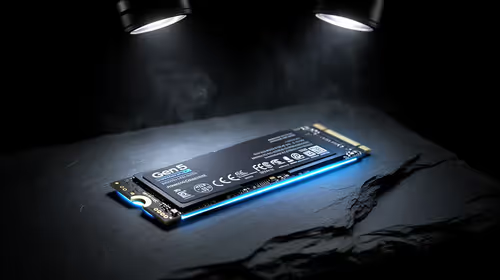
Gen 5 NVMe SSD guide for Bloemfontein gamers should be shortlisted around the job it must do. South African buyers should compare capacity, speed, thermals, and motherboard support, warranty path, and upgrade room before treating any pick as best.
Read more
Skip the RTX 5070 if your first-time builder budget needs better balance. Better SA picks can free room for the right CPU, PSU, case, monitor, storage, and cooling while still giving a strong first gaming PC experience this year in South Africa.
Read more
RTX 5080: weighing the pros and cons for SA should be shortlisted around the job it must do. South African buyers should compare GPU tier, VRAM, cooling, and PSU headroom, warranty path, and upgrade room before treating any pick as best.
Read more
Core i5-13400F gives South African PC builders a capable mid-range CPU choice with clear limits. Check its gaming fit, discrete GPU requirement, LGA1700 platform costs, and upgrade path before locking in your parts list.
Read more
Pros and cons of the Wi-Fi 7 routers for SA should be shortlisted around the job it must do. South African buyers should compare WiFi standard, coverage, latency, and device support, warranty path, and upgrade room before treating any pick as best.
Read more
Steam content servers unreachable needs a download-path check, not an immediate reinstall of every game. Restart the client, inspect download settings and compare another connection when practical. Clearing the download cache is separate from deleting installed games.

Keychron G6 HE has built-in and swappable battery versions with different weights. The product brief lists 42g and 46g respectively, each with a 3g tolerance. Choose by grip and battery preference before treating one headline weight as universal.

Corsair HS80 v2 MAX supports 2.4GHz wireless and Bluetooth. Its maximum battery figures use RGB-off conditions and differ by connection. Check microphone routing, comfort and the exact device support before assuming every wireless mode behaves alike.

Windows taskbar notification badges can be shown or hidden in Taskbar behaviours. This changes the small app indicators, not the underlying messages. Choose a calmer desktop while keeping a deliberate routine for checking important conversations and app updates.
Windows taskbar notification badges can be shown or hidden in Taskbar behaviours. This changes the small app indicators, not the underlying messages. Choose a calmer desktop while keeping a deliberate routine for checking important conversations and app updates.
Windows USB device in use can mean a program still has the drive open. Finish transfers and close files before retrying ejection. Better performance caching requires safe removal; a replacement drive is not the first fix for an open-file warning.

Windows Nearby Sharing not working starts with feature, Bluetooth and visibility checks on both PCs. My devices only depends on matching Microsoft accounts. Test a small harmless file before buying networking hardware or changing your home router.
Windows hardware reserved RAM is different from memory used by applications. Compare installed memory with firmware detection and the usable amount before buying modules. Reservations and reporting limits vary by system; no universal setting restores every byte.

Windows title bar window shake can minimise other open windows when you shake the active window by its title bar. Inspect the Multitasking setting and switch it off if that gesture interrupts your work. The preference costs R0 and does not require new hardware.

Windows Print Screen opens Snipping Tool when its keyboard preference is enabled. Change the option under Accessibility, Keyboard to choose another workflow. Test whether you need a clipboard image or a saved file.

Windows desktop icons missing may be a visibility setting. Right-click the desktop, choose View and inspect Show desktop icons. If only system icons are absent, use Desktop icon settings. Check the Desktop folder before assuming files were deleted.

Windows set time zone automatically greyed out calls for a location and device-policy check. Automatic time-zone selection relies on location services. A manual time-zone choice is separate from synchronising the clock; check both before replacing hardware.