




IPS vs VA for Strategy and Sim Games in SA
IPS vs VA for strategy and sim games should be judged by fit, not a single winner. Compare compatibility, latency, capacity, upgrade path, cost planning, and South African setup needs.
Read moreFour numbers carry this machine: 30 CPU cores, 64 GPU cores, a 32-core Neural Engine and 96GB of shared memory. Add a 1TB SSD, a back panel of six Thunderbolt 5 sockets, an HDMI output, 10Gb networking and a card slot, and the total comes to R108,999.
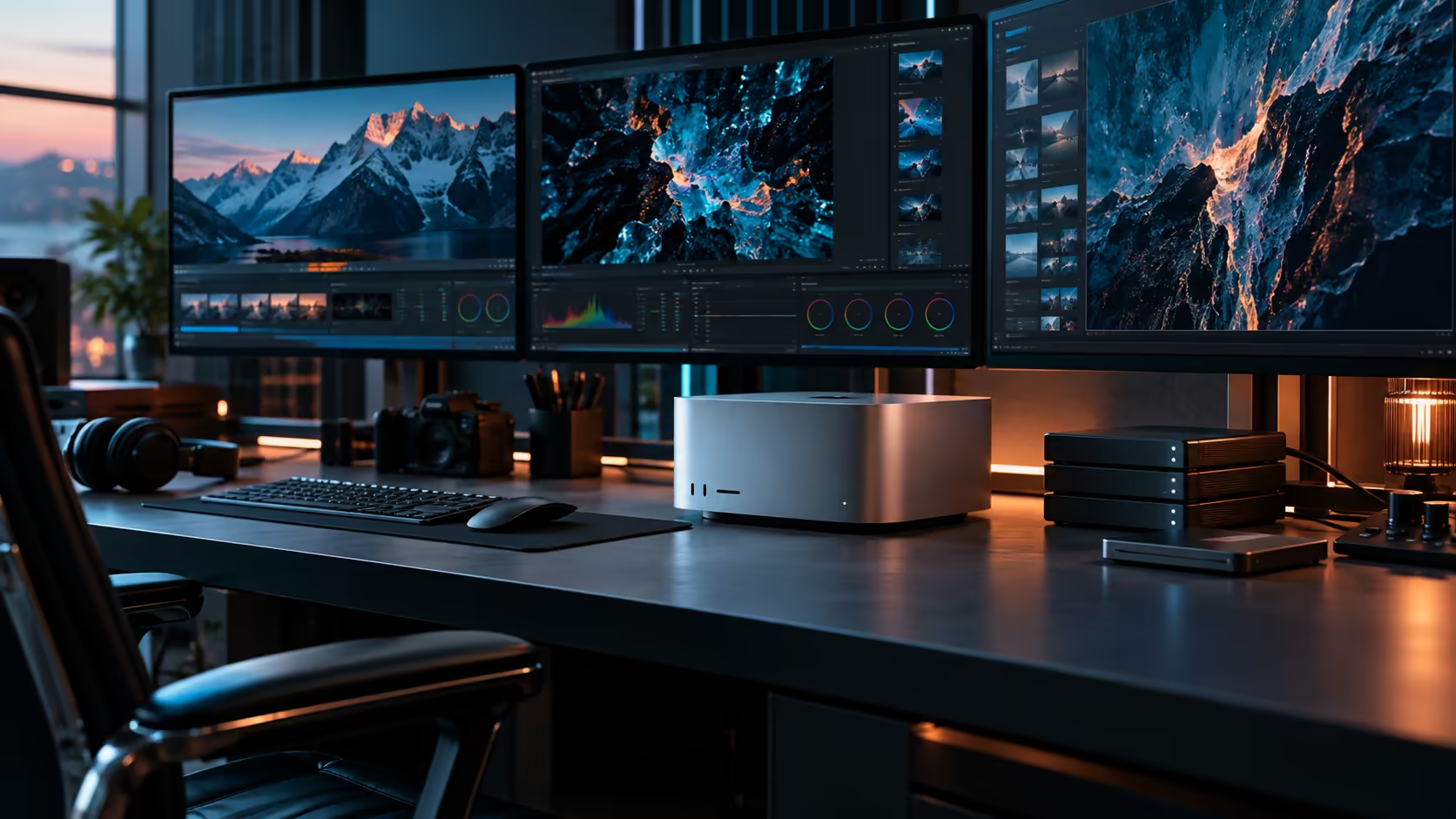
Every figure on the Mac Studio M5 Ultra's spec sheet is roughly double the M5 Max sitting one tier below it. That pattern invites an obvious question: is this simply two Max chips fused together, and if so, does that mean it's really a machine for two people rather than one?
The M5 Ultra is built by joining two M5 Max dies together, which is exactly why its thirty processor cores, sixty-four graphics cores, thirty-two-core Neural Engine and 96GB of memory each roughly double the Max's equivalent figure. It behaves as one unified chip to macOS and every application, not two separate halves a user has to manage. The full configuration, with a 1TB SSD, is R108,999.
This is worth understanding precisely, because "double the chip" doesn't mean "double the machine" in the way people sometimes assume.
Apple's Ultra tier physically connects two Max-class dies with a high-bandwidth interconnect built specifically for this purpose, and the result presents to macOS as a single processor with one 96GB memory pool rather than two separate ones a user would have to manage, all working as one coherent system. A single application doesn't need to be written any differently to use an Ultra chip than a Max chip; the operating system and the hardware handle that unification beneath the surface, seamlessly, without the user or the software needing to think in terms of "which half."
This is the practical question the doubled specification actually raises, and the honest answer depends entirely on how the machine gets used, not on the architecture itself.
For a single demanding user, an Ultra doesn't behave as "two people's worth" of anything at all; it's simply a much larger pool for one person's heaviest work, useful when a single workflow, a huge 3D scene, an enormous AI model, genuinely needs that scale. For a shared setup, the doubled memory and core counts do mean 2 or 3 lighter users can draw on the same machine with more headroom than a Max would offer, but macOS still allocates that pool dynamically rather than formally splitting it per person, so a true "two-user" workload still competes for the identical resources under real concurrent load.
Not every property of the machine scales the same way as the headline core counts.
Processor cores, graphics cores, Neural Engine cores and memory capacity all roughly double from the Max tier to the Ultra tier. Port count doesn't double the same way: six Thunderbolt 5 ports on the Ultra against four on the Max is a smaller proportional jump, reflecting that connectivity is sized to a demanding desk's real needs rather than to the raw processing scale. Storage follows its own logic too, 1TB against 512GB, a doubling that matches the larger projects this tier is generally bought for, rather than being a direct consequence of the chip architecture itself.
R108,999 against the Max's R49,499 is more than double, which is worth acknowledging honestly rather than glossing over.
The premium reflects more than raw silicon: the engineering behind joining two dies into one coherent chip, the additional ports, and the larger fixed storage tier all add real cost beyond simply doubling component counts on a spreadsheet. Whether that premium is worth it comes down to the same test as any tier decision: measure your heaviest realistic workload, alone or shared, and compare it honestly against what the Max's single-die specification already covers before assuming more silicon is automatically the better purchase.
The doubling pattern only tells half the story without the wider range it sits inside.
Step down from the Max to the compact PC lineup more broadly and the figures keep shrinking toward configurations built for general use rather than sustained professional work. Step down further to the Mac mini and you're well outside the territory where doubled dies or halo pricing are relevant at all. Placing the Ultra correctly on that ladder, rather than treating it as simply "the best Mac Studio," is what makes R108,999 make sense as a price rather than a headline number.
Rather than reasoning from the architecture alone, test your actual situation against it directly.
If you're buying for one person, open your heaviest current project and check whether it uses anywhere near the Max's 36GB pool; if it doesn't get close, the Ultra's doubling buys you margin you're unlikely to spend. If you're buying for a small team, measure whether your people's heaviest hours genuinely overlap; if they rarely do, the Ultra's larger shared pool serves them well, and if they consistently collide, that's the scenario the doubled architecture was actually built to handle.
Yes, functionally. Apple connects two Max-class dies with a high-bandwidth interconnect, and the result operates as a single unified chip to macOS and every application.
Not automatically. It presents as one shared resource pool. It CAN serve two or three lighter users with more headroom than a Max would, but real concurrent heavy use from multiple people still competes for the same pool.
Most core figures roughly double, processor cores, graphics cores, Neural Engine cores and memory. Port count and storage scale by different, smaller factors reflecting different design priorities.
For workloads that genuinely need that scale, alone or shared, yes. For lighter work that the M5 Max already comfortably covers, the premium buys headroom that may go unused.
Check your current heaviest project's real memory and processing use against what the Max already provides. If you're consistently nowhere near that ceiling, the Ultra's doubled specification is margin you're unlikely to actually spend.
Ready to see whether the M5 Ultra's doubled specification actually matches your workload? Compare it against the M5 Max before deciding which tier your real work justifies.
Yes, functionally. Apple connects two Max-class dies with a high-bandwidth interconnect, and the result operates as a single unified chip to macOS and every application.
Not automatically. It presents as one shared resource pool. It CAN serve two or three lighter users with more headroom than a Max would, but real concurrent heavy use from multiple people still competes for the same pool.
Most core figures roughly double, processor cores, graphics cores, Neural Engine cores and memory. Port count and storage scale by different, smaller factors reflecting different design priorities.
For workloads that genuinely need that scale, alone or shared, yes. For lighter work that the M5 Max already comfortably covers, the premium buys headroom that may go unused.
Check your current heaviest project's real memory and processing use against what the Max already provides. If you're consistently nowhere near that ceiling, the Ultra's doubled specification is margin you're unlikely to actually spend.
IPS vs VA for strategy and sim games should be judged by fit, not a single winner. Compare compatibility, latency, capacity, upgrade path, cost planning, and South African setup needs.
Read more
Gen 5 NVMe SSD guide for Bloemfontein gamers should be shortlisted around the job it must do. South African buyers should compare capacity, speed, thermals, and motherboard support, warranty path, and upgrade room before treating any pick as best.
Read more
Skip the RTX 5070 if your first-time builder budget needs better balance. Better SA picks can free room for the right CPU, PSU, case, monitor, storage, and cooling while still giving a strong first gaming PC experience this year in South Africa.
Read more
RTX 5080: weighing the pros and cons for SA should be shortlisted around the job it must do. South African buyers should compare GPU tier, VRAM, cooling, and PSU headroom, warranty path, and upgrade room before treating any pick as best.
Read more
Core i5-13400F gives South African PC builders a capable mid-range CPU choice with clear limits. Check its gaming fit, discrete GPU requirement, LGA1700 platform costs, and upgrade path before locking in your parts list.
Read more
Pros and cons of the Wi-Fi 7 routers for SA should be shortlisted around the job it must do. South African buyers should compare WiFi standard, coverage, latency, and device support, warranty path, and upgrade room before treating any pick as best.
Read more
Steam content servers unreachable needs a download-path check, not an immediate reinstall of every game. Restart the client, inspect download settings and compare another connection when practical. Clearing the download cache is separate from deleting installed games.

Keychron G6 HE has built-in and swappable battery versions with different weights. The product brief lists 42g and 46g respectively, each with a 3g tolerance. Choose by grip and battery preference before treating one headline weight as universal.

Corsair HS80 v2 MAX supports 2.4GHz wireless and Bluetooth. Its maximum battery figures use RGB-off conditions and differ by connection. Check microphone routing, comfort and the exact device support before assuming every wireless mode behaves alike.

Windows taskbar notification badges can be shown or hidden in Taskbar behaviours. This changes the small app indicators, not the underlying messages. Choose a calmer desktop while keeping a deliberate routine for checking important conversations and app updates.
Windows taskbar notification badges can be shown or hidden in Taskbar behaviours. This changes the small app indicators, not the underlying messages. Choose a calmer desktop while keeping a deliberate routine for checking important conversations and app updates.

Windows USB device in use can mean a program still has the drive open. Finish transfers and close files before retrying ejection. Better performance caching requires safe removal; a replacement drive is not the first fix for an open-file warning.

Windows Nearby Sharing not working starts with feature, Bluetooth and visibility checks on both PCs. My devices only depends on matching Microsoft accounts. Test a small harmless file before buying networking hardware or changing your home router.

Windows hardware reserved RAM is different from memory used by applications. Compare installed memory with firmware detection and the usable amount before buying modules. Reservations and reporting limits vary by system; no universal setting restores every byte.

Windows title bar window shake can minimise other open windows when you shake the active window by its title bar. Inspect the Multitasking setting and switch it off if that gesture interrupts your work. The preference costs R0 and does not require new hardware.

Windows Print Screen opens Snipping Tool when its keyboard preference is enabled. Change the option under Accessibility, Keyboard to choose another workflow. Test whether you need a clipboard image or a saved file.

Windows desktop icons missing may be a visibility setting. Right-click the desktop, choose View and inspect Show desktop icons. If only system icons are absent, use Desktop icon settings. Check the Desktop folder before assuming files were deleted.

Windows set time zone automatically greyed out calls for a location and device-policy check. Automatic time-zone selection relies on location services. A manual time-zone choice is separate from synchronising the clock; check both before replacing hardware.