Quick Answer
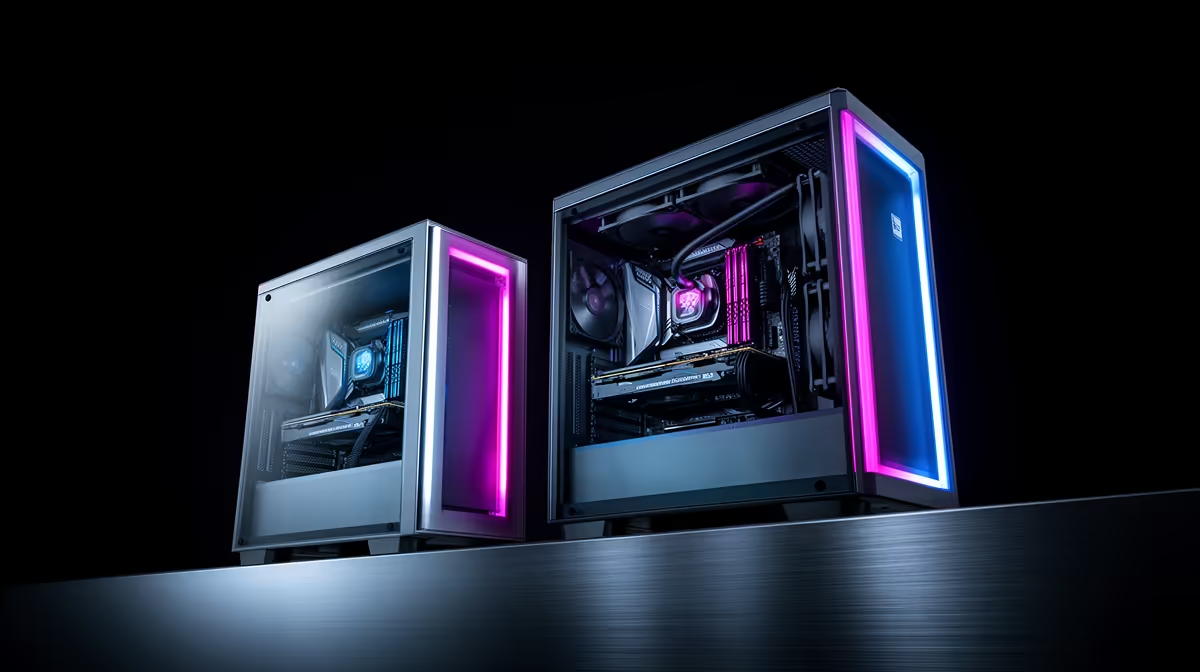
For the overwhelming majority of gaming builds, a mid-tower ATX case is enough. You only need a full tower if you are using an Extended ATX (E-ATX) motherboard, running a custom water-cooling loop with multiple 480mm radiators, or installing more than two full-length expansion cards.
What a Mid-Tower ATX Case Actually Fits 🖥️
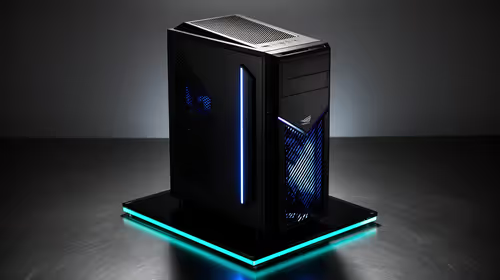
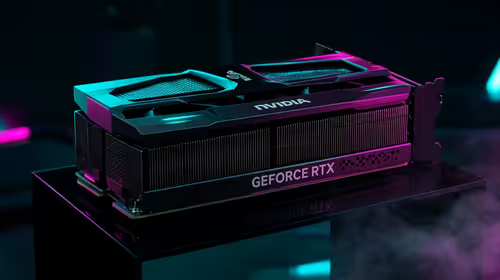
A standard mid-tower ATX case, measuring roughly 430mm to 500mm tall, accommodates ATX motherboards (the most common gaming size), GPUs up to 380mm to 420mm depending on the model, and 360mm front or top radiators in most cases with radiator support. That covers virtually every consumer gaming GPU currently on the market, including the Asus TUF RTX 5080, which measures around 340mm in length.
When a Full Tower Makes Sense 🔧
Full tower cases, typically 550mm to 650mm tall, are built around workstation and enthusiast use cases: dual-CPU motherboards, E-ATX or XL-ATX form factors, custom open-loop water cooling with 480mm radiators at the front and top simultaneously, and multiple GPU configurations for compute tasks. For gaming specifically, no single GPU build needs a full tower. The extra space becomes useful if you are building a PC that also handles video production, 3D rendering, or machine learning workloads where extreme cooling or multiple PCIe devices matter. Full-tower cases run R2,000 to R5,000 in SA and occupy significantly more desk or floor space.
Desktop Space and Placement Considerations 🏠
In a typical South African gaming room or student flat, desk space is a real constraint. A full tower on a desk claims 200mm to 250mm more horizontal or vertical space than a mid-tower, and the weight difference (5 to 9kg heavier typically) matters if you move the PC for LAN events. For most setups in smaller rooms, res accommodation, or home offices, a mid-tower ATX case is the practical answer. If you are building a permanent workstation that lives under a large desk and rarely moves, the full tower's extra room for cable management and cooling headroom is a legitimate advantage.
Measure Your GPU Before Choosing a Case ⚡
Before buying any ATX case, look up the exact length of your chosen GPU on the manufacturer's product page. GPU lengths vary from 270mm to over 360mm depending on the AIB partner's cooler design. Compare this against the case's listed GPU clearance, not just the form factor support, and leave at least 20mm of extra clearance beyond the GPU length to allow cable routing near the PCIe power connectors.
FAQ
Can an E-ATX motherboard fit in a mid-tower case?
Some mid-tower cases advertise E-ATX support, but many only accommodate E-ATX boards up to 272mm wide rather than the full 330mm specification. Check the case's listed maximum motherboard width against your specific E-ATX board dimensions before purchasing. A genuine E-ATX motherboard most reliably fits in a full tower or a case specifically designed around E-ATX.
Is cable management easier in a full tower than a mid-tower?
Yes, full towers offer more clearance behind the motherboard tray and more space for cable routing channels. For a first-time builder, the extra room can reduce frustration. However, mid-tower cases designed specifically for clean builds, such as those with dedicated cable channels and PSU shrouds, achieve near-identical results with more discipline in routing.
What is a reasonable budget for a quality mid-tower ATX case in SA?
For a gaming build, R1,000 to R1,800 buys a quality mid-tower with tempered glass, at least two preinstalled fans, front USB 3.0 or Type-C, and adequate GPU clearance. Spending R2,000 to R2,500 adds better fan count, more integrated ARGB features, or superior cable management channels from premium brands stocked at Evetech.
Mid-tower or full tower? We have both.
Find the right ATX case for your build at Evetech, with a full range of sizes from compact mid-towers to spacious full towers across all major brands.