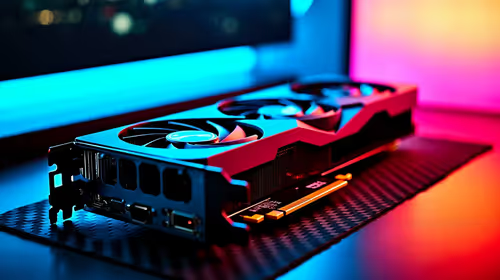
You lined up the perfect headshot... clicked... and still lost the duel. Sound familiar? For South African gamers, that split-second delay isn't just lag... it's system latency. This frustrating gap between your click and the action on-screen can be the difference between a win and a loss. But what if you could measure and shrink that delay? That’s the power of the ultimate low latency synergy: a GeForce GPU paired with an Nvidia Reflex monitor. 🚀
Unpacking System Latency and Nvidia Reflex
Before we dive into monitors, let's quickly clarify what we're fighting against. It's not your internet connection's ping... it's "system latency." This is the total time it takes for your click to register, get processed by your CPU and GPU, and finally appear as a visual change on your screen. In competitive titles like Valorant or Apex Legends, even a few milliseconds can decide the outcome.
Nvidia Reflex is a suite of technologies designed to measure and reduce this very delay. It works in two key ways:
- Reflex SDK: A tool for game developers to integrate directly into their games, optimising the render queue to deliver frames just-in-time.
- Reflex Latency Analyzer: A tool built directly into certified monitors that measures your end-to-end system latency with incredible accuracy.
This combination gives you a measurable competitive advantage, making your actions feel instantly responsive. To get started, you'll need the right gear, beginning with a look at Evetech's huge selection of PC monitors.
The Synergy Secret: Why an Nvidia Reflex Monitor is Essential
Here's the crucial part of this low latency synergy: your GPU and game can be optimised, but without the right display, you're flying blind. A standard high-refresh-rate monitor is great, but a certified Nvidia Reflex monitor is the other half of the equation. These displays have the special hardware... the Reflex Latency Analyzer... built right in.
So, how does it work?
You simply plug a compatible mouse directly into a specific USB port on the monitor. The built-in hardware then measures the exact time from your mouse click to the resulting pixel colour change on the screen (like a muzzle flash). This gives you a precise, real-time latency number in milliseconds (ms). ✨
This isn't just a gimmick; it's a powerful diagnostic tool. It allows you to tweak in-game settings and see exactly how they impact your system's responsiveness, ensuring your rig is perfectly tuned. This technology is available across a wide range of panels, from lightning-fast 1080p screens to immersive, high-resolution 4K monitors, ensuring there's a Reflex-ready option for every setup. You can browse our complete collection of all gaming monitors to see the full range.
How to Optimise Your Low Latency Setup 🔧
Getting your system Reflex-ready is straightforward. Once you have your Nvidia GPU and a compatible monitor, follow these steps to achieve the ultimate low latency performance.
Step 1: Enable Reflex in-game
Launch a Reflex-supported game and navigate to the video settings. You'll find an "Nvidia Reflex Low Latency" option. Turn it to "On" or "On + Boost."
Pro Tip: On vs. On + Boost ⚡
Use "On" as your default for maximum latency reduction. The "On + Boost" setting is more aggressive. It keeps your GPU clocks higher, which can be beneficial in CPU-bound scenarios, but may use slightly more power. Test both in your favourite game to see which feels best for your specific rig!
Step 2: Update Your Drivers
Always ensure you have the latest Nvidia Game Ready Driver installed through GeForce Experience. These drivers often include performance optimisations and new Reflex game support.
Step 3: Use the Latency Analyzer
Connect your mouse to the designated Reflex USB port on your monitor. Use the monitor's on-screen display (OSD) to activate the Latency Analyzer overlay. Now, as you play, you'll see your system's real-time performance, allowing you to fine-tune your settings for the lowest possible delay. This works brilliantly on all kinds of displays, from epic curved monitors that fill your vision to compact portable monitors for a LAN party setup.
Is an Nvidia Reflex Monitor Worth It in South Africa?
Absolutely. For any South African gamer serious about competitive play, an Nvidia Reflex monitor is a vital piece of hardware. While we can't change our physical distance to international servers, we can optimise every single millisecond of delay on our end. Reducing system latency gives you a faster reaction time, making it easier to acquire targets and win those crucial 1v1 encounters.
Think of it as an investment in your performance. You spend thousands of Rands on a powerful GPU and CPU... so why let an unoptimised display become a bottleneck? By pairing your rig with a Reflex-compatible screen and the right monitor accessories, you're ensuring that every bit of performance you paid for translates directly to the screen. To make that investment easier, be sure to keep an eye on the latest PC monitor deals and grab a bargain.
Ready to Eliminate Delay?
A powerful PC is just the start. To truly compete, you need the ultimate low latency synergy that only an Nvidia Reflex monitor can provide. Explore our massive range of gaming monitors and find the perfect display to sharpen your competitive edge.