


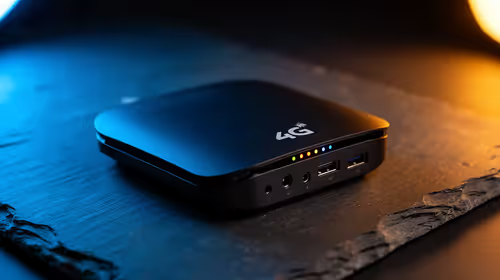
How to Use a Nano SIM 4G Router for Reliable Home Internet
Master using a Nano SIM 4G router as your primary internet solution. Get stable speeds and seamless connectivity for gaming and streaming at home! 🌐🚀
Read moreDiscover how OLED monitors for eye strain are a game-changer. With true blacks, reduced blue light, and zero flicker, OLED technology offers superior visual comfort for long work or gaming sessions. Learn how to protect your vision and boost productivity. 👀✨
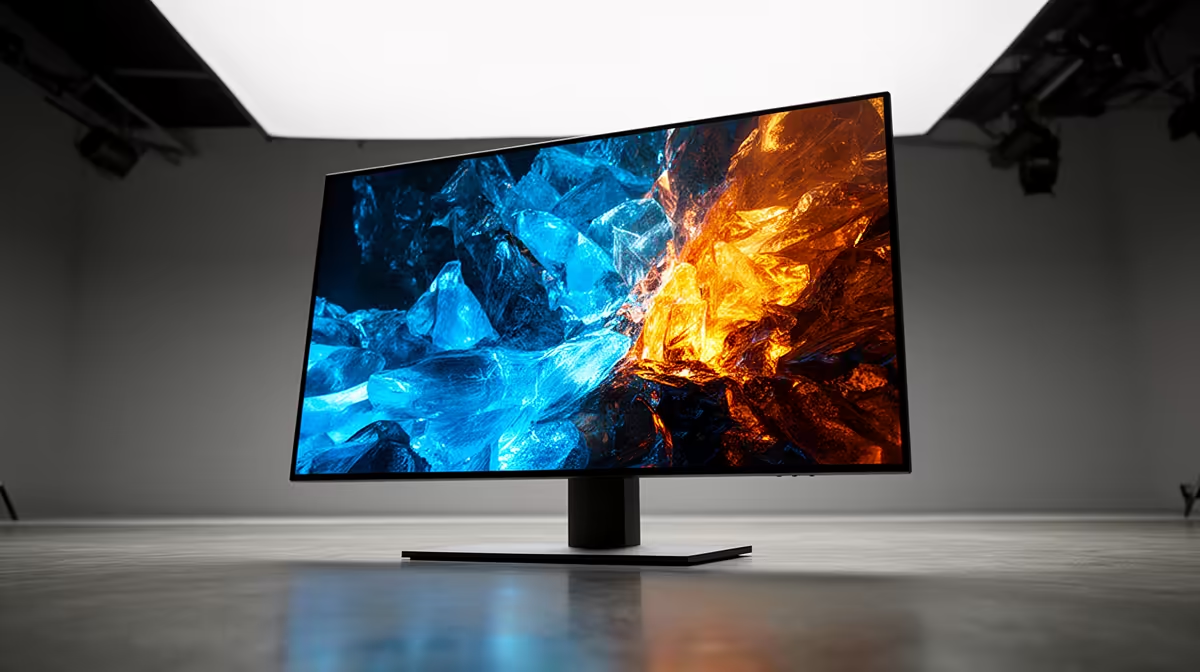
Staring at a screen for hours can feel like a marathon for your eyes. That familiar gritty, tired feeling after a long raid or a full day’s work is something every South African PC user knows well. What if your monitor itself was a major cause of that discomfort? We're diving into how OLED monitors for eye strain are not just about stunning visuals; they pack specific technology designed to be kinder to your eyes, making those long sessions far more comfortable.
Before we explore the solution, let's look at the problem. Most standard displays, including many LED and QLED screens, have a few characteristics that can contribute to digital eye strain, also known as Computer Vision Syndrome.
First, they use a constant backlight to illuminate their pixels. In dark scenes, this can lead to "backlight bleed," where light leaks around the edges, creating a hazy grey instead of a true black. Your pupils have to work harder to adjust, causing fatigue. Second, many non-OLED displays use a technique called Pulse-Width Modulation (PWM) to control brightness, which is essentially a high-speed flicker. While often invisible, your brain and eyes still process it, leading to subconscious strain.
This is where OLED monitors for eye strain really shine... or rather, don't shine when they're not supposed to. The technology works fundamentally differently, and these differences have a direct impact on eye comfort.
OLED stands for Organic Light Emitting Diode. Each pixel creates its own light. To display black, a pixel simply switches off completely. ✨ This means no backlight, no bleed, and an infinite contrast ratio. For your eyes, this is a massive relief. Dark scenes in games or movies are truly dark, reducing ambient screen glow and allowing your eyes to relax instead of constantly straining to distinguish details in a muddy grey. This makes a huge difference on high-resolution 5K and 4K monitors, where detail clarity is paramount.
We've all heard about the negative effects of blue light, from disrupting sleep to causing long-term eye fatigue. While no screen is completely free of it, OLED panels have been shown to emit significantly less harmful blue light than their LCD counterparts. They achieve their vibrant colours without needing an intensely powerful blue backlight, making them a better choice for late-night gaming or work sessions.
Beyond hardware, use your operating system's built-in tools. In Windows, enable 'Night Light' (Settings > System > Display) to automatically reduce blue light in the evenings. It shifts your screen to warmer colours, which is much easier on the eyes and can help you wind down before sleep.
Because OLED pixels control their own brightness directly, most don't need to use PWM flicker. The result is a rock-solid, stable image at any brightness level. Removing this invisible flicker is one of the most significant ways OLED technology protects your eyes, eliminating a major source of subconscious fatigue. Whether you're looking at all gaming monitors or a professional display, a flicker-free experience is a must for comfort.
An OLED monitor is an investment, but it's one in both your visual experience and your physical well-being. The benefits of reduced eye strain are just as valuable as the incredible picture quality. Whether you're looking for total immersion with curved monitors or a versatile screen for work and travel like the latest portable monitors, OLED options are becoming more common across different form factors.
The improved eye comfort provided by an OLED panel means you can stay focused and comfortable for longer, whether you're climbing the ranks in Valorant or finalising a critical project.
The good news? As the technology becomes more popular, prices are becoming more competitive. You no longer have to pay an extreme premium for the benefits of OLED. It's always worth checking for the best PC monitor deals to see if you can snag a top-tier display for a great price right here in SA. 🚀
Ultimately, choosing an OLED monitor for eye strain is a proactive step towards a more comfortable and visually stunning computing experience. Your eyes will thank you for it.
Ready to See the Difference... and Feel It? Investing in an OLED monitor is an upgrade for your eyes as much as your gameplay. From vibrant colours to reduced eye strain, the benefits are clear. Explore our full range of PC monitors and find the perfect display to level up your setup.
Yes, OLED screens are generally better for eye comfort. They emit less harmful blue light, have no backlight flicker, and offer infinite contrast for clearer text and images.
OLEDs reduce eye strain by eliminating backlight flicker, producing deeper blacks for less visual noise, and emitting significantly lower levels of blue light than traditional LCDs.
While OLEDs naturally emit less blue light, many monitors also include software-based low blue light modes for additional protection during late-night work or gaming sessions.
Yes. Unlike LCDs that can use a constantly flashing backlight (PWM), each pixel in an OLED panel is its own light source, resulting in a truly flicker-free viewing experience.
Many users report fewer headaches with OLED monitors. The lack of flicker and reduced blue light exposure can alleviate common triggers for screen-induced headaches and eye fatigue.
True black means OLED pixels turn off completely to display black. This creates infinite contrast, making text sharper and reducing the persistent background glow that can strain eyes.
Master using a Nano SIM 4G router as your primary internet solution. Get stable speeds and seamless connectivity for gaming and streaming at home! 🌐🚀
Read more
Confused by Cat4 vs Cat6 LTE routers? 🌐 We break down the technical differences to help you choose the right router for faster gaming and streaming. Get the speed you deserve today! 🚀
Read more
Learn how to setup a VPN server on your 4G LTE router to secure your remote access. Protect your data and browse safely from anywhere with our easy guide! 🌐🔐
Read more
Choosing the best 4G LTE router for South Africa ensures reliable internet when fibre is unavailable. Discover top connectivity tips for rural and urban areas. 🌐📶
Read more
Discover what is passive PoE and how it streamlines outdoor router installations. Eliminate messy cabling and simplify your network setup with this efficient power delivery method. ⚡🌐
Read more
Need to extend internet coverage to outbuildings or farms? 📡 An outdoor 4G router is the ultimate solution for stable, high-speed connectivity in remote locations. Discover how to boost your range and stay connected anywhere on your property. 🌐
Read more
Wondering if a TKL wireless mechanical keyboard is worth it for everyday productivity? We break down latency, battery life, comfort, and workflow gains for real work. ⚡⌨️

Maximise battery life on a fanless 15-inch laptop using efficiency core architecture. Cut idle drain, tune power profiles, and improve thermals for longer runtime. 🔋⚙️

Learn how to reduce desk clutter with a TKL wireless keyboard using fewer cables, smart placement, and tidy essentials. Get a faster, calmer workspace with better ergonomics. ✅🧼

RGB keyboard lighting too distracting? Learn how to manage backlight modes, set brightness, and reduce distraction for focus and productivity 😌🖱️

Are themed gaming keyboards worth the extra cost? Compare build quality, switch options, features, and resale value to find the best fit for your setup 🎮⌨️

Full-Size vs Tenkeyless mechanical keyboards for gaming: find out if a smaller layout truly improves aim, speed, and comfort. We break down layout, desk space, latency-feel, and keybinds 🎮⌨️

Dedicated media rollers vs function key shortcuts: learn which setup gives you better workflow control, faster media access, and fewer mistakes. 🖱️🎧

Best Mechanical Switch Type for Gaming: Clicky vs Linear vs Tactile. Find your feel, speed, and noise balance with practical guidance for FPS, MOBA, and productivity 😄🎮

Direct mouse answer: Mouse not keeping up with your work? Everything that matters about dual-mode 2.4GHz + BT 5.0: DPI behaviour, channel switching, battery curves and per-app button mapping. Covers when 2.4GHz USB wins (low-latency desk) and when BT 5.0 wins (laptop, d

Plain wireless mouse guide: Mouse not keeping up with your work? Everything that matters about wireless productivity mouse: DPI behaviour, channel switching, battery curves and per-app button mapping. Includes DPI tuning tips, channel switch shortcuts, and ZAR-aware fea

Real productivity numbers: Set up your wireless mouse in this order: everything that matters about wireless productivity mouse: DPI behaviour, channel switching, battery curves and per-app button mapping. Includes DPI tuning tips, channel switch shortcuts, and ZAR-aware

Pen not feeling like paper? Stylus lag and skipping usually trace to old drivers, dirty nibs, or display refresh mismatches, not the pen itself. Covers pressure curve tuning, tilt thresholds, nib swap timing, and SA pricing brackets.