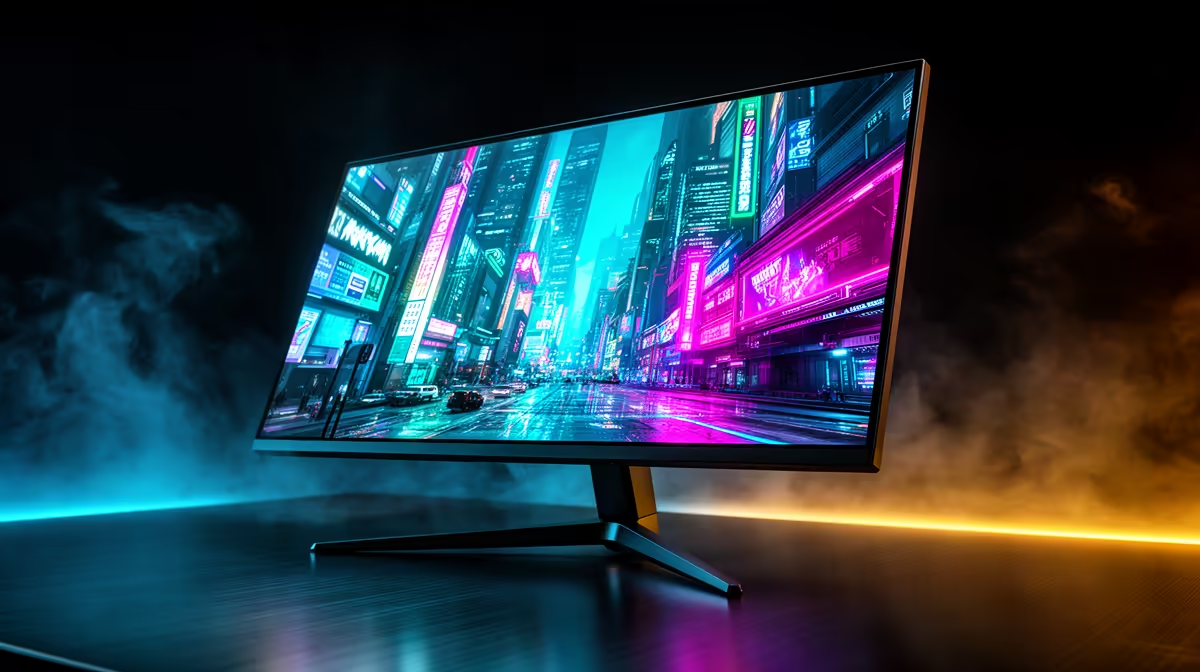
Staring at a wall of monitors, trying to choose your next upgrade? It's a massive decision for any South African gamer. The two heavyweights in the ring are OLED and Mini-LED, both promising breathtaking visuals for your gaming PC. But which technology is truly the best for slaying dragons or clutching a 1v5 in Valorant? Let's break down the OLED vs Mini-LED battle so you can make the perfect choice for your setup and browse the best PC monitors with confidence.
The Allure of OLED: Perfect Blacks and Lightning Speed ⚔️
OLED (Organic Light Emitting Diode) technology is beautifully simple. Each individual pixel creates its own light. When a pixel needs to be black… it just switches off completely. This gives you what's called "infinite contrast" and true, inky blacks that no other display tech can match.
For gamers, this means incredible depth and realism in dark scenes. Imagine exploring a cave in Baldur's Gate 3 where the shadows are truly black, not a murky grey. Plus, OLEDs have near-instantaneous pixel response times, often around 0.1ms. This results in exceptionally clear motion with virtually zero ghosting, a huge advantage in fast-paced games. The immersion, especially on curved monitors, is simply on another level.
The main concern historically has been burn-in, where static images can leave a permanent ghost on the screen. However, modern gaming OLEDs have advanced features like pixel shifting and logo dimming to drastically reduce this risk.
Mini-LED Explained: The Brightness Powerhouse ✨
Don't think of Mini-LED as a completely new technology. Instead, it's a massive upgrade to traditional LCD panels. A standard LCD might have a few dozen backlights. A Mini-LED display has thousands of tiny LEDs grouped into hundreds or even thousands of dimming zones.
This gives the display incredibly precise control over which parts of the screen are bright and which are dark. The result? A massive leap in contrast and a huge reduction in the "greyish-black" look of older LCDs.
Where Mini-LED truly shines, however, is brightness. These panels can get significantly brighter than OLEDs, making them HDR champions. Explosions, spells, and sunlit landscapes in games will pop with blinding intensity. This makes them a fantastic choice for gaming in a bright room and for those who want the most impactful HDR experience, often found on high-resolution 5K and 4K monitors.
OLED vs Mini-LED: The Ultimate Gaming Showdown
So, how do they stack up head-to-head on the factors that matter most to gamers? The choice between OLED and Mini-LED often comes down to your primary use case.
- Contrast & Black Levels: OLED wins. Its per-pixel illumination delivers perfect blacks that Mini-LED, despite its many dimming zones, can't fully replicate.
- Brightness & HDR: Mini-LED wins. Its ability to push higher peak brightness levels delivers a more dazzling and vibrant HDR picture, especially in well-lit rooms.
- Response Time & Motion Clarity: OLED is the clear winner. The near-instant pixel response is a dream for competitive players who need blur-free motion.
- Colour & Longevity: It's a tie. Both technologies offer incredible colour volume and accuracy. Mini-LED has zero risk of burn-in, making it a safer bet if you also use your PC for hours of productivity with static windows.
Ultimately, both are fantastic options, and you can't go wrong browsing the full range of all gaming monitors to see the latest models.
Match Your Monitor to Your Game 🎯
If you mostly play fast-paced shooters like CS2 or Valorant, an OLED's near-instant response time gives you a competitive edge. For visually stunning RPGs like Cyberpunk 2077, a Mini-LED's incredible HDR brightness or an OLED's perfect contrast will make those worlds truly come alive. Think about what you play most!
The Verdict: Which Display Is Right for Your Rig?
The best display for your gaming PC depends entirely on you. The OLED vs Mini-LED decision isn't about which is better overall, but which is better for your needs.
You should choose an OLED monitor if:
- You play in a dim or dark room.
- You prioritise perfect black levels and cinematic immersion.
- You play competitive esports titles and demand the fastest response time possible.
You should choose a Mini-LED monitor if:
- You game in a brightly lit room.
- You want the most impactful, searingly bright HDR experience.
- You use your monitor for both gaming and productivity and want zero anxiety about burn-in.
While the desktop debate rages on, it's also worth noting how display tech is evolving everywhere. For LAN-goers or those with a multi-device setup, even the world of portable monitors is seeing huge improvements.
No matter which path you choose, you're in for a stunning visual upgrade. Check out the latest PC monitor deals in South Africa to find a screen that fits your budget and your playstyle.
Ready to Find Your Perfect Match?
The OLED vs Mini-LED debate is intense, but the perfect screen for you is out there. Whether you crave the deepest blacks or the brightest highlights, your ultimate visual upgrade awaits. Explore our massive range of gaming monitors and find the perfect display to dominate your game.