Quick Answer
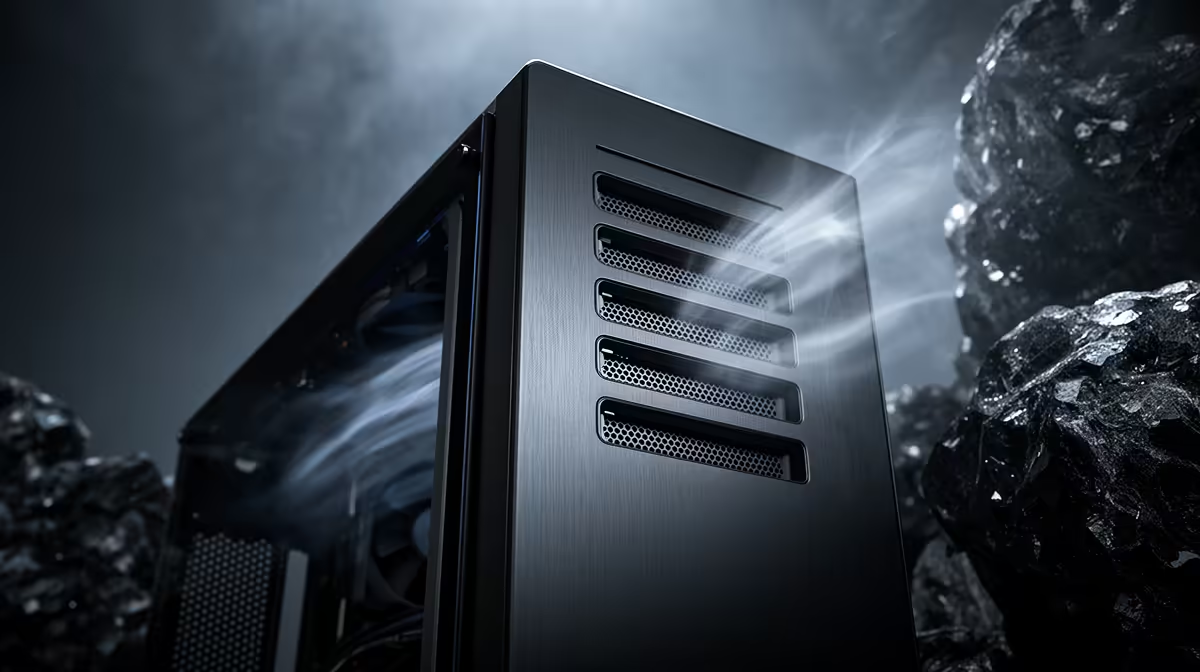
Traditional mesh panels deliver more raw airflow due to higher open-area percentages, typically 65 to 75 percent open versus 30 to 50 percent for patented slot vent designs. Slot vents are quieter and filter dust more effectively. For maximum cooling performance, mesh wins. For balanced noise and cooling, slot vents are a rational choice.
Understanding Open-Area Percentages 📊
Airflow restriction is primarily determined by the percentage of a panel's surface area that is open to air passage. Standard hex-mesh panels found on cases like the Fractal Design Meshify series achieve 65 percent to 75 percent open area, enabling high static pressure fans to move substantial volumes of air with minimal restriction. Patented slot vent designs, such as those used on some Cooler Master and Phanteks cases, feature angled or stacked slots that achieve 30 to 50 percent open area.
Dust Filtration: Mesh vs Slot Vents 🧹
One underappreciated advantage of slot vent panels is their inherent dust resistance. The angled geometry prevents direct line-of-sight airflow, trapping larger dust particles before they enter the chassis. Full hex-mesh panels are excellent for airflow but require a magnetic dust filter mounted in front of them to achieve equivalent filtration; without a filter, mesh cases accumulate visible dust on fan blades and radiator fins within 4 to 6 weeks in typical South African homes. Most premium mesh cases like the Lian Li Lancool 216 include removable magnetic dust filters specifically to address this. A monthly filter clean takes under 5 minutes. Slot vent cases may extend that maintenance interval to 6 to 8 weeks before visible dust accumulation becomes a concern.
Noise Profiles and Temperature Results 🔊
Independent case reviews consistently show that mesh front panel cases run 3°C to 7°C cooler under gaming load compared to solid or restricted-vent designs. The noise difference is more nuanced: a mesh case with fans running at 1,000 RPM is quieter than a slot-vent case with fans running at 1,400 RPM to achieve the same airflow. Total system noise at target temperature is often lower with mesh despite the higher open area, because the fans can operate at a more relaxed speed point. Cases priced between R1,500 and R2,500 locally increasingly ship with mesh front panels as the default due to this thermal advantage.
Set Positive Pressure for Cleaner Air ⚡
Configure your intake fans to move 10 to 15 percent more air than your exhaust fans. This positive pressure configuration pushes air out through gaps and slots, preventing unfiltered dust ingress through unsealed openings. It keeps internal components cleaner than neutral or negative pressure setups.
FAQ
Can I convert a slot-vent case to a mesh front panel?
Some case manufacturers sell mesh front panels as optional accessories for models that shipped with solid or slot-vent fronts. Check the manufacturer's accessory page for your specific case.
Do slot vents affect GPU thermals more than CPU thermals?
GPU thermals are more sensitive to front panel restrictions because the GPU is typically positioned in the lower half of the case where front intake air first arrives. A restrictive front panel raises GPU temperatures by 4°C to 10°C more than CPU temperatures in most horizontal intake configurations.
Is there a meaningful sound difference for someone gaming with headphones?
For headphone users, the noise difference between mesh and slot-vent cases is largely irrelevant during active gaming. The difference becomes noticeable in quiet environments during web browsing or idle states, where a slot-vent case running fans at lower RPMs will be perceptibly quieter from a metre away.
Looking for a case that balances airflow and noise for your gaming setup?
Evetech carries mesh and slot-vent case options across price ranges. Head to the cases section to filter by airflow design and find your match.