Quick Answer
Pressure sensitivity matters more for most artists. At 4,096 levels, it governs line weight, opacity, and texture in virtually every brush stroke. Tilt support enhances shading and broad strokes but is secondary; many professional illustrators work entirely without tilt. If you can only have one, pressure sensitivity is the priority.
What Each Feature Contributes to Your Artwork 🎨
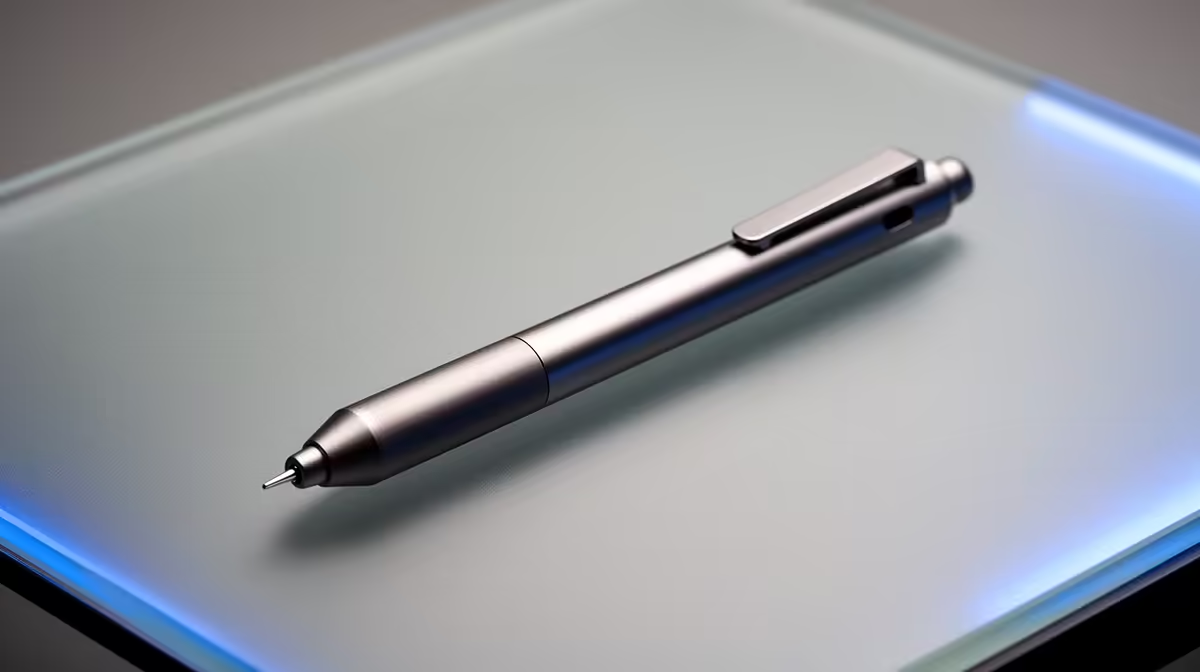
Pressure sensitivity translates the force of your pen into variable line width or opacity. Press lightly and you get a thin, transparent mark; press firmly for a thick, solid stroke. This mirrors the behaviour of a traditional pen, brush, or pencil and is foundational to expressive digital art. Without it, every stroke is uniform regardless of hand pressure, removing a primary dimension of artistic expression. Tilt support, by contrast, detects the angle of the pen relative to the tablet surface (measured in degrees) and can widen a stroke or shift a texture when the pen is tilted sideways, simulating a flat pencil shading at an angle. It is a refinement, not a foundation.
When Tilt Support Becomes the Priority 🖌️
For artists who work primarily in traditional-simulation styles, including charcoal drawing, graphite sketching, or watercolour wash effects, tilt support is highly valuable. These techniques rely on the broadside of a pencil or brush, which tilt accurately replicates. Concept artists doing rapid environment thumbnails or texture studies also benefit from tilt-to-width shading, which speeds up coverage of large areas without switching brush size. Comic artists doing precise linework, by contrast, almost never need tilt; their workflow is 99 percent pressure-dependent. Architecture students and technical illustrators fall in between.
Making the Right Choice in the SA Market 💡
Entry-level drawing tablets (R800 to R1,500 in the SA market) typically offer 4,096-level pressure sensitivity without tilt. Mid-range options (R1,500 to R3,500) add 60-degree tilt recognition. Professional models above R3,500 include both at maximum precision. For a student starting out in digital illustration or a designer doing product mockups, prioritise pressure sensitivity first and upgrade to a tilt-supporting model as your technique demands it. For traditional artists transitioning to digital who rely on shading techniques, spending the extra R500 to R1,000 for a tilt-capable pen and tablet is money well spent from day one.
Test Pressure Curve Before You Draw ⚡
Before starting any artwork session, run a single long diagonal stroke from featherlight to full press on a new layer. If the transition from thin to thick is not smooth, adjust the pressure curve in your driver settings before working on anything important. Five seconds of checking saves hours of redrawn lines.
FAQ
Does tilt support require specific software to work?
Yes. The drawing app must support tilt as an input parameter for brushes. Clip Studio Paint, Krita, Photoshop, and Procreate all support tilt. Simpler apps may not, in which case tilt hardware goes unused even if the tablet supports it.
Can I add tilt support to a tablet that ships without it?
No. Tilt recognition is a hardware feature built into the tablet's sensor layer and the stylus's internal electronics. If the spec sheet does not list tilt support, software cannot enable it.
Is 8,192 pressure levels a meaningful upgrade over 4,096 for most artists?
For most artists, no. The jump from 1,024 to 4,096 levels is clearly noticeable; the jump from 4,096 to 8,192 is nearly imperceptible in practice and mainly benefits scientific and forensic illustration applications requiring extreme gradient precision.
Choosing between pressure sensitivity and tilt for your next tablet?
Browse Evetech's drawing tablet range, from entry pressure-only models to full-featured tilt-and-pressure options, stocked locally for South African artists and students.