


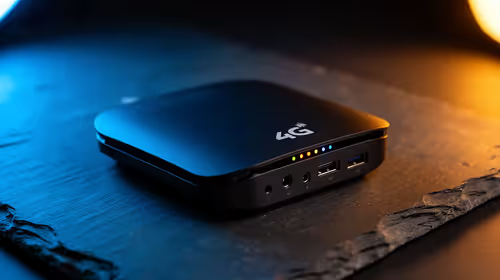
How to Use a Nano SIM 4G Router for Reliable Home Internet
Master using a Nano SIM 4G router as your primary internet solution. Get stable speeds and seamless connectivity for gaming and streaming at home! 🌐🚀
Read more🔍 Facing USB hub port recognition problems? Our expert refurbishment guide reveals proven fixes to restore device detection. Find your solution now! 💻🔌

You’ve just scored a great deal on a refurb USB hub, ready to declutter your battle station. You plug in your mouse, keyboard, and headset… only to find some ports are completely unresponsive. Ja, it’s frustrating. Before you toss it in the bin, take a breath. This guide to refurb USB hub troubleshooting is here to help you conquer those annoying port recognition issues and get your peripherals back online, fast. 🔧
Before diving into complex settings, let's cover the simple stuff. More often than not, fixing port recognition issues starts with a physical check. It’s the classic "have you tried turning it off and on again?" approach, and for good reason… it works.
First, unplug everything from the hub and the hub from your PC. Give it a solid 30 seconds. Reconnect the hub directly to a different USB port on your computer, preferably one on the motherboard I/O at the back. Now, plug in just one device, like a mouse, to test. Does it work? If so, you might have a faulty port on your PC, not the hub.
Also, inspect the cable connecting the hub to your PC. A dodgy cable is a common culprit. If you have a spare, swap it out. Sometimes the problem is as simple as a weak connection, especially if you’re running a demanding setup on one of the many powerful gaming laptops under R20k that offer incredible value.
If the physical checks don't solve it, it’s time to look at your system’s software. Windows can be a bit overzealous with power management, sometimes disabling USB ports to save a few watts of power. This is a key step in refurb USB hub troubleshooting.
Win + X and select "Device Manager".This process ensures your PC provides consistent power to your ports, which is crucial for both Intel and AMD systems. You can often find chipset-specific drivers that improve stability, whether you're looking at the latest Intel laptops on special or their powerful counterparts.
In Device Manager, you can also right-click and "Uninstall device" for the problematic USB Root Hub. Don't panic! Simply restart your PC, and Windows will automatically reinstall the drivers, often fixing corruption issues in the process.
Sometimes, a clean slate is the best way forward. Troubleshooting a refurbished USB hub can feel repetitive, but a driver reinstall often resolves stubborn conflicts. This is particularly true after a major Windows update or when adding new hardware. If you're a gamer who loves customising your rig, you'll know that driver conflicts can pop up anywhere, even on high-performance AMD laptops on special known for their robust architecture. A fresh driver install ensures everything communicates correctly.
You’ve checked the cables and wrestled with Device Manager, but some ports are still dead. What now? It’s time to consider the hub itself. Refurbished gear is fantastic for saving cash, but it can occasionally have lingering hardware faults. ✨
Inspect the ports on the hub for any physical damage… bent pins or debris can easily cause a connection to fail. Also, consider what you're plugging in. High-power devices like external hard drives, webcams, and RGB-heavy gaming keyboards can draw more power than a simple, unpowered hub can provide. If you’re trying to run multiple power-hungry peripherals, you likely need a powered USB hub—one that plugs into the wall for extra juice. Without it, your PC's single USB port just can't supply enough power, causing devices to randomly disconnect or not be recognised at all.
If you’ve tried all these refurb USB hub troubleshooting steps and you’re still stuck, the unit itself might just be a dud. It happens. But don’t let it sour your tech experience. It might be the perfect excuse to browse for an upgrade, and there are always great laptop specials for sale in South Africa to get you a fresh, reliable setup. 🚀
Stop Troubleshooting, Start Gaming If your gear is fighting you every step of the way, it might be time for an upgrade. Check out the best gaming laptop deals for performance that just works, right out of the box.
Common causes include outdated drivers, port damage, or software conflicts. Our guide provides 5+ repair methods for recognition issues.
Yes, especially if internal components degraded. Our step-by-step fix helps restore proper USB device detection and power delivery.
Try driver updates, power cycle the hub, or test different USB slots. Our specialized troubleshooting addresses Windows-specific port detection.
Intermittent detection points to loose internal connections or power management settings. Our repair strategies target unstable device recognition patterns.
Yes, USB 2.0 vs 3.0 compatibility matters. Our guide helps identify version-specific recognition issues and provides appropriate fixes.
Physical port damage requires professional soldering. We share safe detection methods to identify bad ports before considering board-level repairs.
Use device manager checks, test with multiple devices, and verify power delivery. Our diagnostic process reveals exact recognition failure points.
Master using a Nano SIM 4G router as your primary internet solution. Get stable speeds and seamless connectivity for gaming and streaming at home! 🌐🚀
Read more
Confused by Cat4 vs Cat6 LTE routers? 🌐 We break down the technical differences to help you choose the right router for faster gaming and streaming. Get the speed you deserve today! 🚀
Read more
Learn how to setup a VPN server on your 4G LTE router to secure your remote access. Protect your data and browse safely from anywhere with our easy guide! 🌐🔐
Read more
Choosing the best 4G LTE router for South Africa ensures reliable internet when fibre is unavailable. Discover top connectivity tips for rural and urban areas. 🌐📶
Read more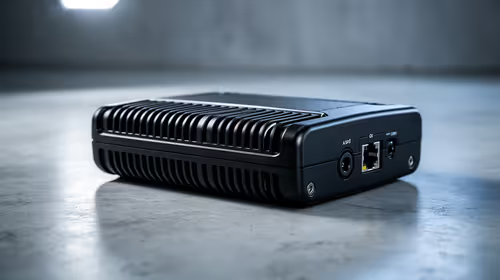
Discover what is passive PoE and how it streamlines outdoor router installations. Eliminate messy cabling and simplify your network setup with this efficient power delivery method. ⚡🌐
Read more
Need to extend internet coverage to outbuildings or farms? 📡 An outdoor 4G router is the ultimate solution for stable, high-speed connectivity in remote locations. Discover how to boost your range and stay connected anywhere on your property. 🌐
Read more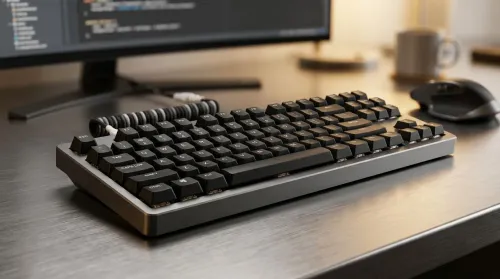
Wondering if a TKL wireless mechanical keyboard is worth it for everyday productivity? We break down latency, battery life, comfort, and workflow gains for real work. ⚡⌨️

Maximise battery life on a fanless 15-inch laptop using efficiency core architecture. Cut idle drain, tune power profiles, and improve thermals for longer runtime. 🔋⚙️
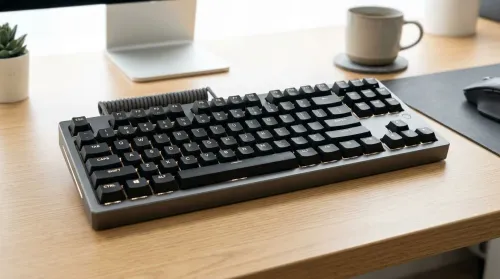
Learn how to reduce desk clutter with a TKL wireless keyboard using fewer cables, smart placement, and tidy essentials. Get a faster, calmer workspace with better ergonomics. ✅🧼
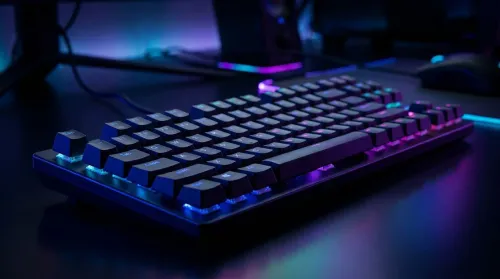
RGB keyboard lighting too distracting? Learn how to manage backlight modes, set brightness, and reduce distraction for focus and productivity 😌🖱️

Are themed gaming keyboards worth the extra cost? Compare build quality, switch options, features, and resale value to find the best fit for your setup 🎮⌨️
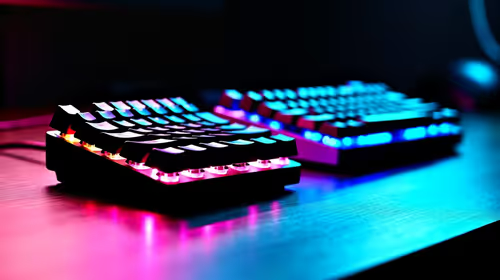
Full-Size vs Tenkeyless mechanical keyboards for gaming: find out if a smaller layout truly improves aim, speed, and comfort. We break down layout, desk space, latency-feel, and keybinds 🎮⌨️

Dedicated media rollers vs function key shortcuts: learn which setup gives you better workflow control, faster media access, and fewer mistakes. 🖱️🎧

Best Mechanical Switch Type for Gaming: Clicky vs Linear vs Tactile. Find your feel, speed, and noise balance with practical guidance for FPS, MOBA, and productivity 😄🎮
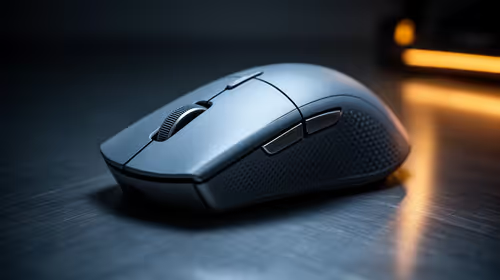
Direct mouse answer: Mouse not keeping up with your work? Everything that matters about dual-mode 2.4GHz + BT 5.0: DPI behaviour, channel switching, battery curves and per-app button mapping. Covers when 2.4GHz USB wins (low-latency desk) and when BT 5.0 wins (laptop, d
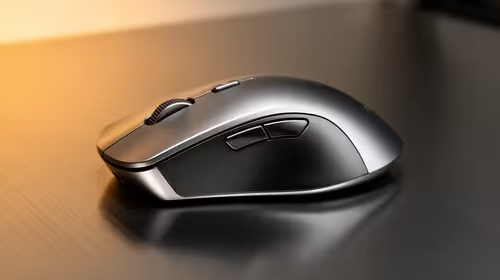
Plain wireless mouse guide: Mouse not keeping up with your work? Everything that matters about wireless productivity mouse: DPI behaviour, channel switching, battery curves and per-app button mapping. Includes DPI tuning tips, channel switch shortcuts, and ZAR-aware fea
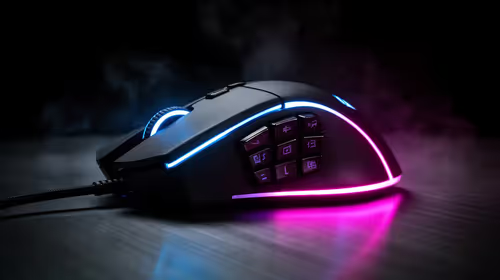
Real productivity numbers: Set up your wireless mouse in this order: everything that matters about wireless productivity mouse: DPI behaviour, channel switching, battery curves and per-app button mapping. Includes DPI tuning tips, channel switch shortcuts, and ZAR-aware
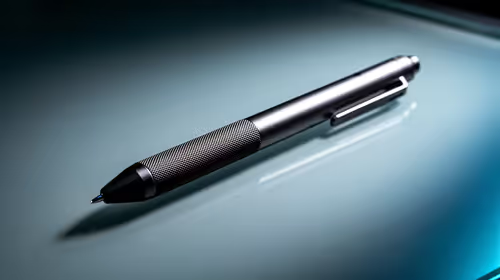
Pen not feeling like paper? Stylus lag and skipping usually trace to old drivers, dirty nibs, or display refresh mismatches, not the pen itself. Covers pressure curve tuning, tilt thresholds, nib swap timing, and SA pricing brackets.