Quick Answer
Reverse fans and standard fans move air in the same direction for the same installed position. What changes is the visual: a reverse fan shows its clean blade face through the glass panel rather than the motor hub. Airflow performance is essentially identical when both types use the same blade geometry, so the choice is purely aesthetic for glass-side builds.
How Reverse Fans Differ in Design 🔄
A standard fan is engineered with the motor hub on the airflow entry side, hidden inside the chassis. A reverse fan flips this: the blade face is on the motor side, so when mounted as an intake, the smooth spinning blades face outward toward the glass. Motor housing faces inward and is hidden behind the blade disc. Lian Li's UNI Fan SL series is a well-known example of purpose-built reverse-oriented fans. The blade profile on purpose-built reverse fans is designed to pull air efficiently in the new orientation.
Airflow and Static Pressure Compared 💨
When a purpose-built reverse fan is tested against a standard fan of similar specs, airflow (CFM) and static pressure (mmH2O) results are within 2 to 5% of each other in controlled benchmarks. This difference is negligible in real builds. Both types operate on the same motor, bearing, and blade pitch physics. The only scenario where reverse fans measurably underperform is when a standard fan is physically flipped without a blade pitch designed for the new draw direction, reducing static pressure by 10 to 20%.
Visual Impact in a Glass-Side Build 🎨
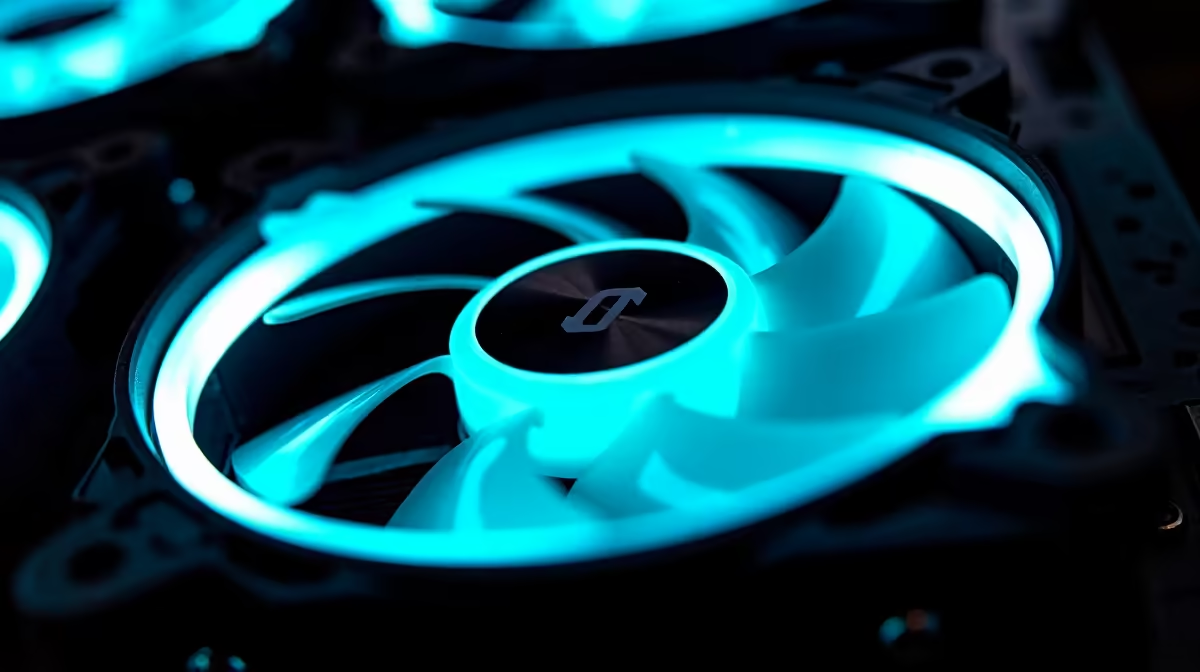
The primary reason SA builders choose reverse fans is the look inside a tempered glass chassis. Standard fans reveal a plastic motor hub with struts that interrupt the blade disc, creating a cluttered visual especially with ARGB lighting active. Reverse fans present an uninterrupted spinning disc that looks more polished and showcases LED ring lighting without the hub obstruction. For builds where the side panel is solid or opaque, reverse fans offer no meaningful advantage and the extra cost (typically R50 to R150 more per fan) is wasted.
Which to Choose for Your Build 🖥️
Choose standard fans if your case has a solid side panel, if you are building a budget rig where every rand counts, or if you plan to mount fans in top or rear positions not visible through glass. Choose reverse fans if your case features a full-glass side panel and you are mounting fans in front intake positions directly visible through the glass. Both types benefit equally from PWM speed control, ARGB hubs, and quality bearings, so non-visual performance criteria should focus on noise rating (below 25 dBA at max speed) and bearing type (fluid dynamic or dual-ball for longevity).
Check Mounting Hole Symmetry First ⚡
Before buying reverse fans, confirm your case's front intake bracket positions the fan with the intended face visible through the glass. Some cases have asymmetric fan brackets that block the motor side regardless of fan orientation, making reverse fans pointless in that specific chassis.
FAQ
Do reverse fans cool better than standard fans?
No, they cool equally well when purpose-built for reverse orientation. Cooling performance depends on CFM, static pressure, and placement, not on which face of the fan is visible.
Are reverse fans more expensive than standard fans?
Generally yes by a small margin, R50 to R150 per unit more in SA. Purpose-built reverse fans carry a premium reflecting their dual-orientation motor and blade engineering.
Can I run a mix of reverse and standard fans in one build?
Yes. Many builders use reverse fans in front intake positions (visible through glass) and standard fans for rear or top exhaust (not visible). There is no compatibility or performance issue with mixing orientations.
Comparing fan styles for your next build?
Evetech stocks both reverse-orientation and standard ARGB case fans across popular brands so you can choose the look and spec that fits your chassis.