Quick Answer
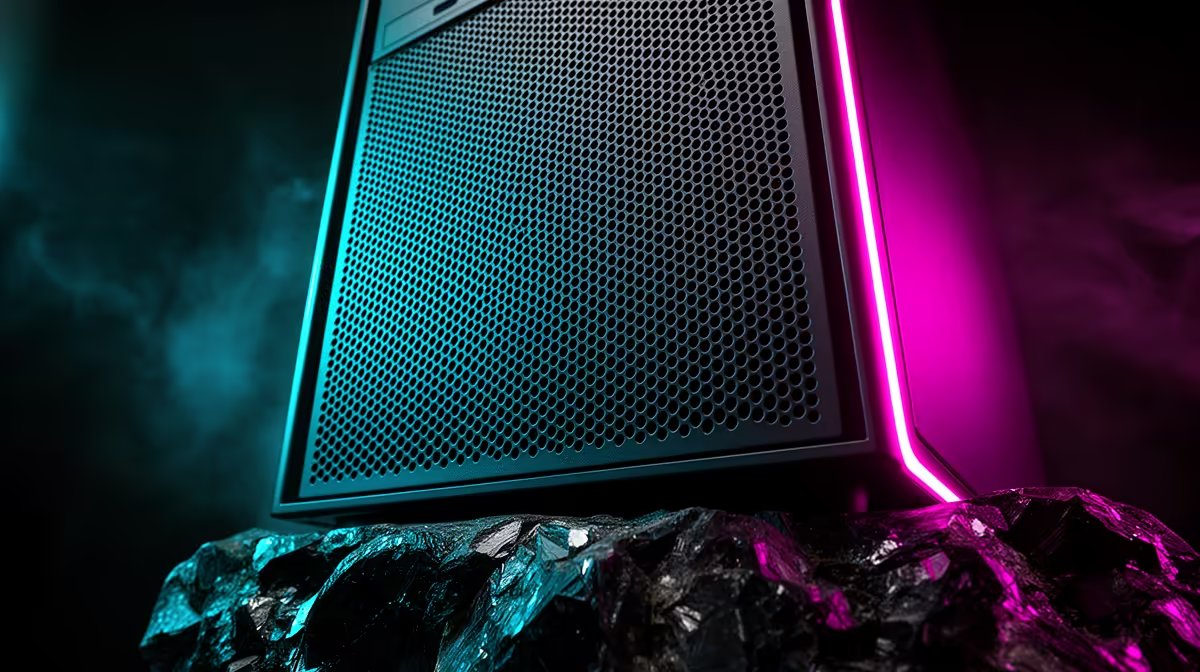
Yes, choose a high-porosity front grill case if your build includes a GPU drawing over 200W, a 240mm or larger AIO, or if your ambient temperature regularly exceeds 28 degrees Celsius. Front mesh with at least 40% open area lowers CPU and GPU temperatures by 3 to 8 degrees Celsius under sustained load versus a solid-front design with identical fans.
Why Front Panel Porosity Matters More Than Fan Count 🌬️
A solid or low-porosity front forces fans to pull air through small edge gaps, creating turbulence and raising static pressure. High-porosity mesh above 40% open area lets fans operate closer to free-air conditions, improving volumetric flow without increasing RPM or noise. For South African builders in warmer inland regions where summer ambients regularly hit 32 to 38 degrees Celsius in Gauteng, front porosity is a meaningful thermal variable, not a cosmetic choice. Cases with fine hexagonal mesh, typically 50 to 60% open area, outperform stamped-grill designs in sustained gaming and rendering workloads.
Estimating Open Area Before You Buy 🔧
Manufacturers rarely publish an exact porosity figure. A practical shortcut: if the anti-dust filter sits directly behind the mesh, airflow is barely restricted. If the filter is a foam pad pressed against the inner wall of a solid panel, porosity is low. Cases in the R1,800 to R4,500 range in South Africa include strong mesh performers at both budget and premium levels.
Dust Management in a High-Porosity Case 🧹
The trade-off is faster dust accumulation, particularly in drier Highveld environments or homes with pets. Choose a case with washable magnetic filters behind the mesh and maintain them every four to six weeks. A positive-pressure fan setup, running more intake than exhaust, pushes dust toward filters rather than pulling it through panel gaps. Two 140mm front intakes plus one 120mm rear exhaust is a solid positive-pressure baseline for most mainstream gaming builds.
Test Airflow With a Candle ⚡
Hold a lit candle about 10cm in front of the case intake under full load. If the flame bends toward the mesh, intake flow is healthy. If it barely moves, check that front fans are connected and that filters are not clogged.
FAQ
Does a mesh front make the PC louder?
Mesh removes acoustic damping, but because fans spin at lower RPM for equivalent airflow through an open front, total noise often stays similar or drops. Tune fan curves in the BIOS for the quietest setting that keeps temperatures safe.
Are high-porosity cases compatible with 420mm AIO radiators?
Front 420mm support depends on case dimensions, not porosity. Full-towers like the Phanteks Enthoo Pro 2 support front 420mm mounting. Always verify the case spec sheet for radiator length before ordering an AIO.
What open area percentage suits an RTX 5090 build?
Aim for at least 50% open area and three 120mm or two 140mm intake fans. Below 40% open area, fans must spin aggressively to keep a 450W-class GPU cool, pushing noise above 45 dBA in a quiet room.
Building a high-performance PC that runs cool?
The Evetech case range includes top-rated mesh and high-porosity airflow enclosures for mid-range gaming builds through full workstation rigs.