There is always a next graphics card on the horizon, and right now the temptation is to hold out for the RTX 60 series. The maths does not favour waiting. NVIDIA's next architecture, Rubin, is not expected before the second half of 2027, and as of now it has no confirmed specs, no pricing, and no day-one stock picture. That is well over a year of staring at a slideshow if your current card is struggling today.
Quick Answer
Do not wait for the RTX 60 series unless you genuinely have time to spare. Rubin is not expected until H2 2027 at the earliest, with nothing confirmed about performance, price, or launch availability. If you need GPU performance now, a current-generation RTX 50 card is the practical buy, and waiting buys you uncertainty, not value.
The timeline problem
Waiting only makes sense when the wait is short and the payoff is known. Neither is true here. The RTX 60 series, built on the Rubin architecture, is not expected to arrive before the second half of 2027. That is a long horizon for anyone whose current card already chokes on the games they want to play.
And a launch date is not the same as availability. New flagship GPU generations routinely launch with thin stock, inflated early pricing, and weeks or months before supply settles. So even the optimistic H2 2027 window is really the start of a further wait before you can buy a card at a sensible price. Stack that on top of the year-plus until launch and the "just wait" plan can easily mean two years of making do.
Nothing is confirmed yet
Just as important: there is nothing concrete to wait for. There are no confirmed specifications, no announced pricing, and no performance figures for the RTX 60 series, only expectations and rumour. You cannot make a rational purchase decision against a product whose performance and price are both unknown. Waiting for it is waiting for a blank.
What buying today actually gets you
The current RTX 50 generation is here, benchmarked, and stocked. You can read real reviews, compare real frame rates, and pay a known price. That certainty has value on its own, but the cards back it up.
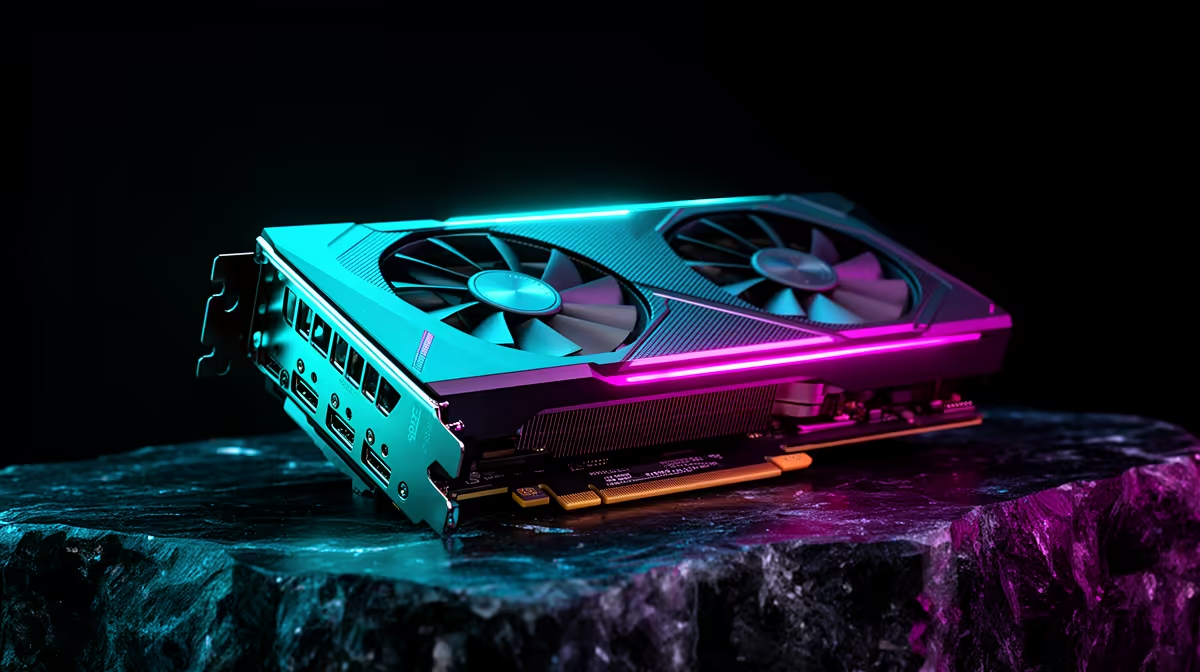
A current-gen RTX 50 card delivers strong performance across modern titles at the resolutions most people play, with current-generation ray tracing and the latest upscaling and frame-generation features baked in. For a gamer who needs performance now, that is not a compromise pick while waiting for something better, it is a complete, capable solution available immediately. Browse the NVIDIA graphics card range to compare available tiers and current Rand pricing directly.
Match the card to your screen
The right RTX 50 card depends mostly on the monitor you drive:
- 1080p high-refresh gaming: a mid-tier RTX 50 card pushes high frame rates comfortably and leaves headroom.
- 1440p gaming: this is the sweet spot for the middle and upper-middle of the range, balancing frame rate and detail.
- 4K and high-refresh 4K: the higher-end cards are where you want to be, especially with ray tracing and upscaling enabled.
Buying to your resolution rather than chasing the absolute top tier is how you get the best value out of a current-gen purchase.
The real cost of waiting
Holding out is not free. There are three quiet costs people overlook.
First, opportunity cost. Every month you wait is a month you are gaming on a card that is not keeping up, lowering settings or living with poor frame rates, while a capable card sits available on the shelf.
Second, the upgrade treadmill never ends. There is always a next generation after the next one. If RTX 60 is the reason to wait now, RTX 70 will be the reason later. At some point you have to step on, and the best time is when your current hardware no longer does the job.
Third, price unpredictability at launch. Even when Rubin arrives, early pricing tends to sit high before settling, and exchange-rate movement adds its own uncertainty to landed costs in South Africa. The card you waited two years for may not be the bargain the wait implied.
When waiting is actually reasonable
To be fair, there are cases where holding off makes sense, and it is worth being honest about them. If your GPU handles the titles you care about at the frame rates and detail levels you want, nothing forces you to spend, and you can revisit the market whenever your needs change. If you are not far from a natural upgrade point anyway and genuinely do not mind the games you cannot run well in the meantime, waiting costs you little.
The decision really comes down to one question: is your current card holding you back today? If yes, buy now. If no, you were never under pressure to wait in the first place, and you can revisit the market whenever your needs change. What does not make sense is suffering with inadequate performance for over a year to reach an unconfirmed product at an unknown price.
A practical buying approach for SA gamers
For most South African buyers the sensible plan is straightforward. Decide on your target resolution and the frame rate you want, set a realistic budget, and pick the current RTX 50 card that meets it from what is actually in stock. Pair it with a power supply that comfortably covers the card and a case with proper airflow, since a strong GPU starved of cooling or clean power underperforms.
If budget is the real constraint, it is better to buy the best current-gen card you can afford now and game on it for years than to wait for a halo product you may not be able to afford at launch anyway. The best-selling GPUs are a good gauge of where the value sits for buyers in the same position as you.
Frequently Asked Questions
When is the RTX 60 series coming out?
The RTX 60 series, based on the Rubin architecture, is not expected before the second half of 2027 at the earliest. There is no officially confirmed release date, only expectations at this stage.
Are there confirmed specs for the RTX 60 series?
No. There are no confirmed specifications, pricing, or performance figures for the RTX 60 series yet, only rumour and expectation. That makes it impossible to weigh against a card you can buy and benchmark today.
Should I wait for the RTX 60 or buy an RTX 50 now?
If you need performance now, buy a current-gen RTX 50 card. It is available, benchmarked, and capable across modern games. Waiting means over a year for an unconfirmed product, then likely more time for stock and pricing to settle.
Will the RTX 50 series feel outdated soon?
Not for years. Current RTX 50 cards handle modern titles strongly with the latest ray tracing and upscaling features. A new generation launching does not stop your card from playing today's games well.
Which RTX 50 card should I get?
Match it to your monitor. A mid-tier card suits 1080p high-refresh, the middle of the range targets 1440p, and the higher-end cards are for 4K. Buy to your resolution rather than chasing the top of the stack.