Quick Answer
AIO coolers with embedded VRM fans solve VRM overheating by directing a dedicated active airstream across the power delivery components that a standard CPU cooler ignores. On platforms running Ryzen 9 9950X or Intel Core Ultra 9 285K at full power, this can reduce VRM temperatures by 10 to 20 degrees Celsius compared to relying on passive VRM heatsinks alone.
How VRM Overheating Shows Up in Your Build 🔥
VRM throttling is sneakier than CPU thermal throttling because most monitoring tools do not surface VRM temperature data prominently. The symptom is a CPU that drops clock speeds under sustained all-core loads even when CPU package temperature stays below 80 degrees Celsius. This happens because the motherboard's power delivery stages overheat and reduce output voltage to protect themselves. On B650E boards running a Ryzen 9 9950X at full PBO settings, VRM temperatures can reach 95 to 105 degrees Celsius under Cinebench or extended rendering, causing the board to throttle power delivery before the CPU itself hits its thermal limit. HWiNFO64 exposes VRM sensor data under the motherboard section, which is where you confirm this diagnosis.
How Embedded VRM Fans Address the Problem 💨
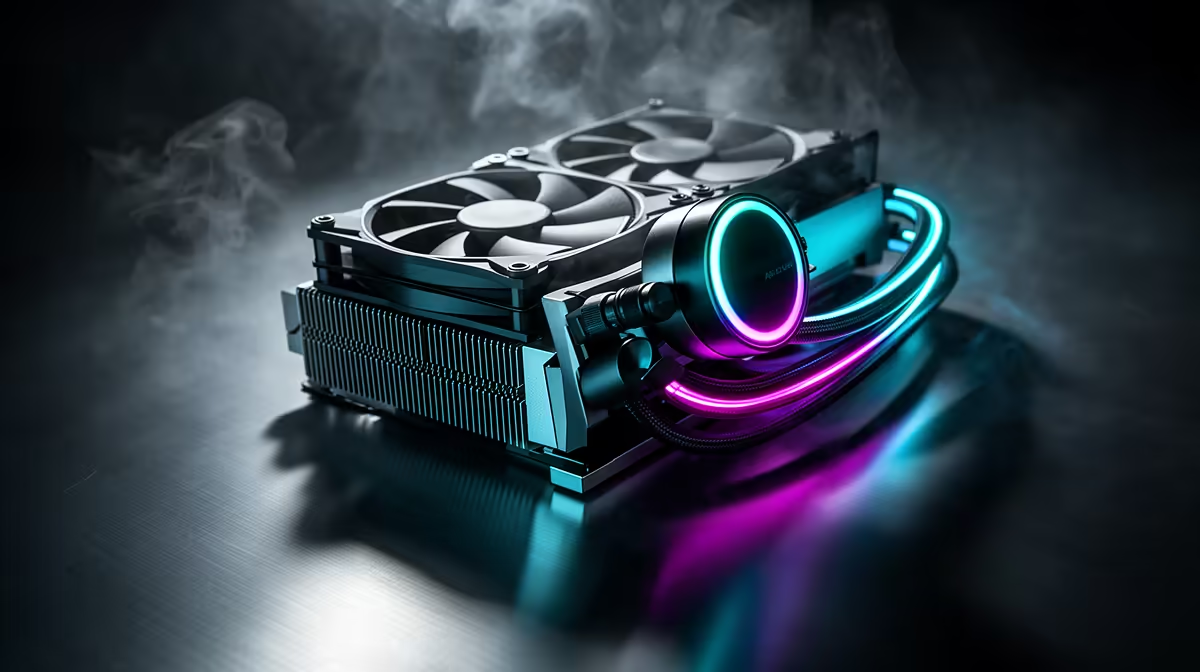
An embedded fan on an AIO pump block is a small secondary fan, typically 30mm to 50mm in diameter, positioned on the side or base of the pump head facing the VRM heatsink array. When correctly mounted, this fan blows a directed airstream across VRM fins that would otherwise rely solely on case airflow. This active airflow sustains VRM temperatures in the 70 to 80 degree range during workloads where passive cooling would reach 95 degrees or above. Corsair's iCUE Elite series is the most widely cited implementation, with units in the R3,500 to R5,000 range in SA.
Alternative VRM Cooling Approaches 🔧
If an AIO with an embedded fan is outside budget, other approaches improve VRM temperatures. Moving to a higher-quality X870E motherboard with more robust VRM heatsinks is the most direct solution. Adding a small 40mm or 60mm case fan directed at the VRM area achieves meaningful temperature reduction at minimal cost. Ensuring at least one case fan draws fresh air toward the motherboard area rather than relying solely on front-to-rear airflow also helps. For sustained workstation users in SA, the embedded fan AIO is the cleanest integrated solution.
Confirm VRM Heatsink Clearance Before Purchasing ⚡
An embedded VRM fan only works if the pump block's secondary fan is actually positioned above and facing your board's VRM heatsink. Measure the distance from your CPU socket centre to the edge of the VRM heatsink and compare it to the pump block dimensions in the AIO spec sheet. Some board layouts position VRM fins far enough from the socket that the embedded fan misses them entirely.
FAQ
Does every high-end motherboard need VRM fan assistance?
No. X870E and Z890 flagship boards have robust enough VRM designs to handle Ryzen 9 9950X and Core Ultra 9 285K at rated TDP without active fan assistance. VRM cooling becomes critical primarily on mid-range boards running flagship CPUs beyond their recommended power limits.
Can I add an aftermarket VRM fan to an existing AIO?
Not directly. Aftermarket VRM fans are standalone small fans mounted near the socket area rather than integrated into the AIO pump block. These work and are a cost-effective alternative to replacing an existing AIO, but they add cable management complexity and require a spare fan header.
Are AIO coolers with embedded VRM fans significantly more expensive in SA?
Yes, by approximately R800 to R1,500 compared to equivalent-spec AIOs without the embedded fan. Whether this premium is worthwhile depends entirely on your motherboard's VRM quality and the CPU load profile you run regularly.
Experiencing mysterious throttling under sustained loads?
Browse Evetech's range of advanced AIO coolers, including models with embedded VRM fans, to address power delivery heat on high-end platforms.