


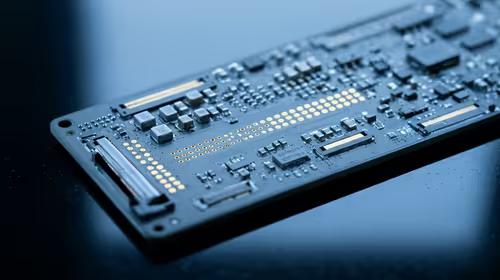
Hot-Swappable PCB Architecture in Modern Keyboards: Guide
Learn hot-swappable PCB architecture in modern keyboards—what it is, how sockets and traces work, and how to pick the right board. Speed up swaps, reduce risk, and upgrade faster 🔧⚡
Read moreDaisy-chain ARGB on a 360mm radiator stack cuts six to nine connectors out of the radiator stack, which makes airflow paths cleaner and keeps cable combs tidy. SA pricing, warranty cover and current stock are factored in.
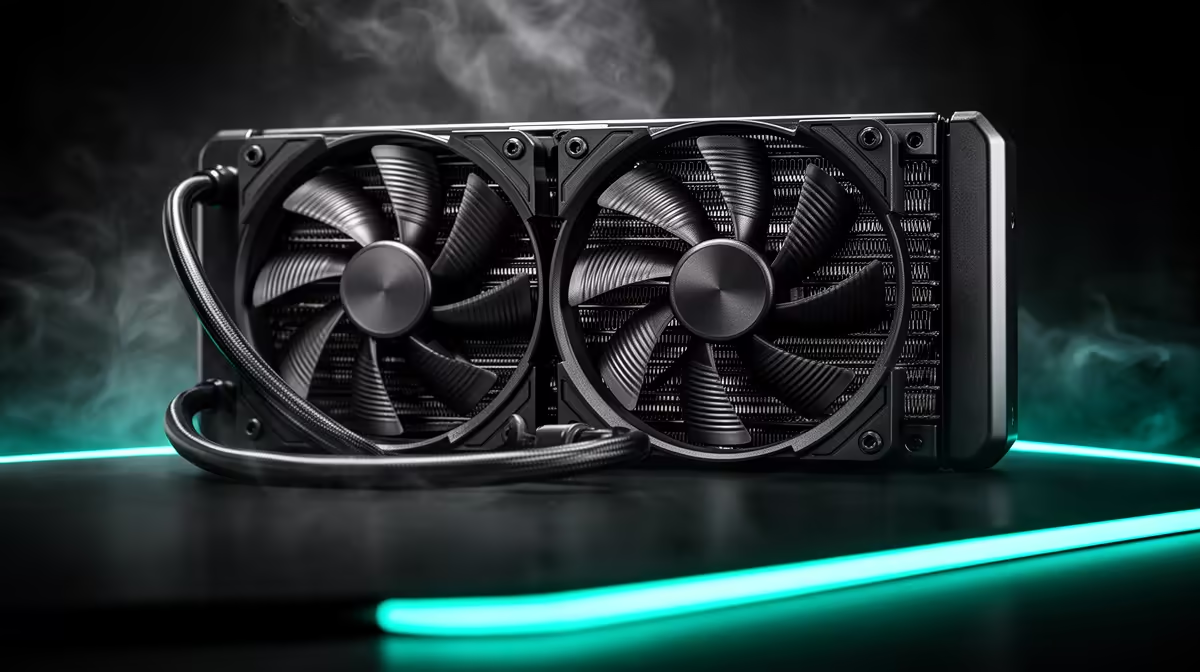
For a 360mm radiator, static pressure fans outperform airflow fans. Radiator fin stacks present resistance to airflow, and static pressure fans are engineered to overcome this resistance and push air through dense fins effectively. Airflow fans move more air in an unobstructed setting but lose efficiency quickly when pushing against a radiator's fin density.
Fan performance is measured by two metrics: airflow (CFM) and static pressure (mm H2O). Airflow fans use fewer, wider blades to sweep air through open space efficiently. Static pressure fans use narrower, overlapping blades to force air through resistive surfaces like radiator fins and CPU heatsinks. On a 360mm radiator with 18 to 22 fins per centimetre, an airflow fan stalls quickly as back-pressure exceeds its blade geometry. A static pressure fan rated at 2.5mm H2O or above pushes effectively through those fins at lower RPM, giving better cooling with less noise.
Airflow fans have a clear role in PC builds, just not on radiators. They excel as case intake and exhaust fans where air moves through open grilles or mesh panels with minimal obstruction. Mounting two or three high-CFM 120mm or 140mm airflow fans on the front intake of a mid-tower case draws large volumes of cool air into the chassis efficiently, improving overall thermal performance for GPU, VRMs, and case ambient temperature. For SA builders aiming for a well-cooled system overall, the ideal setup pairs static pressure fans on the 360mm radiator with airflow-optimised fans on case intakes. This combination maximises thermal performance at every stage of the airflow path.
When shopping for radiator fans, look for static pressure above 2.0mm H2O for adequate performance and above 2.5mm H2O for premium results. The best static pressure fans balance cooling and low noise across their RPM range, which matters for SA builders using their PCs for long gaming sessions or WFH setups. Budget R200 to R500 per fan for a quality 120mm static pressure unit; a three-fan set costs R600 to R1,500 at Evetech.
If you have spare airflow fans from a case upgrade, test them briefly on your radiator versus your current static pressure fans with a monitoring tool like HWiNFO64. The temperature difference under a sustained Cinebench load quantifies exactly what you gain with static pressure fans on your specific radiator.
You can, but the lower-performing fan in the mixed set will limit the overall result. Consistent static pressure fans across all three radiator positions give more predictable and better-tuned performance.
No. Thicker radiators (30mm to 38mm) present even more resistance to airflow than thin ones, making static pressure fans even more important rather than less. The fin density typically stays similar regardless of radiator thickness; thickness mainly adds coolant volume.
Static pressure fans at the same RPM often produce slightly more turbulence noise due to their aggressive blade design. However, because they achieve better cooling at lower RPM on a radiator, they typically operate more quietly in practice than airflow fans working harder to achieve the same result.
Upgrading your radiator fans or building fresh? Find static pressure fans and full AIO coolers at Evetech for your 360mm build.
Learn hot-swappable PCB architecture in modern keyboards—what it is, how sockets and traces work, and how to pick the right board. Speed up swaps, reduce risk, and upgrade faster 🔧⚡
Read more
Mechanical switch lifespan explained—what the 50 million keystroke rating really means, plus tips to extend switch life and reduce double-press issues 🔧⌨️
Read more
60-percent vs full-size mechanical keyboard layouts—learn what each layout includes, who it suits, and how to choose the right fit 🧩⌨️ for typing, gaming, and productivity.
Read more
Double injection keycaps last far longer than standard printed keycaps in most setups. Learn typical lifespan ranges, what shortens them, and how to maximize durability for smoother daily typing and gaming 😊⌨️
Read more
Full-key anti-ghosting: does it stop missed inputs during fast-paced gaming? We break down latency, polling, and key matrix limits so you can buy smarter 🎮⚡
Read more
Protect mechanical keyboard switches from South African dust and summer humidity with practical cleaning and storage habits. Keep your switches smooth, reduce failures, and extend lifespan. 🌬️💧
Read more
Wondering if a TKL wireless mechanical keyboard is worth it for everyday productivity? We break down latency, battery life, comfort, and workflow gains for real work. ⚡⌨️

Maximise battery life on a fanless 15-inch laptop using efficiency core architecture. Cut idle drain, tune power profiles, and improve thermals for longer runtime. 🔋⚙️

Learn how to reduce desk clutter with a TKL wireless keyboard using fewer cables, smart placement, and tidy essentials. Get a faster, calmer workspace with better ergonomics. ✅🧼

RGB keyboard lighting too distracting? Learn how to manage backlight modes, set brightness, and reduce distraction for focus and productivity 😌🖱️

Are themed gaming keyboards worth the extra cost? Compare build quality, switch options, features, and resale value to find the best fit for your setup 🎮⌨️

Full-Size vs Tenkeyless mechanical keyboards for gaming: find out if a smaller layout truly improves aim, speed, and comfort. We break down layout, desk space, latency-feel, and keybinds 🎮⌨️

Dedicated media rollers vs function key shortcuts: learn which setup gives you better workflow control, faster media access, and fewer mistakes. 🖱️🎧

Best Mechanical Switch Type for Gaming: Clicky vs Linear vs Tactile. Find your feel, speed, and noise balance with practical guidance for FPS, MOBA, and productivity 😄🎮

Direct mouse answer: Mouse not keeping up with your work? Everything that matters about dual-mode 2.4GHz + BT 5.0: DPI behaviour, channel switching, battery curves and per-app button mapping. Covers when 2.4GHz USB wins (low-latency desk) and when BT 5.0 wins (laptop, d

Plain wireless mouse guide: Mouse not keeping up with your work? Everything that matters about wireless productivity mouse: DPI behaviour, channel switching, battery curves and per-app button mapping. Includes DPI tuning tips, channel switch shortcuts, and ZAR-aware fea

Real productivity numbers: Set up your wireless mouse in this order: everything that matters about wireless productivity mouse: DPI behaviour, channel switching, battery curves and per-app button mapping. Includes DPI tuning tips, channel switch shortcuts, and ZAR-aware

Pen not feeling like paper? Stylus lag and skipping usually trace to old drivers, dirty nibs, or display refresh mismatches, not the pen itself. Covers pressure curve tuning, tilt thresholds, nib swap timing, and SA pricing brackets.