Quick Answer
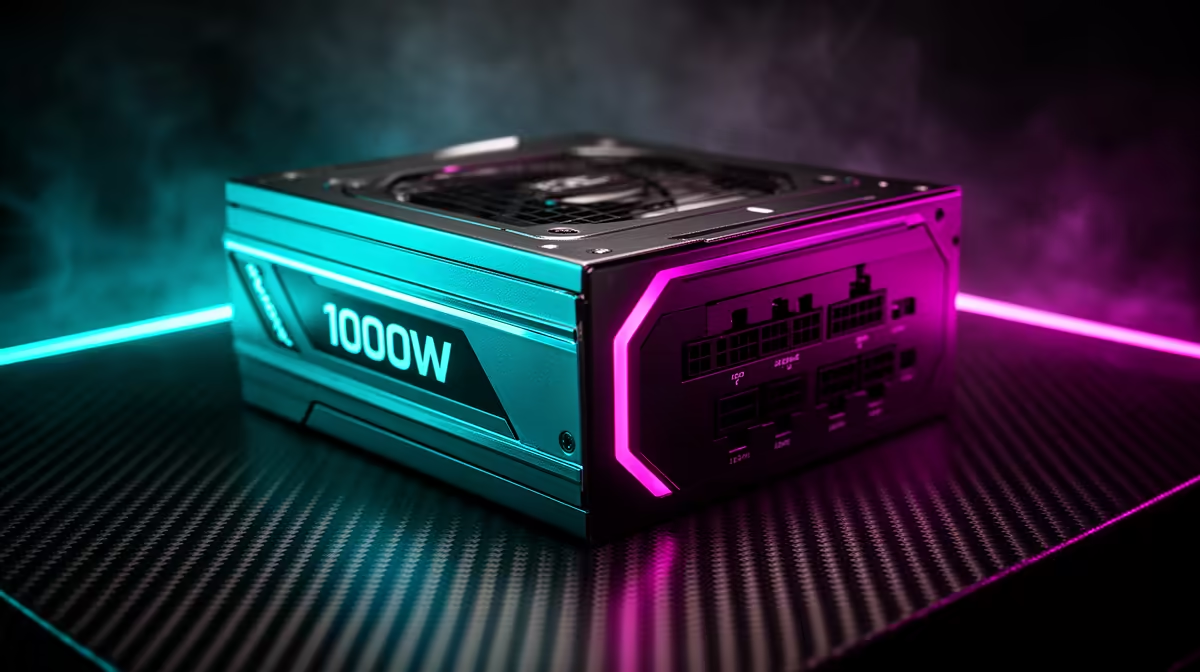
A 1,000W PSU is the correct choice for high-end gaming PCs pairing an RTX 5080 or RTX 5090 with a Core Ultra 9 285K or Ryzen 9 9950X, or for workstations running GPU compute tasks alongside a high-TDP CPU. For mid-range builds on 65W to 125W CPUs with sub-300W GPUs, an 850W unit is sufficient and often better value.
When a 1,000W PSU Is the Right Specification 🔌
The RTX 5090 has a 575W TDP; the RTX 5080 sits at 320W. A full gaming system with the RTX 5090, a Core Ultra 9 285K (250W boost TDP), 64GB DDR5, four NVMe SSDs, and six ARGB case fans draws approximately 700W to 800W under sustained full load. The recommended 40% headroom rule places the PSU requirement at 980W to 1,120W, making a 1,000W or 1,200W unit the correct specification. ATX 3.0 1,000W PSUs in South Africa are priced from approximately R3,500 to R5,500 depending on efficiency rating and brand. ASUS ROG Thor 1000P3, Seasonic Focus GX-1000, and Corsair RM1000x SHIFT are among the 1,000W units stocked locally, all with 80 Plus Gold certification and ten-year warranties on flagship models.
Efficiency Ratings and Workstation Considerations ⚡
For workstation builds running GPU compute tasks (3D rendering, machine learning inference, video encoding) at near-continuous 80% to 100% CPU and GPU load, 80 Plus Platinum or Titanium certification above Gold becomes financially justifiable. At 100% load, a Gold PSU operates at 87% efficiency while a Platinum unit hits 89% to 92%. For a workstation running a 1,000W load continuously at South African electricity rates, the 2% to 5% efficiency difference saves 20W to 50W continuously, equalling 175 to 440 kWh per year. A 1,000W Platinum PSU costs approximately R500 to R1,500 more than a Gold equivalent in South Africa, with payback in electricity savings within two to four years for continuous-use workstations.
ATX 3.0 and Cable Management at 1,000W 🔧
All current 1,000W units from major brands include the 16-pin 12V-2x6 connector required for RTX 50-series GPUs natively. At 1,000W, most units include two to three 16-pin or PCIe 8-pin GPU cables, four to six SATA power connectors, and two to four peripheral connectors. Fully modular units at this wattage become particularly valuable because the cable set is large and routing it cleanly without a selection filter leads to substantial cable congestion. Choose a fully modular 1,000W unit for high-end or workstation builds and route only the cables your specific drive and GPU configuration needs.
Verify 12V-2x6 Cable Gauge Before Installing on RTX 5090 ⚡
The 16-pin 12V-2x6 cable on 1,000W PSUs must use 16AWG or heavier conductors to carry 600W safely. Genuine OEM cables from certified PSU manufacturers meet this spec, but aftermarket replacements sometimes use 18AWG conductors that run hot under sustained RTX 5090 load. Only use the cable supplied with your specific PSU unit.
FAQ
Is a 1,000W PSU overkill for an RTX 5080 build?
An 850W Gold unit is sufficient for an RTX 5080 paired with a 125W TDP CPU. A 1,000W unit provides extra headroom for future GPU upgrades or system expansion, which some builders prefer. Neither is overkill if the system load justifies it.
Do 1,000W PSUs run louder than lower-wattage units?
Not inherently. At typical gaming loads of 500W to 700W, a 1,000W unit operates at 50% to 70% rated capacity where most premium units run semi-passively (fan off below 40% load) or at very low fan speeds.
What warranty should I expect on a quality 1,000W PSU in South Africa?
Premium 1,000W units from Seasonic, Corsair, and ASUS ROG carry ten-year warranties when purchased through authorised SA channels. Entry-level 1,000W units typically offer three to five years.
Speccing a high-end gaming or workstation PC in South Africa?
Evetech stocks 1,000W PSUs from top brands with ATX 3.0 support, 80 Plus ratings, and full local warranty details on every product listing.