Quick Answer
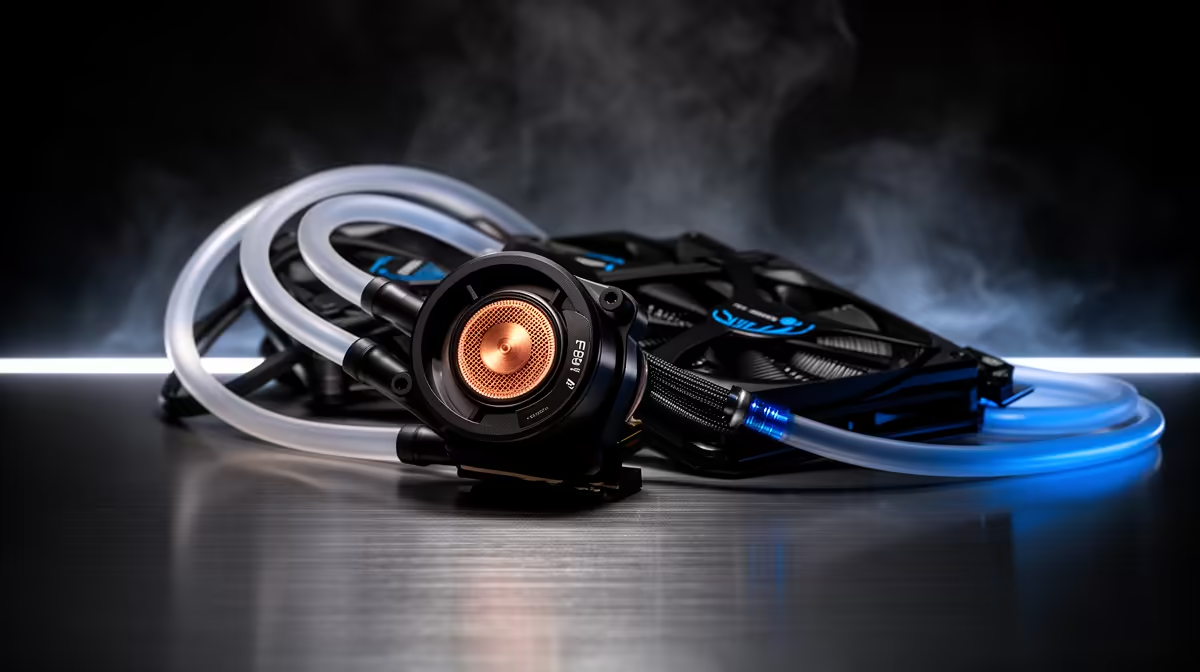
A 360mm AIO liquid cooler uses a closed-loop pump, three 120mm radiator fans, and a cold plate to keep high-TDP CPUs like the Ryzen 9 9950X or Core i9-14900K under 90 degrees Celsius during sustained workloads. For South African gaming and creator builds above R25,000, a 360mm AIO is the go-to thermal solution that balances performance, noise, and aesthetics.
How a 360mm AIO Works and Why It Outperforms Smaller Units 🔧
An AIO (all-in-one) liquid cooler circulates coolant between a cold plate on the CPU and a radiator mounted in the case, where fans draw heat out of the loop. The 360mm designation refers to a radiator measuring roughly 360mm by 120mm, housing three 120mm fan positions. This gives it approximately 50 percent more heat-dissipation surface area than a 240mm unit and around 30 percent more than a 280mm unit. For content creators running DaVinci Resolve or Blender on a Ryzen 9 9900X alongside game streaming, that thermal headroom prevents the mid-session throttle events that drop render times unpredictably.
Choosing the Right 360mm AIO for Your Use Case 🖥️
Three variables drive the right choice: socket compatibility, case clearance, and software ecosystem. Socket support must explicitly list your platform, whether AM5 for Ryzen 7000 and 9000 series or LGA 1851 for Intel Core Ultra 200-series. Most premium 360mm AIOs available locally support both and include mounting hardware in the box. Software matters if you care about synchronised ARGB lighting across your build: ASUS AIOs work best with Armoury Crate for Aura Sync boards, while Corsair iCUE units integrate tightly with iCUE-compatible peripherals.
What to Budget in South Africa 💰
Quality 360mm AIOs locally span a wide range. Entry-level models from ID-Cooling or Deepcool start around R1,600 to R2,000 and offer solid cooling without premium features. Mid-range units from ASUS Prime, MSI MAG, or Corsair H150i land between R2,200 and R3,200, adding better pump reliability, LCD or ARGB pump heads, and stronger software integration. For a R30,000 to R50,000 gaming and creator build, the R2,500 to R3,500 mid-range bracket represents the best value overlap between performance and features.
Top-Mount Radiator Is Usually Best ⚡
In most mid-tower cases, mounting the 360mm radiator at the top as exhaust keeps hot air from the radiator moving directly out of the case rather than recirculating over components. Front-intake radiator mounting works well in cases designed specifically for it, like the Fractal Torrent, but is less effective in standard cases with restricted front panels. Check your case airflow design before deciding on radiator placement.
FAQ
How long does a 360mm AIO typically last?
Quality sealed units from established brands last 5 to 8 years under normal operating conditions. The pump is the component most likely to fail first, usually indicated by rising CPU temperatures or audible pump cavitation. Most premium brands offer 5-year warranties that cover pump failure, which is important to confirm before purchase in South Africa.
Does a 360mm AIO add much noise to a build?
The three radiator fans are the primary noise source. At low RPM (800 to 1,000 RPM), modern 120mm ARGB fans are near-silent. Under sustained load when fans ramp to 1,500 to 1,800 RPM, noise increases to around 35 to 42 dBA, which is audible in a quiet room but below the headset threshold for most gaming sessions. The pump itself produces a gentle hum at around 25 to 28 dBA.
Is a 360mm AIO worth it over a premium tower air cooler?
For CPUs above 125W sustained, yes. The Noctua NH-D15 and be quiet! Dark Rock Pro 4 are excellent air coolers but struggle above 150W sustained in warm ambient conditions, which is exactly where South African builders in summer hit problems. The 360mm AIO provides a more consistent thermal ceiling regardless of ambient temperature.
Ready to build with proper liquid cooling?
Browse Evetech's full range of 360mm AIO coolers across every budget tier, from solid entry-level units to premium LCD-equipped flagship options.