Quick Answer
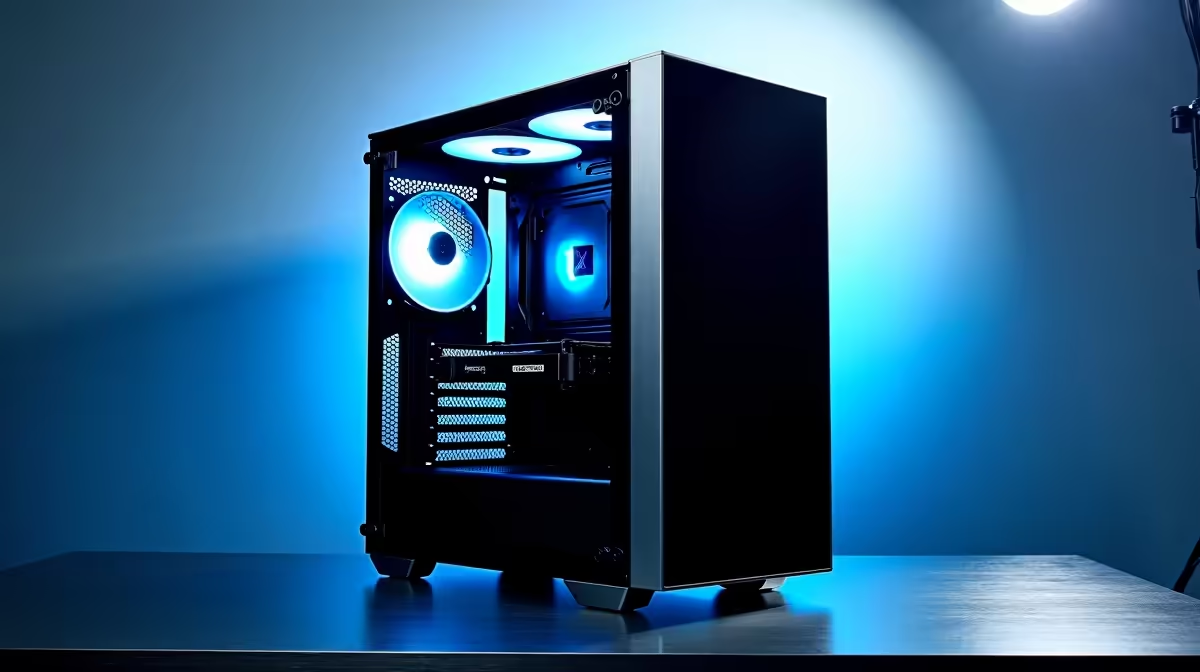
E-ATX mid-tower cases for creator and workstation builds need to satisfy six criteria: full 305mm x 330mm E-ATX board support, at least 440mm GPU clearance, 360mm or 420mm AIO radiator support, a minimum of 25mm behind-tray cable management depth, front USB Type-C at Gen 2 or faster, and a quiet fan configuration. Cases meeting all six in SA retail range from R2,800 to R5,000.
Form Factor and Board Support Explained 📐
The E-ATX form factor covers boards from 305mm x 264mm up to 305mm x 330mm. The full 305mm x 330mm size appears on consumer HEDT platforms like TRX50 for Threadripper and high-end X870E boards from ASUS and Gigabyte. When a case is marketed as E-ATX compatible, verify whether it supports the full 330mm board depth or only the smaller 264mm variant: the case manual should state maximum board dimensions explicitly. A mismatch means the board physically overhangs the tray and cannot be safely grounded at its four corners, introducing flex risk during GPU installation. Mid-tower cases that genuinely support full-spec E-ATX boards are typically 220 to 240mm wide and 490 to 540mm tall.
Cooling Configuration for Creator Workloads 🌡️
Creator workloads place sustained thermal demands that gaming does not. Blender CPU rendering, DaVinci Resolve GPU encoding, and compilation jobs keep both processor and graphics card at peak temperatures for minutes to hours. The cooling configuration should include a top mount for a 360mm or 420mm AIO (front-mount 420mm is preferable where the case allows it), at least two 140mm front intake positions, and an isolated PSU intake at the bottom. Avoid cases where the PSU intake draws from the main chamber rather than fresh room air: this recirculates hot GPU exhaust through the PSU, raising its operating temperature and accelerating capacitor wear in SA's warm ambient conditions.
Connectivity and Cable Management Essentials 🔌
A creator workstation connects more peripherals than a gaming rig: audio interfaces, drawing tablets, external drives, cameras, and docking stations. The front I/O panel should offer at minimum two USB 3.2 Gen 1 Type-A ports, one USB 3.2 Gen 2 Type-C port, and a headphone or microphone combo jack. For cable management behind the tray, 25 to 35mm of clearance is the functional target. Below 25mm, thick PSU cables from an 850W or larger modular unit cannot be routed flat, causing the side panel to bow. Premium E-ATX mid-tower cases include dedicated velcro anchor strips along the tray spine and pre-installed grommets at the six main routing positions.
Cable-Route Before the Board Goes In ⚡
In an E-ATX mid-tower, thread all PSU cables through their grommets before installing the motherboard. Once the E-ATX board covers the lower half of the tray, access to the lower routing holes is significantly reduced. Pre-routed cables can be plugged in from the front after board installation, saving 20 to 30 minutes on a dense build.
FAQ
Can an E-ATX mid-tower fit under a standard desk in SA?
Typically yes, if the desk clearance is at least 540mm. Most E-ATX mid-towers sit between 490 and 540mm tall. Measure your available desk height before purchasing and factor in the case feet, which can add 10 to 20mm.
How does an E-ATX mid-tower differ from a full tower for a creator build?
A full tower offers more drive bays, usually an extra 40 to 80mm of internal depth, and sometimes additional fan positions. An E-ATX mid-tower is sufficient for most creator builds and is more practical for SA living spaces where floor area is limited.
Is Ryzen Threadripper the only CPU that requires an E-ATX board?
No. Some high-end AMD X870E flagship boards also use the E-ATX form factor. A Ryzen 9 9950X can therefore be used in an E-ATX build on an X870E board without requiring a Threadripper platform.
Ready to spec your creator or workstation build?
Evetech stocks a full range of E-ATX mid-tower cases matched to current-generation HEDT and high-end consumer platforms. Browse the case and component ranges to plan your complete build.