


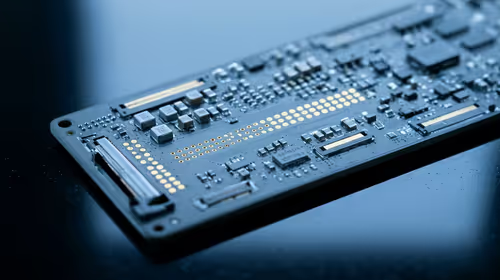
Hot-Swappable PCB Architecture in Modern Keyboards: Guide
Learn hot-swappable PCB architecture in modern keyboards—what it is, how sockets and traces work, and how to pick the right board. Speed up swaps, reduce risk, and upgrade faster 🔧⚡
Read moreEverything that matters about reverse blade: airflow CFM, static pressure mm-H2O, bearing type and ARGB wiring in plain terms. Shows how reverse blades flip the visible side without inverting intake flow, plus mount and cable tips.

Reverse orientation fans spin opposite to standard fans and are designed to mount in the same position while pushing air in the reverse direction. In practice, they let you achieve a front-to-back positive pressure airflow path without flipping the fan frame around, preserving the ARGB lighting orientation so all LEDs face the tempered glass side panel.
A standard 120mm or 140mm PC fan is labelled so that the sticker side faces the intake direction and the frame side faces the exhaust direction. Reverse orientation fans simply have their blade pitch mirrored, meaning when installed the same way as a standard fan (label outward), they push air in the opposite direction. This is specifically useful on the front intake of cases where builders want the ARGB lighting ring to face forward toward the glass rather than being hidden behind the blade cage. Without reverse fans, achieving the same result means physically flipping a standard fan, which points the LEDs toward the back of the frame and away from the viewer. Brands like Lian Li Uni Fan and others have commercialised this design, producing daisy-chainable fans where orientation is consistent across the entire array.
Reverse fans generate the same CFM and static pressure figures as equivalent standard models because the blade geometry is aerodynamically identical, just mirrored. A reverse 120mm fan rated at 56 CFM and 2.5 mm-H2O static pressure delivers those specs regardless of which direction you call forward. Where they change the equation is in system airflow routing. When used as front intakes with a conventional installation direction, they pull cool air in through the front mesh and push it toward the GPU and CPU. Paired with standard rear and top exhausts, the result is a clean front-to-rear channel. This matters in SA where ambient room temperatures can reach 30C to 35C in summer, pushing component temps up meaningfully unless intake airflow is well directed.
The biggest practical win from reverse fans is LED visibility. In a case with a mesh front panel and tempered glass, both the front grill side and the glass side can display the ARGB ring if the fan is reverse-oriented. Some builders mount three 120mm reverse fans on the front intake so all three LED rings face the glass and create a mirrored effect visible from outside. Daisy-chain connector designs mean fewer cables running back to the motherboard, since each fan clips to the next and only one PWM and one ARGB cable exits the array. This simplifies cable routing significantly behind the front panel, keeping the visible interior cleaner.
If you mix reverse and standard fans across intake and exhaust positions, check that the intake fans collectively move slightly more air than the exhaust fans. Slight positive pressure keeps dust out of unfiltered gaps. Aim for intakes at about 5 to 10 percent higher CFM than your exhausts.
Yes, but it defeats the purpose. A reverse fan used as exhaust simply becomes a standard intake configuration. Use reverse fans where you need standard intake behaviour but want the LED face pointing outward.
Absolutely. Reverse fans connect to standard 4-pin PWM headers and behave identically for speed control. The BIOS does not know or care about blade pitch direction.
No, static pressure depends on blade design and RPM, not orientation. A high-static-pressure reverse fan handles dense mesh as well as its standard equivalent.
Want cleaner airflow and better LED visibility? Evetech carries case fans including reverse orientation and daisy-chain designs suited for custom mid-tower and full-tower builds. Check the current range for your next upgrade.
Learn hot-swappable PCB architecture in modern keyboards—what it is, how sockets and traces work, and how to pick the right board. Speed up swaps, reduce risk, and upgrade faster 🔧⚡
Read more
Mechanical switch lifespan explained—what the 50 million keystroke rating really means, plus tips to extend switch life and reduce double-press issues 🔧⌨️
Read more
60-percent vs full-size mechanical keyboard layouts—learn what each layout includes, who it suits, and how to choose the right fit 🧩⌨️ for typing, gaming, and productivity.
Read more
Double injection keycaps last far longer than standard printed keycaps in most setups. Learn typical lifespan ranges, what shortens them, and how to maximize durability for smoother daily typing and gaming 😊⌨️
Read more
Full-key anti-ghosting: does it stop missed inputs during fast-paced gaming? We break down latency, polling, and key matrix limits so you can buy smarter 🎮⚡
Read more
Protect mechanical keyboard switches from South African dust and summer humidity with practical cleaning and storage habits. Keep your switches smooth, reduce failures, and extend lifespan. 🌬️💧
Read more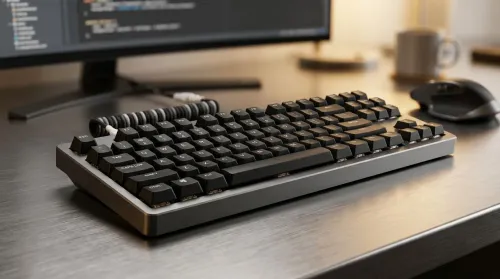
Wondering if a TKL wireless mechanical keyboard is worth it for everyday productivity? We break down latency, battery life, comfort, and workflow gains for real work. ⚡⌨️

Maximise battery life on a fanless 15-inch laptop using efficiency core architecture. Cut idle drain, tune power profiles, and improve thermals for longer runtime. 🔋⚙️
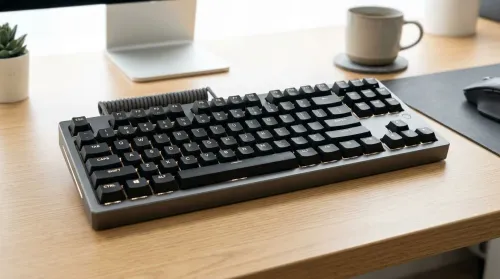
Learn how to reduce desk clutter with a TKL wireless keyboard using fewer cables, smart placement, and tidy essentials. Get a faster, calmer workspace with better ergonomics. ✅🧼
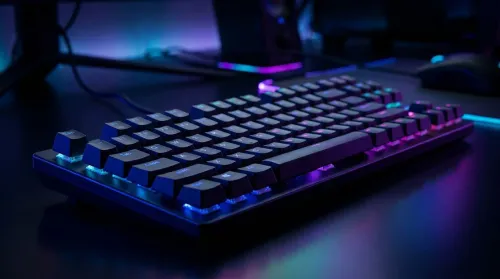
RGB keyboard lighting too distracting? Learn how to manage backlight modes, set brightness, and reduce distraction for focus and productivity 😌🖱️

Are themed gaming keyboards worth the extra cost? Compare build quality, switch options, features, and resale value to find the best fit for your setup 🎮⌨️

Full-Size vs Tenkeyless mechanical keyboards for gaming: find out if a smaller layout truly improves aim, speed, and comfort. We break down layout, desk space, latency-feel, and keybinds 🎮⌨️

Dedicated media rollers vs function key shortcuts: learn which setup gives you better workflow control, faster media access, and fewer mistakes. 🖱️🎧

Best Mechanical Switch Type for Gaming: Clicky vs Linear vs Tactile. Find your feel, speed, and noise balance with practical guidance for FPS, MOBA, and productivity 😄🎮

Direct mouse answer: Mouse not keeping up with your work? Everything that matters about dual-mode 2.4GHz + BT 5.0: DPI behaviour, channel switching, battery curves and per-app button mapping. Covers when 2.4GHz USB wins (low-latency desk) and when BT 5.0 wins (laptop, d

Plain wireless mouse guide: Mouse not keeping up with your work? Everything that matters about wireless productivity mouse: DPI behaviour, channel switching, battery curves and per-app button mapping. Includes DPI tuning tips, channel switch shortcuts, and ZAR-aware fea
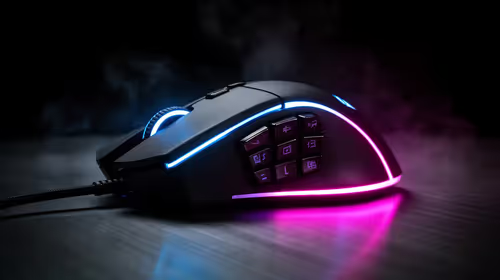
Real productivity numbers: Set up your wireless mouse in this order: everything that matters about wireless productivity mouse: DPI behaviour, channel switching, battery curves and per-app button mapping. Includes DPI tuning tips, channel switch shortcuts, and ZAR-aware
Pen not feeling like paper? Stylus lag and skipping usually trace to old drivers, dirty nibs, or display refresh mismatches, not the pen itself. Covers pressure curve tuning, tilt thresholds, nib swap timing, and SA pricing brackets.