


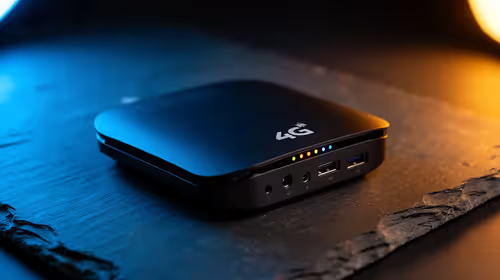
How to Use a Nano SIM 4G Router for Reliable Home Internet
Master using a Nano SIM 4G router as your primary internet solution. Get stable speeds and seamless connectivity for gaming and streaming at home! 🌐🚀
Read moreATX 3.1 and PCIe Gen 5.1 compatibility standards define cable, connector, and transient rules for modern PSUs and GPUs. Wattage, efficiency tier, and ATX 3.1 readiness shape both your daily power bill and your transient stability.
ATX 3.1 is the PSU power delivery specification published by Intel in 2024, standardising the 12V-2x6 connector and tightening transient spike tolerances. PCIe Gen 5.1 is a separate bus standard governing data transfer speed between the CPU and discrete devices. They are related only in that next-gen GPUs use both, but ATX 3.1 compliance does not automatically guarantee PCIe Gen 5.1 support, which depends on the motherboard and CPU.
The ATX 3.1 specification, released mid-2024, defines four primary updates over ATX 3.0. First, the 12V-2x6 connector replaces 12VHPWR as the standard high-power GPU connector, with shorter sense pins that prevent partial seating and improved thermal handling up to 600W sustained and 900W peak. Second, transient load response requirements are tightened: the 12V rail must remain within plus or minus 3% during load steps up to 200% of the GPU's rated power, with response time under 100 microseconds. Third, hold-up time requirements are revised to maintain outputs within spec for at least 17 milliseconds after input power removal. Fourth, standby power consumption ceilings are refined for lower idle draw. None of these changes affect PCIe bus speed, which is a motherboard and CPU function entirely separate from PSU design.
PCIe Gen 5.1 doubles the per-lane bandwidth from PCIe 5.0's 4GB/s to 8GB/s per lane. For a 16-lane GPU slot, this means theoretical bandwidth of 128GB/s in each direction, up from 64GB/s on PCIe 5.0. In practice, current GPUs including the RTX 5090 and RX 9080 do not saturate PCIe 5.0 bandwidth in gaming workloads: CPU-to-GPU bandwidth is rarely the bottleneck at current resolutions and game engine architectures. PCIe 5.1 matters more for next-generation NVMe SSDs and enterprise accelerators. For an SA builder in 2025 or 2026, a motherboard with PCIe 5.0 x16 GPU support and a PCIe 5.0 x4 NVMe slot is the practical target: Intel Z890 and AMD X870E platforms both provide this.
For an SA builder combining an ATX 3.1 PSU with a PCIe 5.0 capable system, the compatibility check is straightforward. Confirm the PSU has ATX 3.1 certification and includes a native 12V-2x6 cable. Confirm the motherboard has a PCIe 5.0 x16 primary slot, present on all current Z890 and X870E boards. Confirm the GPU uses the 12V-2x6 connector, which all RTX 50-series and RX 9000-series cards do. PCIe Gen 5.1 board support is less common in 2025 to 2026 but will appear in X890E and next-gen Intel platforms. For current builds, PCIe 5.0 is the ceiling and more than sufficient. Budget R3,800 to R9,000 for a quality ATX 3.1 PSU in the 850W to 1200W range, all stocked at Evetech.
Some budget B-series motherboards pair a PCIe 5.0 primary slot with only one PCIe 5.0 NVMe slot and downgrade secondary slots to PCIe 4.0. If you plan to add multiple high-speed NVMe drives, verify each M.2 slot's PCIe generation in the motherboard spec sheet before purchasing. Running a PCIe 5.0 NVMe in a PCIe 4.0 slot halves its maximum throughput and can waste money spent on a premium storage upgrade.
No.
Not meaningfully with current GPU architectures.
Almost certainly yes. The PSU's ATX version governs power delivery connectors and voltage tolerances, not the PCIe bus version. As long as the physical connector standard does not change again, an ATX 3.1 PSU will power PCIe 6.0 GPUs using the same 12V-2x6 connector they already use.
Building on the latest Intel Z890 or AMD X870E platform and need ATX 3.1 power? Evetech stocks ATX 3.1 compliant PSUs from 850W to 1600W with local warranty, ready for current and next-gen GPU compatibility.
Master using a Nano SIM 4G router as your primary internet solution. Get stable speeds and seamless connectivity for gaming and streaming at home! 🌐🚀
Read more
Confused by Cat4 vs Cat6 LTE routers? 🌐 We break down the technical differences to help you choose the right router for faster gaming and streaming. Get the speed you deserve today! 🚀
Read more
Learn how to setup a VPN server on your 4G LTE router to secure your remote access. Protect your data and browse safely from anywhere with our easy guide! 🌐🔐
Read more
Choosing the best 4G LTE router for South Africa ensures reliable internet when fibre is unavailable. Discover top connectivity tips for rural and urban areas. 🌐📶
Read more
Discover what is passive PoE and how it streamlines outdoor router installations. Eliminate messy cabling and simplify your network setup with this efficient power delivery method. ⚡🌐
Read more
Need to extend internet coverage to outbuildings or farms? 📡 An outdoor 4G router is the ultimate solution for stable, high-speed connectivity in remote locations. Discover how to boost your range and stay connected anywhere on your property. 🌐
Read more
Wondering if a TKL wireless mechanical keyboard is worth it for everyday productivity? We break down latency, battery life, comfort, and workflow gains for real work. ⚡⌨️

Maximise battery life on a fanless 15-inch laptop using efficiency core architecture. Cut idle drain, tune power profiles, and improve thermals for longer runtime. 🔋⚙️
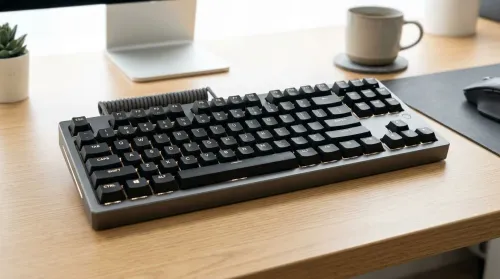
Learn how to reduce desk clutter with a TKL wireless keyboard using fewer cables, smart placement, and tidy essentials. Get a faster, calmer workspace with better ergonomics. ✅🧼
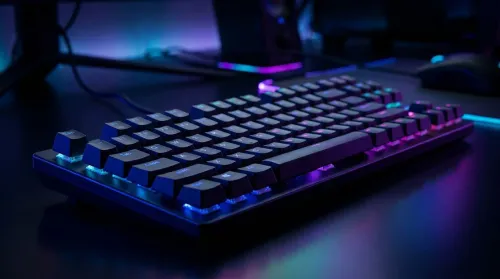
RGB keyboard lighting too distracting? Learn how to manage backlight modes, set brightness, and reduce distraction for focus and productivity 😌🖱️

Are themed gaming keyboards worth the extra cost? Compare build quality, switch options, features, and resale value to find the best fit for your setup 🎮⌨️

Full-Size vs Tenkeyless mechanical keyboards for gaming: find out if a smaller layout truly improves aim, speed, and comfort. We break down layout, desk space, latency-feel, and keybinds 🎮⌨️

Dedicated media rollers vs function key shortcuts: learn which setup gives you better workflow control, faster media access, and fewer mistakes. 🖱️🎧

Best Mechanical Switch Type for Gaming: Clicky vs Linear vs Tactile. Find your feel, speed, and noise balance with practical guidance for FPS, MOBA, and productivity 😄🎮

Direct mouse answer: Mouse not keeping up with your work? Everything that matters about dual-mode 2.4GHz + BT 5.0: DPI behaviour, channel switching, battery curves and per-app button mapping. Covers when 2.4GHz USB wins (low-latency desk) and when BT 5.0 wins (laptop, d

Plain wireless mouse guide: Mouse not keeping up with your work? Everything that matters about wireless productivity mouse: DPI behaviour, channel switching, battery curves and per-app button mapping. Includes DPI tuning tips, channel switch shortcuts, and ZAR-aware fea
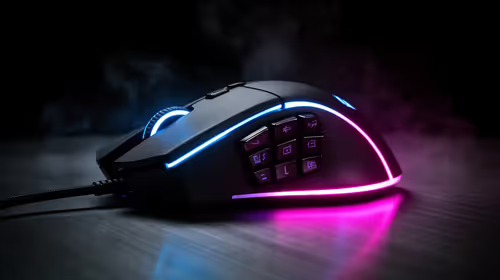
Real productivity numbers: Set up your wireless mouse in this order: everything that matters about wireless productivity mouse: DPI behaviour, channel switching, battery curves and per-app button mapping. Includes DPI tuning tips, channel switch shortcuts, and ZAR-aware
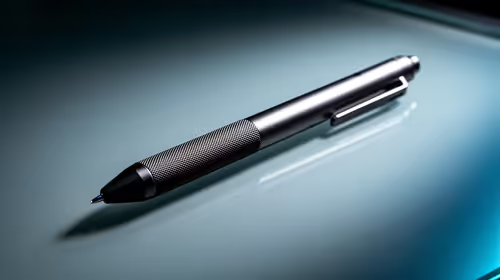
Pen not feeling like paper? Stylus lag and skipping usually trace to old drivers, dirty nibs, or display refresh mismatches, not the pen itself. Covers pressure curve tuning, tilt thresholds, nib swap timing, and SA pricing brackets.