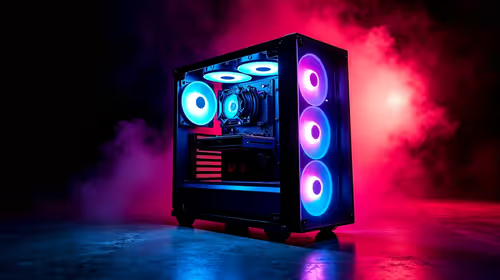
Is your gaming rig letting you down? That sudden frame drop in a firefight or a complete system crash during a boss battle isn't just frustrating; it can cost you the win. Often, the culprit is your processor. Before you start pricing new hardware, let's dive into how to troubleshoot gaming CPU issues. Whether you're running Team Red or Team Blue, these AMD and Intel-specific fixes will help you diagnose and solve those performance problems for good.
Diagnosing Common Gaming CPU Problems
Before you can apply a fix, you need to know the symptoms. The most common signs of CPU trouble during gaming include:
- Stuttering & Micro-Freezes: The game appears to hang for a split second, repeatedly.
- System Crashes & BSODs: Your PC suddenly reboots or shows the infamous Blue Screen of Death.
- Extreme Heat: Your PC case feels unusually hot, and fan noise is excessive.
- Performance Degradation: Games that used to run smoothly now feel sluggish and unresponsive.
These issues don't automatically mean your CPU is faulty. More often, they point to problems with cooling, power delivery, or software settings. Understanding the root cause is the first step in effective CPU troubleshooting.
Universal CPU Troubleshooting Steps 🔧
Regardless of your CPU's brand, some foundational checks apply to everyone. These steps solve a surprising number of performance hiccups.
Check Your Cooling System 🌡️
Heat is the number one enemy of performance. When a CPU gets too hot, it automatically reduces its speed (a process called thermal throttling) to protect itself, which kills your frame rate.
- Clean Your PC: Dust is an insulator. Open your case and carefully clean out dust from fans, heatsinks, and vents using compressed air.
- Check Thermal Paste: The paste between your CPU and its cooler can dry out over years. If your PC is over three years old, consider reapplying a fresh layer of quality thermal paste.
- Ensure Good Airflow: Are your case fans spinning correctly? Is there enough space around your PC for air to circulate?
A simple clean-up can make a world of difference, ensuring that today's powerful CPU processors have the thermal headroom they need to perform at their best.
Update Your Drivers and BIOS
Outdated software can cause bizarre stability issues. Make sure you have the latest chipset drivers from your motherboard manufacturer's website. A BIOS update can also improve memory compatibility and system stability, which is a crucial step when trying to fix CPU stuttering.
Check Your RAM's QVL ⚡
Before you suspect a faulty CPU, check your motherboard's support page for its Qualified Vendor List (QVL). This is a list of RAM kits tested and guaranteed to work with your board. Running RAM that isn't on the QVL can sometimes cause instability, especially when using high-speed profiles like XMP or EXPO.
AMD-Specific CPU Fixes for Gamers
Ryzen CPUs are fantastic for gaming, but they have their own quirks. If you're on Team Red, these AMD-specific CPU fixes can help you troubleshoot common issues.
A common issue is unstable memory overclocks. Ryzen processors, particularly on the AM5 platform, are very sensitive to RAM speed and timings. Ensure you have enabled the correct EXPO (for AM5) or XMP (for AM4) profile in your BIOS, but if you experience crashes, try running your RAM at a slightly lower frequency to test for stability. Sometimes, the issue isn't the processor itself, but the components it's communicating with. If you find your older chip is the bottleneck, exploring the latest AMD Ryzen CPUs might be the ultimate solution for a smoother experience.
Intel-Specific CPU Fixes for Gamers 🚀
Intel processors are known for their raw gaming power, but they can also be power-hungry beasts that require careful management.
Many modern Intel CPUs feature a mix of powerful Performance-cores (P-cores) and smaller Efficient-cores (E-cores). While brilliant for multitasking, some older games or anti-cheat software can get confused, leading to stuttering. A common Intel CPU fix is to use a tool like Process Lasso to ensure the game is prioritised on the P-cores. In extreme cases, you can disable E-cores in the BIOS as a temporary troubleshooting step. Also, be mindful of power limits; if your cooling can't keep up, the CPU will throttle. Ensuring your motherboard's power settings are appropriate for your cooler is key to unlocking the full potential of modern Intel CPUs.
When Is it Time for an Upgrade?
You've cleaned your PC, updated your drivers, and tweaked every setting... but the lag persists. Sometimes, the problem is simply that your CPU is a bottleneck for your GPU and modern games. If your processor is several generations old and frequently hits 100% usage while gaming, no amount of troubleshooting will fix the core issue. It might be time to invest in a new heart for your gaming rig.
Ready for a Rock-Solid Upgrade?
Sometimes the best fix is a fresh start. If you've exhausted your troubleshooting options, a new processor can provide the stable, high-performance foundation you need. Explore our massive range of CPUs and find the perfect chip to conquer your favourite games.