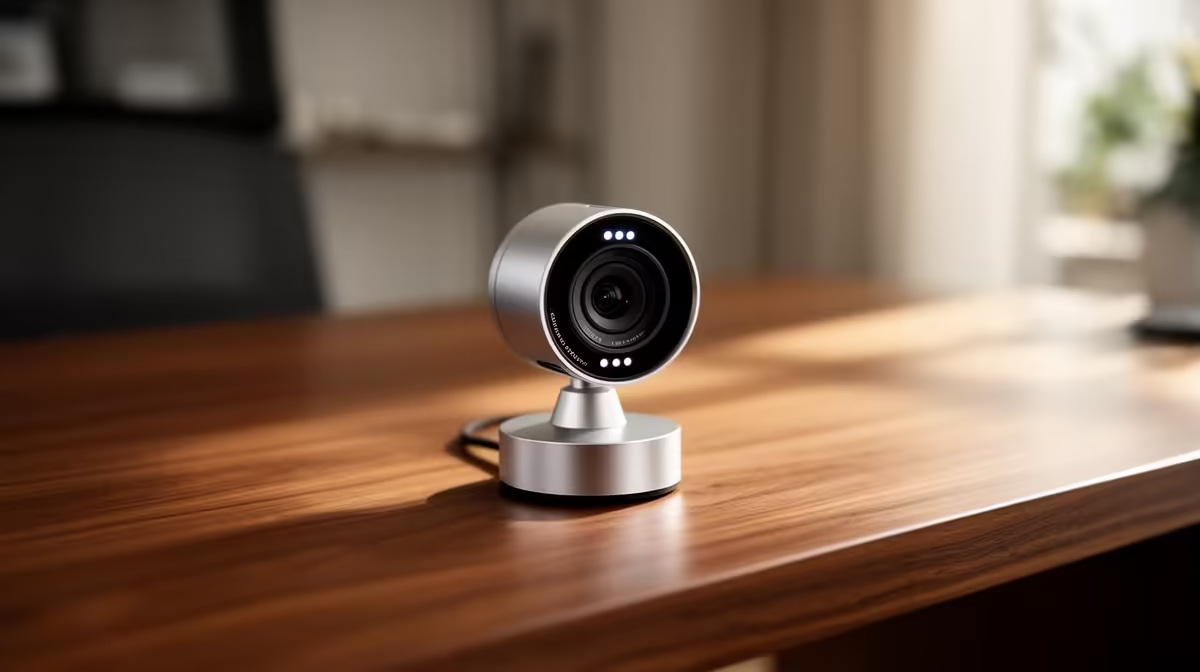
The 4K webcam market has done a remarkable job convincing remote workers that resolution is the main thing worth paying for. For most South African professionals on daily video calls, true autofocus 1080p webcams represent a smarter allocation of budget, and the technical argument for that is straightforward once you look at what the platforms actually do with your video.
Quick Answer
A true autofocus 1080p webcam is typically the best Rand-per-result buy for SA remote workers. Meeting platforms compress incoming video to around 720p, which means 4K detail is discarded before anyone sees it. A quality 1080p autofocus model in the R1,200 to R2,000 range delivers excellent call-ready sharpness without overpaying for resolution that disappears in transit.
🔆 What Meeting Platforms Do to Your Video Feed
Before spending money on resolution, it helps to know what happens to the video between your camera and your colleague's screen.
Platforms that handle large volumes of video calls process every incoming stream to manage bandwidth across their infrastructure. That processing includes downscaling. Even if your camera sends a crisp 1080p signal, the platform may display it to your viewer at 720p or below, depending on their connection quality, window size, and server load at that moment. Some platforms serve 1080p to viewers with fast connections and large windows, but the conditions for that to happen consistently are narrower than most people assume.
4K webcam footage undergoes two compression rounds in this scenario: the camera's own internal compression and the platform's transcoding. By the time it reaches the viewer, the advantage of four times the pixel count has been mostly erased. What remains visible, and what viewers actually respond to, is whether you look sharp and in focus in the frame, whether your lighting is even, and whether you move around without the image hunting and blurring.
That last point is where the autofocus question becomes the practical argument.
🎯 Why Autofocus Earns Its Premium More Than Resolution Does
A fixed-focus webcam sets its focal distance at the factory, typically calibrated for someone sitting about 60 to 80cm from the screen. That works for a rigid, perfectly-positioned setup. It stops working the moment you lean forward to look at something on your desk, turn to grab a document, or sit back in your chair.
True autofocus continuously reads the scene and adjusts the focus distance to keep the sharpest detail on your face. On a quality 1080p model, this happens quickly enough to be invisible: you move, the camera tracks, and the image stays sharp.
The difference between a R800 fixed-focus camera and a R1,500 autofocus model is visible on screen. The difference between a R1,500 autofocus 1080p model and a R3,500 4K autofocus model is, for most video call audiences, invisible. That is the core of the value argument.
What the Autofocus Mechanism Actually Does
Contrast-detection autofocus, which most webcams use, samples the sharpness of edges across the image and shifts focus until those edges are at their sharpest. Phase-detection systems, found on more expensive models, predict focus movement before measuring it, resulting in faster tracking with less hunting. For a seated remote worker who moves gradually, contrast detection is entirely adequate. For someone who frequently steps away from and back to the desk mid-call, phase detection removes the occasional soft-focus moment.
💰 Realistic Pricing in the South African Market
The R1,200 to R2,000 band in South Africa represents the sweet spot for autofocus 1080p webcams. Cameras in this range generally include:
- 1080p at either 30fps or 60fps depending on the model
- A built-in stereo or noise-filtering microphone as a fallback
- True continuous autofocus, not software-emulated sharpening
- A clip mount that sits securely on a monitor or laptop screen
- USB plug-and-play with no driver installation required
Below R1,000, autofocus claims become unreliable. Some budget models advertise autofocus but implement it as infrequent step adjustments rather than continuous tracking, which produces a noticeable focus lurch rather than smooth correction.
Above R2,500, you are typically paying for 4K capability, wide-field AI framing, or advanced low-light sensors. Those features are worthwhile in specific contexts, but the average home-office setup in Cape Town, Joburg, or Durban, with a reasonable desk lamp or ring light, does not need them to produce professional call quality.
Pro Tip ⚡
Before buying a higher-tier webcam, test your current setup with better lighting first. Adding a small LED key light at around R400 to R600 will improve your perceived sharpness and colour accuracy more than most resolution upgrades. Many SA remote workers discover their existing or entry-level webcam looks significantly better once the room lighting matches what the sensor needs.
🧠 Longevity and the Resolution Roadmap
A concern worth addressing directly: will 1080p feel outdated in a few years as 4K becomes the meeting standard?
The answer, realistically, is no in the near term. 1080p remains the standard delivery format for video conferencing on nearly every major platform. Widespread 4K call quality would require platform infrastructure investment, client hardware upgrades across millions of endpoints, and bandwidth norms that are not yet universal in South Africa. The upgrade cycle for that transition, even if it happens, is measured in years.
A quality autofocus 1080p webcam purchased now should remain the right tool for the job for at least four to five years. By that point, the market will have shifted again and pricing structures will look different. Buying a 4K model today to future-proof against a transition that may not affect SA connectivity norms for years is the opposite of a good Rand decision.
Frequently Asked Questions
Why does 1080p look as sharp as 4K on a video call?
Meeting platforms receive your video and re-encode it for delivery, which typically scales the feed down to 720p for most viewers. 4K input still undergoes this process, so the resolution advantage is compressed away before your colleague sees it. On-screen sharpness is determined more by autofocus accuracy, lighting quality, and the platform's compression settings than by the camera's native resolution.
What should I expect to pay for a reliable autofocus 1080p webcam in SA?
The R1,200 to R2,000 range consistently delivers genuine continuous autofocus with 1080p at 30fps or 60fps. Below R1,000 the autofocus mechanisms become inconsistent. Above R2,000 you begin paying for 4K sensors or AI framing features that add value primarily in specific production scenarios rather than everyday remote work.
How long will a 1080p autofocus webcam stay adequate for professional calls?
A quality 1080p autofocus model should remain fully suitable for at least four to five years. Video conferencing platforms have been using 1080p as their quality ceiling for years and are not close to rolling out universal 4K delivery. SA network infrastructure and typical home connection speeds further extend the timeline before 4K becomes a meaningful meeting standard locally.
Does autofocus actually matter if I sit at a fixed distance from my monitor?
Less so if you never move. But most people shift position throughout a working day, lean toward the screen, turn aside, or change posture. A fixed-focus camera calibrated for 70cm goes soft when you move to 40cm or 100cm from the lens. Autofocus absorbs that variation invisibly, which over a long work day is a meaningful quality-of-life difference.
Is the built-in mic on a 1080p autofocus webcam good enough for calls?
For background use as a fallback, yes. For primary audio on calls that matter, a dedicated USB microphone improves intelligibility noticeably, particularly in reverberant rooms. Most R1,500 to R2,000 webcams include a usable stereo microphone that handles casual calls, but a separate mic is worth considering if audio quality is equally important to video quality.
Ready to upgrade your remote work video without overpaying for resolution you cannot use?
Explore the autofocus webcam range at Evetech to find a 1080p model that keeps your calls sharp and your Rand on the right side of the value equation.