Quick Answer
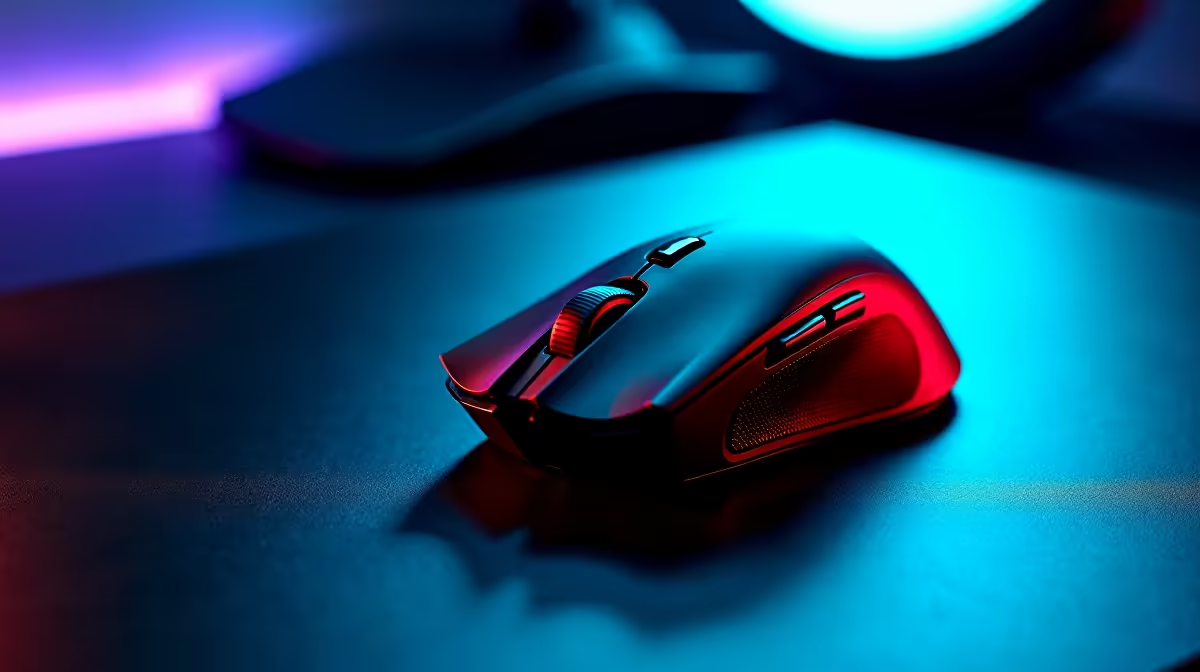
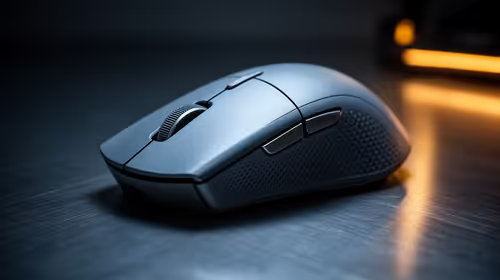
Ultra-lightweight wireless mice (under 70g) reduce wrist fatigue and allow faster flick shots, but standard wireless mice (80 to 120g) often offer better build quality, more buttons, and longer battery life. For everyday gaming that mixes FPS, RPG, and work use, a standard wireless mouse in the 90 to 110g range is more versatile; ultra-lightweight designs shine specifically in competitive FPS.
What Changes When You Drop Below 70 Grams 🎮
An ultra-lightweight mouse below 70g, such as the Razer Viper V3 HyperSpeed or Logitech G Pro X Superlight 2, lets your wrist muscles guide movement with less effort per swipe. This matters in extended FPS sessions: two hours of Valorant with a 60g mouse places substantially less cumulative load on the forearm than the same session with a 110g mouse. The reduced weight also allows faster direction changes, showing in crosshair micro-corrections and 180-degree flick shots. The trade-off is that lightweight mice frequently use thinner plastics and smaller batteries, resulting in less satisfying build feedback and shorter charge cycles, typically 50 to 70 hours versus 100 to 200 hours for denser standard designs.
What Standard Wireless Mice Still Do Better 🖥️
Standard wireless mice in the 90 to 120g range have physical space for larger battery cells and more robust switch housings. Models like the Logitech G502 X Plus or Razer Basilisk V3 HyperSpeed include programmable side buttons, scroll wheel resistance adjustment, and textured grips that an ultra-lightweight design cannot accommodate without adding weight. For SA gamers who use the same mouse for work spreadsheets, MMO gaming, and competitive FPS in the same day, the extra buttons and grip security of a standard mouse reduce fatigue from grip adaptation. Heavier mice also feel more stable during rapid repositioning, which some players prefer in MOBA and RTS titles where precision over large surfaces matters more than raw flick speed.
Which to Choose Based on Your Gaming Pattern ⚙️
Choose ultra-lightweight if your primary genre is competitive FPS or battle royale, you play for more than two hours per session, and you use a mousepad of 30 cm or larger. Choose a standard wireless mouse if you play across multiple genres, need programmable side buttons, or use your mouse for extended daily work. SA pricing puts quality ultra-lightweight wireless mice at R1,200 to R2,500 and capable standard wireless options at R700 to R2,000. For competitive university esports players at institutions like Wits or UCT, the lightweight advantage is worth the premium if the primary game is FPS.
Test Your Grip Style Before Buying ⚡
Ultra-lightweight mice suit claw or fingertip grip, where the palm does not rest on the mouse body. If you use a full palm grip, a lightweight design may feel unstable. Match the mouse weight to your grip style, not just the marketing around competitive advantages.
FAQ
Will an ultra-lightweight mouse improve my aim?
It can improve your ability to execute fast, precise movements, but it will not compensate for poor tracking fundamentals. Players with consistent aim mechanics benefit noticeably; beginners are unlikely to see an immediate improvement from weight reduction alone.
Do lightweight mice have weaker sensors than standard mice?
No. Current-generation lightweight mice use the same sensors as full-weight flagships. The Razer Viper V3 HyperSpeed uses the Focus Pro 30K sensor regardless of the mouse body weight.
What is a good entry-point ultra-lightweight mouse for SA buyers?
The Razer Viper V3 HyperSpeed is one of the most accessible ultra-lightweight options currently stocked at Evetech, offering HyperSpeed wireless, a 59g weight, and reliable performance at a price under R1,500.
Not sure which weight class suits you?
Browse lightweight and standard wireless gaming mice at Evetech to compare weight, sensor specs, and battery life before deciding.