Quick Answer
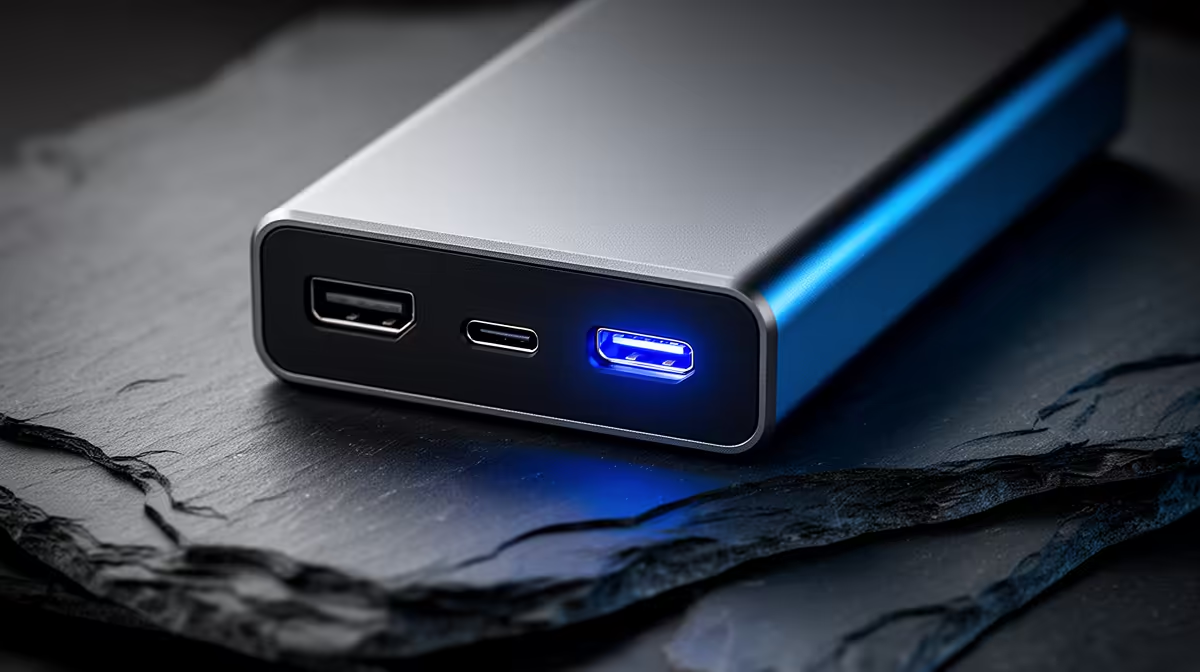
For external storage, USB 10Gbps Type-C (USB 3.2 Gen 2) is up to twice as fast as a standard USB 3.0 Type-A port at 5Gbps, and up to twenty times faster than USB 2.0. Copying a 100GB folder from a portable NVMe SSD takes roughly 90 seconds at 10Gbps versus three minutes at 5Gbps. If you regularly move large files, the front-panel 10Gbps port matters significantly.
The Real Speed Gap in Practical Storage Transfers 📊
USB 2.0 at 480Mbps delivers around 40 to 55MB/s real throughput. USB 3.0 or 3.2 Gen 1 at 5Gbps delivers 400 to 450MB/s. USB 3.2 Gen 2 at 10Gbps delivers 900 to 1,050MB/s on a compatible NVMe enclosure. A Samsung T7 Shield portable SSD, rated at 1,050MB/s sequential read, consistently achieves those speeds on a 10Gbps Type-C port and is throttled to around 450MB/s on a 5Gbps port regardless of connector type. For a South African content creator archiving 4K footage, the difference between a 5Gbps and 10Gbps front port turns a 20-minute file transfer into an 8-minute one per 200GB of data.
When the Standard USB Type-A Port Is Adequate 🖱️
For the majority of daily peripheral use, a standard USB 3.0 Type-A port at 5Gbps is entirely sufficient. USB flash drives typically max out at 150 to 300MB/s, well within the 5Gbps envelope. Wired mice, keyboards, USB headsets, and phone charging all operate far below 5Gbps and see no benefit from a faster port. Backing up a phone over USB tops out around 50MB/s due to smartphone storage speeds, making the 5Gbps versus 10Gbps distinction irrelevant for that use case. The 10Gbps port pays off specifically when the connected device can sustain above 450MB/s: NVMe portable drives, CFexpress card readers, and high-end USB capture cards.
Choosing a Case Based on Your Storage Workflow 🎯
Builders who only connect thumb drives and charge phones do not need a 10Gbps Type-C front port and should not pay a premium for it. Builders who regularly transfer large video projects or move 100GB or more per session should prioritise a case with a USB 3.2 Gen 2 front port. In the SA market, cases with this port are available from R1,800 to R8,000, and it is now common in the R2,500 to R5,000 bracket. Check that the motherboard in your build has a matching USB 3.2 Gen 2 Type-C internal header before treating the case spec as a guarantee.
Match the Drive to the Port Generation ⚡
A 10Gbps Type-C front port only delivers its speed advantage when the connected drive also supports USB 3.2 Gen 2. Connecting a USB 3.0-rated external hard drive to a Gen 2 port does not speed up the drive; it runs at the drive's own rated speed. Before assuming a transfer is slow because of the case port, verify that the portable drive is rated for 900MB s or above.
FAQ
Does the cable between the device and the front panel affect speed?
Yes. A USB cable rated for USB 3.2 Gen 2 (labelled with a 10Gbps speed icon) is required to achieve 10Gbps throughput. Using an older USB 3.0 cable on a Gen 2 port drops the link to 5Gbps. Most quality portable SSDs include a Gen 2 rated cable in the box.
Is a USB-C port the same speed regardless of which side it connects on?
The connection speed is determined by the port the cable is plugged into. A USB-C to USB-A cable connecting to a USB 3.0 Type-A port is limited to 5Gbps regardless of the USB-C port's rating. For full 10Gbps speeds, both the front panel port and the device port must be Gen 2 rated.
Should I use the front panel or rear panel 10Gbps port for fastest speeds?
Rear panel ports connect directly to the motherboard's USB controller without the intermediate header cable, so they often outperform front-panel header implementations. For the fastest possible transfer, use a rear panel port; use the front panel port for convenient regular-use transfers.
Looking to maximise external storage speeds from your PC?
Evetech stocks portable NVMe SSDs and gaming cases with USB 3.2 Gen 2 front panels, so you can pair the right enclosure with the right case connectivity. Browse storage and cases at Evetech.