




IPS vs VA for Strategy and Sim Games in SA
IPS vs VA for strategy and sim games should be judged by fit, not a single winner. Compare compatibility, latency, capacity, upgrade path, cost planning, and South African setup needs.
Read moreStandard PD picks from a short list of fixed voltages; PPS slides between them to suit the battery. The phones that gain most implement PPS and run large batteries, because heat is what limits their charging rate. Both live on the same 30W port, at R349.
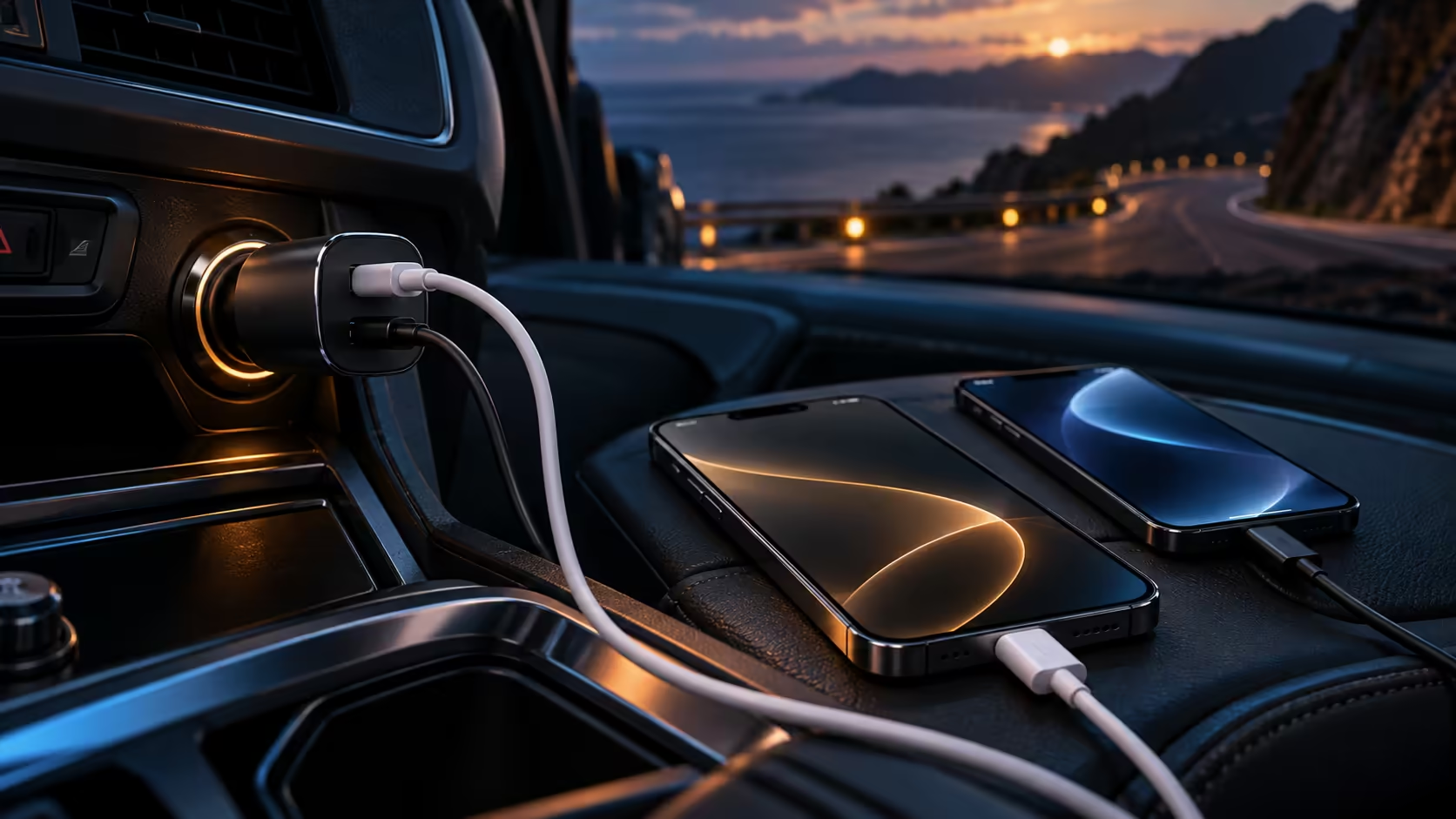
USB-C PPS charging and standard fixed-voltage PD are not competing technologies fighting for the same phone. They are two tiers of the same protocol, and which one a specific phone actually benefits from depends heavily on how that phone is built, not on which charger it happens to plug into.
Standard PD offers a short list of fixed voltages, 5V, 9V, 15V or 20V, and a phone picks the closest match from that menu. A PPS session instead tracks the battery continuously, nudging the supply in 20mV steps as conditions change through the charge. Big-battery phones chasing aggressive fast-charging numbers gain the most from that, because heat rather than raw wattage is usually what actually holds them back. Both modes share the same 30W USB-C port on Anker's R349 two-port charger; which one runs is entirely down to what the connected phone asks for.
Standard PD's fixed rungs are a reasonable approximation most of the time, but an approximation nonetheless. A battery that ideally wants 4.35V at a given moment still gets whatever the nearest PD rung supplies after the phone's own converter steps it down, and that gap between requested and ideal becomes heat inside the phone.
PPS removes the approximation. Instead of picking the nearest of a handful of options, a PPS-capable phone asks for something much closer to what its battery wants right then, and the charger adjusts to match. The wattage ceiling does not change between the two modes; what changes is how precisely the supply tracks what the phone is actually asking for moment to moment.
A phone's own charging chip decides whether PPS gets used at all, so the benefit is not universal across every device that touches a PPS-capable port. Phones designed around fast, high-wattage charging targets, often with larger batteries specifically, tend to implement PPS because the heat generated during aggressive charging is otherwise the practical ceiling on how fast they can safely go.
A phone with a smaller battery or a more modest charging target has less to gain, since the heat problem PPS solves is smaller to begin with on that kind of device. It is not a case of PPS phones being superior generally; it is that PPS solves a specific problem that only shows up meaningfully on certain kinds of phones. A smartwatch sharing the socket makes the point well, since its own draw sits so far under either mode's ceiling that the fine voltage matching has almost nothing to do.
The difference between standard PD and PPS is hardest to notice on a short, cool session and clearest on a long, warm one. A quick top-up during a five-minute errand rarely runs hot enough on either mode for the difference to matter. A sustained fast charge during a hot, multi-hour drive is where the two modes actually diverge, since PPS keeps the phone that bit further from the point where it would otherwise start capping its own rate to stay safe.
That timing detail is worth knowing before assuming PPS makes every charge noticeably better; its advantage is real but concentrated in specific, demanding conditions rather than spread evenly across every session. Anyone standardising on Apple gear in the car can check the Apple accessories range separately, since PPS support there follows the same model-by-model pattern as everywhere else.
Not necessarily slower in raw speed, since both can reach the same wattage ceiling. The difference shows up mainly as heat, not top speed.
No. PPS activation depends entirely on the phone's own charging chip requesting it; a charger cannot impose it on a device that never asks.
It is an addition on top of standard PD, not a replacement. A PPS-capable charger still falls back to fixed-voltage PD for any device that does not request the programmable mode.
Less so than on a longer, hotter session, since the heat-reduction benefit compounds over time and starting temperature.
If anything the opposite tends to hold: a cooler session is generally easier on a lithium-ion cell over the long run than an equally fast but hotter one would be.
Some phones surface a fast-charging indicator in their battery settings without naming the specific protocol behind it, which makes PPS harder to confirm directly from the screen alone. A more reliable sign, though not a scientific one, is a phone that runs 2 or 3 degrees cooler to the touch partway through a fast charge compared with how the same phone feels on an older, fixed-voltage charger at a similar point in the session.
Manufacturer specification pages are the more definitive source, usually listing supported charging protocols explicitly for a given model, including whether PPS is part of that list. Checking there before assuming a phone benefits from a PPS-capable port avoids the common mistake of crediting the charger for a difference the phone's own hardware was never built to produce.
Yes. Power sharing operates on the total current the converter can produce, independent of which negotiation mode either port is running, so both PPS sessions still divide the same underlying budget once both ports are active together.
Not for a properly protected charger. Whatever the supply is doing gets smoothed out by the protection circuitry before it ever reaches the negotiation stage, so both standard PD and PPS work from a clean, steady interface throughout.
For anyone doing long, hot drives regularly, checking a phone's own specification page for PPS support is a reasonable part of the decision, alongside battery size and general charging speed claims.
Ready to charge a phone the way it was actually designed to be charged? Take a look at the car charger range for a port that supports both standard PD and PPS.
Not necessarily slower in raw speed, since both can reach the same wattage ceiling. The difference shows up mainly as heat, not top speed.
No. PPS activation depends entirely on the phone's own charging chip requesting it; a charger cannot impose it on a device that never asks.
It is an addition on top of standard PD, not a replacement. A PPS-capable charger still falls back to fixed-voltage PD for any device that does not request the programmable mode.
Less so than on a longer, hotter session, since the heat-reduction benefit compounds over time and starting temperature.
If anything the opposite tends to hold: a cooler session is generally easier on a lithium-ion cell over the long run than an equally fast but hotter one would be.
IPS vs VA for strategy and sim games should be judged by fit, not a single winner. Compare compatibility, latency, capacity, upgrade path, cost planning, and South African setup needs.
Read more
Gen 5 NVMe SSD guide for Bloemfontein gamers should be shortlisted around the job it must do. South African buyers should compare capacity, speed, thermals, and motherboard support, warranty path, and upgrade room before treating any pick as best.
Read more
Skip the RTX 5070 if your first-time builder budget needs better balance. Better SA picks can free room for the right CPU, PSU, case, monitor, storage, and cooling while still giving a strong first gaming PC experience this year in South Africa.
Read more
RTX 5080: weighing the pros and cons for SA should be shortlisted around the job it must do. South African buyers should compare GPU tier, VRAM, cooling, and PSU headroom, warranty path, and upgrade room before treating any pick as best.
Read more
Core i5-13400F gives South African PC builders a capable mid-range CPU choice with clear limits. Check its gaming fit, discrete GPU requirement, LGA1700 platform costs, and upgrade path before locking in your parts list.
Read more
Pros and cons of the Wi-Fi 7 routers for SA should be shortlisted around the job it must do. South African buyers should compare WiFi standard, coverage, latency, and device support, warranty path, and upgrade room before treating any pick as best.
Read more
Steam content servers unreachable needs a download-path check, not an immediate reinstall of every game. Restart the client, inspect download settings and compare another connection when practical. Clearing the download cache is separate from deleting installed games.

Keychron G6 HE has built-in and swappable battery versions with different weights. The product brief lists 42g and 46g respectively, each with a 3g tolerance. Choose by grip and battery preference before treating one headline weight as universal.

Corsair HS80 v2 MAX supports 2.4GHz wireless and Bluetooth. Its maximum battery figures use RGB-off conditions and differ by connection. Check microphone routing, comfort and the exact device support before assuming every wireless mode behaves alike.

Windows taskbar notification badges can be shown or hidden in Taskbar behaviours. This changes the small app indicators, not the underlying messages. Choose a calmer desktop while keeping a deliberate routine for checking important conversations and app updates.
Windows taskbar notification badges can be shown or hidden in Taskbar behaviours. This changes the small app indicators, not the underlying messages. Choose a calmer desktop while keeping a deliberate routine for checking important conversations and app updates.

Windows USB device in use can mean a program still has the drive open. Finish transfers and close files before retrying ejection. Better performance caching requires safe removal; a replacement drive is not the first fix for an open-file warning.

Windows Nearby Sharing not working starts with feature, Bluetooth and visibility checks on both PCs. My devices only depends on matching Microsoft accounts. Test a small harmless file before buying networking hardware or changing your home router.

Windows hardware reserved RAM is different from memory used by applications. Compare installed memory with firmware detection and the usable amount before buying modules. Reservations and reporting limits vary by system; no universal setting restores every byte.

Windows title bar window shake can minimise other open windows when you shake the active window by its title bar. Inspect the Multitasking setting and switch it off if that gesture interrupts your work. The preference costs R0 and does not require new hardware.

Windows Print Screen opens Snipping Tool when its keyboard preference is enabled. Change the option under Accessibility, Keyboard to choose another workflow. Test whether you need a clipboard image or a saved file.

Windows desktop icons missing may be a visibility setting. Right-click the desktop, choose View and inspect Show desktop icons. If only system icons are absent, use Desktop icon settings. Check the Desktop folder before assuming files were deleted.

Windows set time zone automatically greyed out calls for a location and device-policy check. Automatic time-zone selection relies on location services. A manual time-zone choice is separate from synchronising the clock; check both before replacing hardware.