Quick Answer
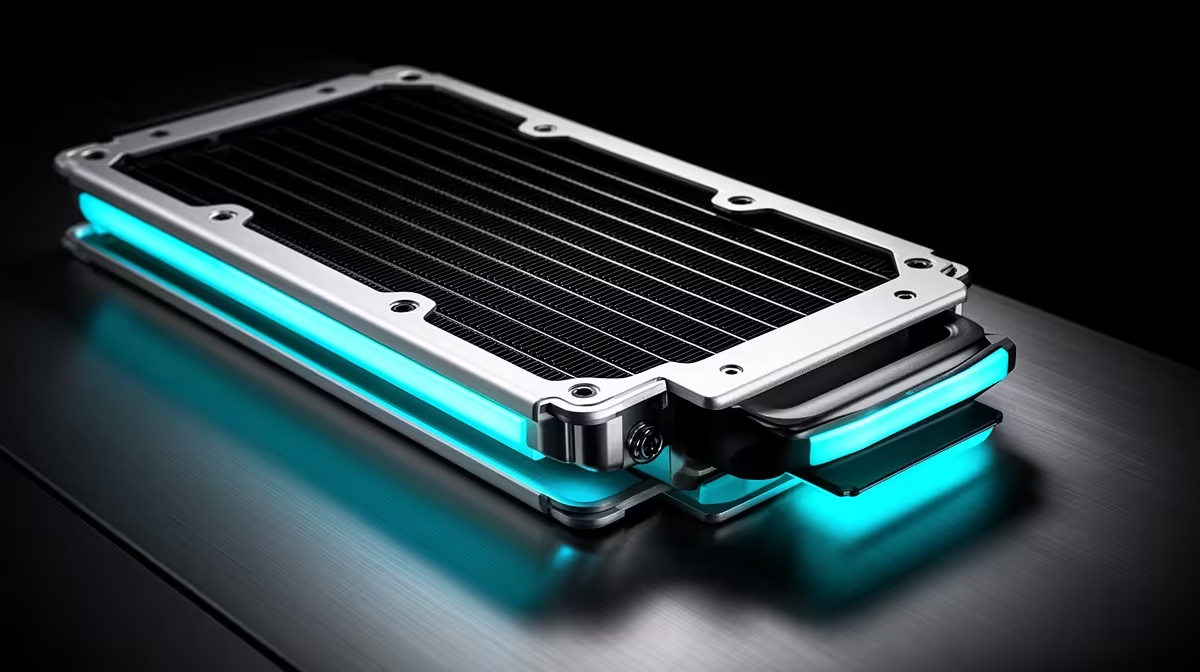
A 360mm AIO liquid cooler should keep your CPU under 85 degrees Celsius during sustained gaming loads, and under 90 degrees Celsius during full stress tests. For modern chips like the Ryzen 7 9700X or Core i7-14700K, real-world gaming temps of 65 to 78 degrees are typical on a quality 360mm unit with decent airflow.
What Temperature Ranges to Expect by Workload 🌡️
Idle temperatures on a well-seated 360mm AIO generally sit between 28 and 40 degrees Celsius depending on ambient room temperature. South African rooms in summer (Gauteng can hit 35 degrees ambient indoors without air conditioning) raise that idle baseline noticeably compared to what international reviewers measure in climate-controlled environments. Under gaming loads at 1080p or 1440p, a Ryzen 7 9700X pulling around 65W to 88W will typically sit between 60 and 75 degrees on a quality 360mm cooler. During long Blender renders or Prime95 stress tests where the chip sustains 125W-plus, expect 80 to 90 degrees. Anything consistently above 95 degrees suggests poor mounting pressure, insufficient case airflow, or pump failure.
Why TDP Matters More Than the CPU Brand 🔧
The relevant figure is not whether you have an AMD or Intel chip, but the sustained package power draw. A Ryzen 9 9950X running all-core workloads can sustain 170W, while a Core i9-14900K under Cinebench R24 can spike past 250W before power limits kick in. A 360mm AIO handles the 9950X comfortably in most scenarios, keeping it in the 75 to 88 degree range. The 14900K at full unlimited power requires careful case airflow pairing to stay under 90 degrees on the same cooler. LGA 1851 processors like the Core Ultra 9 285K are more efficient per watt and respond even better to 360mm cooling, often staying below 80 degrees under gaming.
Pump Speed, Fan Curve and Case Setup 🖥️
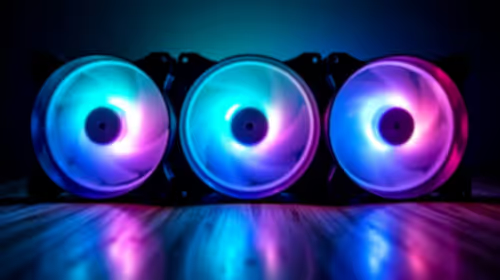
A 360mm AIO delivers its full temperature benefit only when the pump runs at least 70 percent speed and the three radiator fans are set to a sensible curve above 900 RPM under load. Many South African builders set fans to near-silent profiles and wonder why temps creep up. The other critical variable is case airflow: two intake fans at the front and one exhaust at the rear, with the radiator mounted as a top exhaust, is the most effective layout for a mid-tower. Avoid mounting the radiator as a front intake when using a sealed case, as recycled warm air from the radiator can heat other components.
Re-Paste Every Two Years ⚡
Thermal paste between the CPU IHS and the AIO cold plate degrades over time, especially in warm SA climates. Re-applying a quality paste like Thermal Grizzly Kryonaut every 18 to 24 months can recover 5 to 10 degrees on chips that have drifted hotter than usual.
FAQ
What is the thermal limit I should never cross?
AMD's Ryzen 7000 and 9000 series have a maximum junction temperature (Tj Max) of 95 degrees Celsius. Intel's 14th-gen chips list 100 degrees as their limit. Sustained operation above these points triggers thermal throttling, reducing clock speeds and lowering performance in games.
Does a 360mm AIO cool better than a 240mm in hot SA rooms?
Yes, meaningfully so. The extra radiator surface area gives the 360mm unit roughly 30 to 40 percent more thermal dissipation capacity, which translates to 5 to 12 degrees lower CPU temps under sustained load depending on the specific chip and case.
Should I set my AIO pump to full speed all the time?
Running the pump at full speed 100 percent of the time is not necessary and adds audible noise. A pump speed of 70 to 80 percent is quieter and keeps the coolant circulating fast enough for full heat transfer efficiency. Reserve full pump speed for dedicated performance profiles during benchmarks or intensive renders.
Want reliable CPU temps in your gaming build?
Check out the 360mm AIO liquid cooler range at Evetech to find a unit sized for your CPU's heat output and your case's radiator slot.