Quick Answer
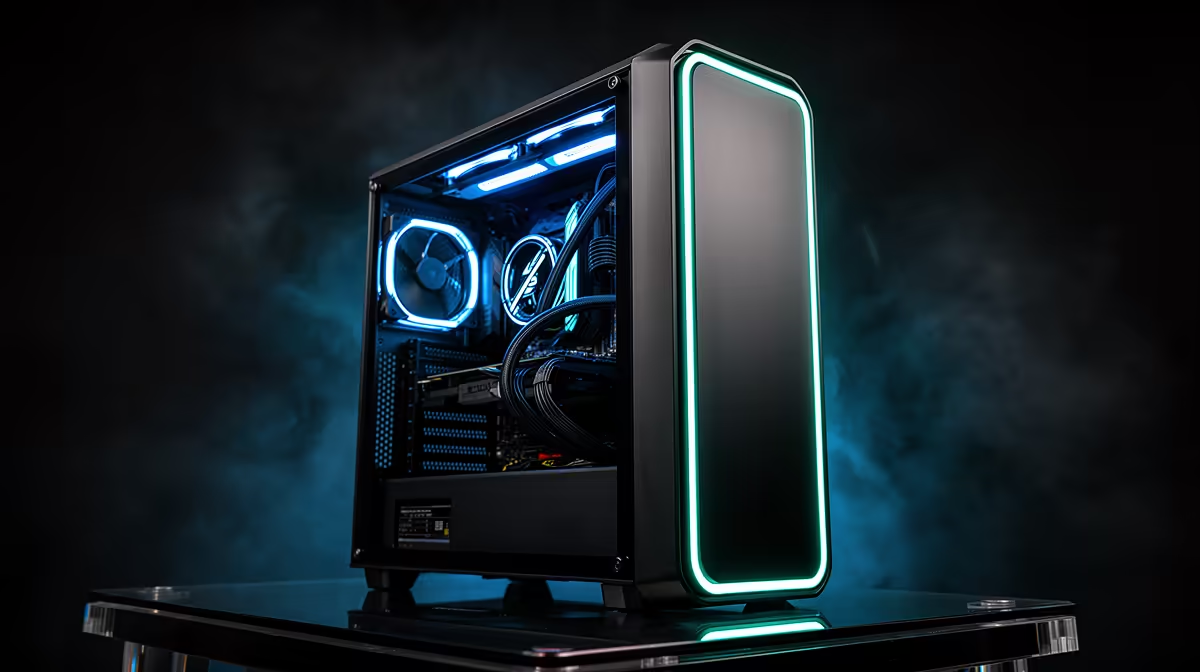
Before buying an E-ATX gaming case, verify seven things: confirmed E-ATX board support in millimetres (not just the label), GPU length clearance with the motherboard installed, 420mm radiator support, PSU basement length, storage bay count, cable routing grommet positions relative to your board's connectors, and local warranty availability.
Why E-ATX Cases Require Extra Research 📐
E-ATX is not a single standard. Boards range from 305mm x 277mm (slightly wider than ATX) to 305mm x 330mm (full E-ATX width). A case listing E-ATX support may only accommodate the narrower 277mm variant, not the full 330mm used by ASUS ROG Maximus or GIGABYTE AORUS Xtreme. Before purchasing, find the actual maximum motherboard dimensions in millimetres from the case spec sheet and compare to your board's dimensions. E-ATX cases with full 330mm width support typically call this out explicitly. These range from R3,500 to R8,000 at Evetech.
GPU and Radiator Clearances Are Not Guaranteed 🔧
E-ATX cases are large, but this does not mean unlimited internal clearance. Some designs sacrifice GPU length clearance to accommodate front radiator depth. Check the spec sheet for GPU maximum length with the front radiator installed (not just empty case clearance). Confirm the case supports your radiator size at both front and top simultaneously if planning a dual-radiator loop. Drive bay placement can interfere with front radiator length: many cases only achieve full radiator length after removing two or three 3.5-inch drive bays. If you need large HDD storage arrays, verify that the bays you need are not the ones the radiator occupies.
Build Quality and Weight Considerations 🏗️
Full-tower E-ATX cases weigh 12 to 18kg fully loaded. Ensure your desk or rack can support the weight. Panel thickness matters: look for 1.0mm to 1.2mm steel rather than 0.8mm. Tempered glass panels should be 4mm thick minimum; thinner glass vibrates audibly from fan resonance. Premium cases use silicone gaskets or rubber washers at glass mounting points, which damp vibration better than direct metal contact. Check whether the front mesh is removable for cleaning and whether dust filters are accessible without opening the side panel.
Download the Case Manual Before Buying ⚡
Most PC case manufacturers post full installation manuals online as PDFs. Download the manual for any E-ATX case you are considering and scan the exploded-view diagrams. This reveals real-world clearances and hidden limitations like drive bays that block radiator length. SA buyers sometimes receive a case and discover E-ATX support requires removing a bracket not mentioned in marketing copy.
FAQ
Does an E-ATX case need a special PSU?
No. E-ATX cases use standard ATX PSUs. However, very large cases sometimes require PSU cable extensions to reach motherboard connectors. Check the stated maximum PSU length for the basement compartment (most support 220 to 250mm) and confirm your PSU fits.
Are E-ATX cases compatible with micro-ATX or ITX motherboards?
Generally yes, via included standoff positions. However, the resulting build looks aesthetically sparse in a large case, and cable lengths designed for full-board positions can be awkward for smaller boards.
What brands have the best E-ATX case availability in South Africa?
Phanteks, Lian Li, and Corsair have the most consistent E-ATX stock through SA distributors. These brands have established local warranty service paths, which matters when a premium case develops a manufacturing defect. Evetech carries all three in the E-ATX segment.
Ready to spec out an E-ATX build?
Evetech carries a curated selection of full E-ATX cases from Phanteks, Lian Li, and Corsair, with product specialists who can confirm motherboard fitment for your specific board dimensions.