Quick Answer
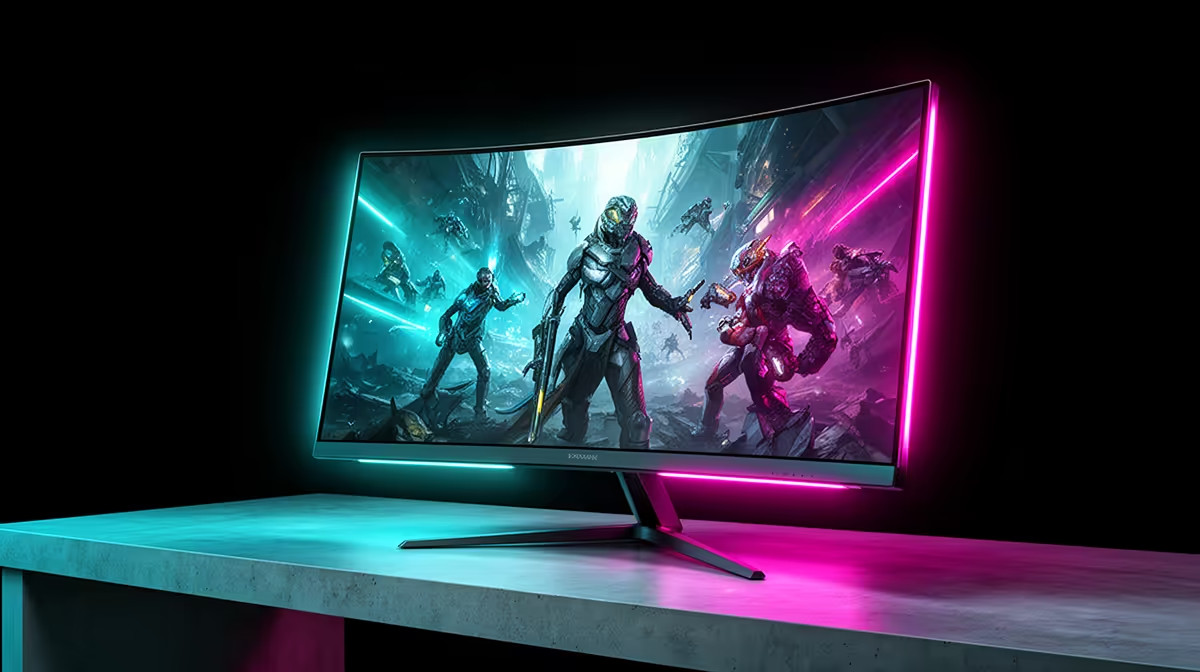
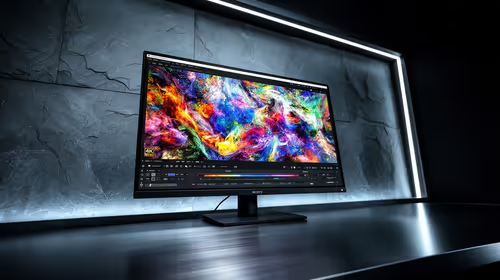
Before upgrading to a 4K 240Hz OLED in South Africa, know that an RTX 5080 or 5090 class GPU is needed to sustain 4K at high frame rates with frame generation, the monitor will cost R18,000 to R25,000 at current rand pricing, and local warranty support varies significantly between brands. The upgrade delivers a transformative visual experience but demands a proportionate GPU investment to realise its full potential.
GPU Reality Check for 4K 240Hz 🔧
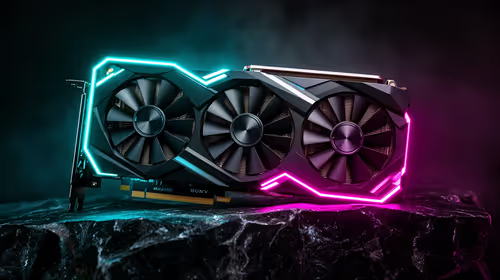
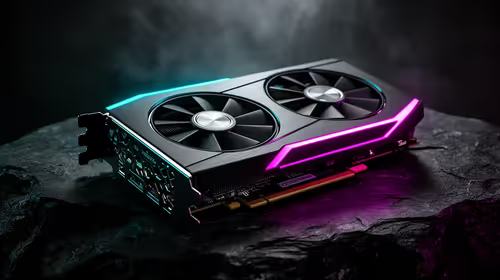
At native 4K without upscaling, sustaining 240fps in modern triple-A titles is beyond even an RTX 5090 in heavy scenes with path tracing. With DLSS 4 Quality mode and Multi Frame Generation, an RTX 5080 achieves 180 to 240fps at 4K in most current games. The RTX 5070 Ti manages 100 to 160fps at 4K in similar conditions. The RX 9070 XT from AMD competes at 4K with FSR 3 enabled and costs less than the RTX 5080, currently in the R14,000 to R18,000 range at Evetech. Pairing a 4K 240Hz OLED with a GPU below this tier means primarily using QHD mode or running 4K below 120fps in most titles.
Understanding SA-Specific Upgrade Costs 💰
The total cost of a 4K 240Hz OLED upgrade includes more than the monitor price. The panel costs R18,000 to R25,000. A DisplayPort 2.1 cable adds R300 to R700. If your GPU does not meet the performance threshold, that upgrade is the largest line item, potentially pushing combined spend to R40,000 to R55,000. Factor in PSU adequacy: an RTX 5080 recommends a 750W to 850W PSU. If yours is older than three years at lower wattage, it may need replacing. These downstream costs are easy to overlook when the monitor is the focal point of the upgrade decision.
What You Actually Gain and When It Shows 🎮
The upgrade is most impactful for single-player story games: Black Myth: Wukong, Final Fantasy VII Rebirth and Horizon Forbidden West look dramatically different on a 4K OLED compared to a 1440p IPS. Infinite contrast, wide colour gamut and 4K texture resolution combine for an image quality that is genuinely distinct. For competitive titles like CS2 or Valorant, the 240Hz refresh advantage is real but the 4K resolution benefit is less significant. Some top competitive players prefer 1440p at maximum frame rates for lower system latency. A mixed game library makes the 4K 240Hz OLED an excellent all-rounder, provided the GPU supports it.
Enable Dual-Mode Before Your First Gaming Session ⚡
Many 4K 240Hz OLED monitors include a dual-mode that switches to QHD 480Hz for competitive sessions. Set this up before gaming and assign a hotkey in the OSD. Switching between 4K for story games and QHD mode for multiplayer is a two-second change that maximises the monitor's versatility without adjusting GPU settings each time.
FAQ
Does a 4K 240Hz OLED work at lower resolutions and refresh rates on older hardware?
Yes. You can run the monitor at 1080p or 1440p and at 60Hz to 144Hz if your GPU cannot sustain higher settings. OLED panel quality remains excellent at any resolution, and you can upgrade the GPU later without replacing the monitor.
Is burn-in a practical concern for South African gamers using 4K OLED daily?
For most gaming use with varied content, burn-in during a two-to-three year warranty period is very unlikely on current-generation OLED panels. Risk increases with static elements: always-on HUDs and leaving a paused game on screen. The panel's built-in screen saver timer and weekly pixel refresh cycle mitigates this substantially.
How long will a R20,000-plus OLED monitor remain relevant for gaming in SA?
A current-generation 4K 240Hz OLED purchased today should remain at or near the display performance frontier for four to six years. Monitor technology advances more slowly than GPUs, making the panel investment longer-lived than the GPU pairing it.
Ready to make an informed 4K OLED upgrade decision?
Evetech stocks 4K OLED gaming monitors alongside compatible GPUs and accessories. Visit the monitors and GPU sections at Evetech to compare pricing and plan a complete upgrade path.