Quick Answer
For a ZAR-based custom build, prioritise ATX 3.1 compliance and transient load tolerance first, followed by 80 Plus Gold efficiency, then capacitor quality, then full modularity, and finally local warranty support. Getting the first two wrong causes hardware instability; getting the last two wrong mainly affects convenience and long-term cost.
Priority One: ATX 3.1 Compliance 🔧
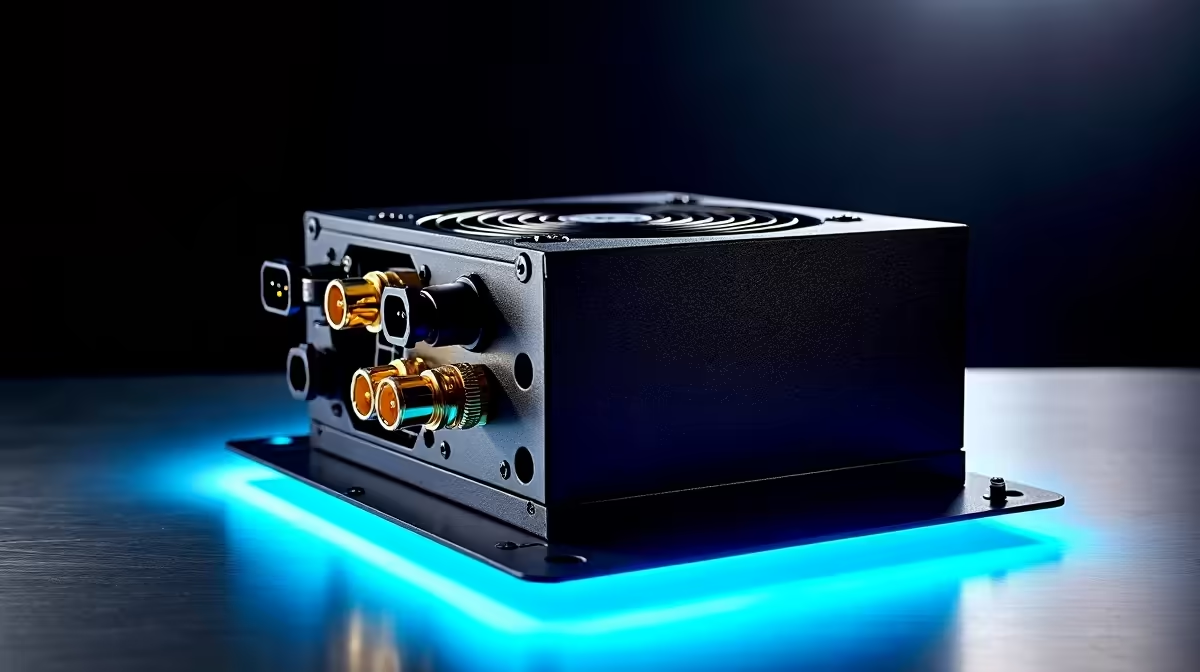
ATX 3.1 compliance is the non-negotiable starting point for any 1200W PSU destined for an RTX 5000-series or RX 9000-series GPU. The specification requires the unit to handle 200 percent of rated 12V current for up to 100 microseconds without triggering overcurrent protection. An RTX 5090 paired with a Ryzen 9 9950X regularly produces transient spikes exceeding 1,000W for fractions of a second during scene transitions. A non-compliant PSU responds with a protection cutoff, crashing the system. Confirming ATX 3.1 compliance narrows the field to units that will actually run the intended hardware without instability. Locally, ATX 3.1 compliant 1200W units start from around R3,800 and extend to R6,500, with the R4,500 to R5,500 segment offering the best full-specification value at Evetech.
Priority Two: Efficiency and Capacitor Grade 🖥️
Once ATX 3.1 compliance is confirmed, 80 Plus Gold efficiency is the next filter. At 90 percent efficiency at 50 percent load, a Gold unit wastes roughly 66W as heat at 600W delivered, compared to around 90W for a Bronze unit. In a South African gaming room at 32 to 35 degrees ambient in summer, 24W less internal PSU heat is a genuine thermal benefit. Within the Gold tier, capacitor grade separates durable units from merely certified ones. Japanese 105-degree-rated capacitors from manufacturers like Nippon Chemi-Con or Nichicon provide a two-to-five-times longer baseline lifespan than standard 85-degree caps at equivalent operating temperatures. For a 1200W build expected to last seven or more years in SA conditions, this specification is worth confirming in product documentation before purchase.
Run a Wattage Calculation Before Committing ⚡
finalising your 1200W PSU purchase, use a system power calculator to estimate your build's actual sustained draw: input CPU TDP, GPU TDP, RAM count, SSD count, and fan count. If the result is below 900W sustained, a 1000W Gold unit with equivalent specifications saves R400 to R800 while providing the same transient headroom. Only choose 1200W if sustained draw exceeds 850W or future GPU upgrades within the build's life are planned.
FAQ
Does cable quality matter as much as PSU internal quality for a 1200W build?
Cable quality matters at high current. The 12V-2x6 cable for the GPU carries 50 amps or more at peak load. Thin gauge cables heat up and increase voltage drop at the connector. Quality PSUs include 16AWG or better cabling on GPU and ATX connectors. Confirm the cable gauge in the accessory specification when building at 1200W capacity.
How many PCIe power connectors should a 1200W PSU include?
Consumer motherboards support a single primary GPU slot. Most 1200W PSUs ship with one or two 12V-2x6 or PCIe cable sets. For consumer builds, two 12V-2x6 cables provide sufficient headroom for a single GPU at maximum draw without cable stacking.
Should I buy the 1200W unit now or wait for local pricing to improve?
If your build is ready and the current price sits within R500 of a recent low, purchasing now avoids compatibility uncertainty from waiting. If local pricing has spiked more than R1,000 above recent norms, watching for the next stock cycle at Evetech often yields better value within four to eight weeks.
Configuring a ZAR custom build and need the right PSU?
Evetech stocks ATX 3.1 compliant 1200W power supplies with full modular cabling and local warranty support. Browse the power supply category to match specs to your build requirements.