Quick Answer
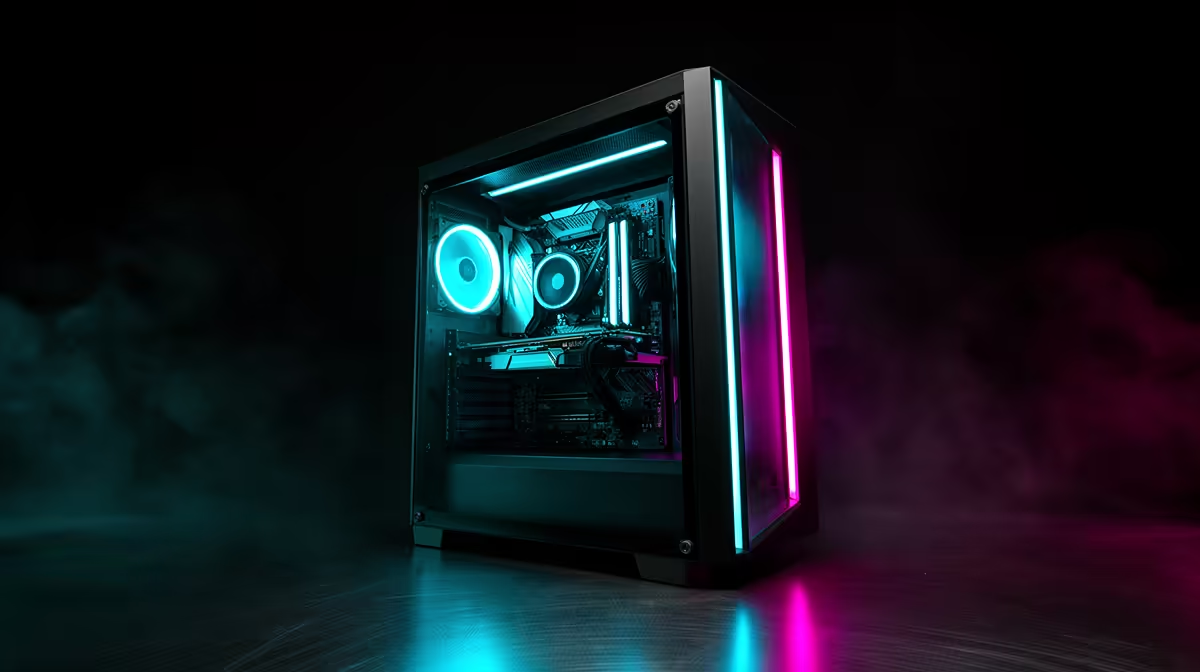
A case with 450 mm GPU clearance typically costs R3,800 to R7,000 in South Africa and makes sense when your GPU budget exceeds R15,000, where AIB partner cards with large triple-fan coolers regularly reach 360 mm to 420 mm in length. Below that GPU spend tier, 380 mm clearance cases cost R1,500 to R2,500 less and are fully adequate.
Where 450mm GPU Clearance Earns Its Place 🖥️
The 450 mm GPU clearance threshold exists to accommodate the most extreme AIB partner cooler designs on flagship cards. Partner variants of the RTX 5090 from premium AIB brands use elaborate triple-fan coolers that can reach 390 mm to 410 mm in total length, well beyond the 336 mm of the Founders Edition. A 450 mm case provides a 40 mm to 60 mm buffer above these cards, which is comfortable clearance that ensures the front intake fans have room to breathe even when the GPU's front fan sits near the radiator face. For R35,000 to R45,000 GPU investments, the extra clearance protection that a 450 mm case provides is a worthwhile safeguard against the specific failure mode of front-fan obstruction reducing cooling performance.
Fitting a 450mm Case Into a Total Build Budget 💰
In a ZAR-denominated gaming build, the case typically represents 5 percent to 10 percent of the total build cost at the high end. For a full flagship build with an RTX 5090, Ryzen 9 9950X, 64 GB DDR5, and NVMe storage totalling R80,000 to R100,000, a R5,500 to R7,000 case is a proportionate spend at 5.5 percent to 7 percent of budget. For a mid-range build at R30,000 to R40,000 with an RTX 5070 Ti, a 380 mm clearance case at R3,000 to R4,000 is sufficient and reallocates R1,500 to R3,000 to GPU or CPU. The 450 mm case is specifically appropriate when the GPU is the primary budget driver and the card is a large AIB variant.
Long-Term Case Value and Next-Gen Compatibility 🔧
PC cases are typically kept across two to three GPU generations. A 450 mm GPU-ready case purchased now will accommodate next-generation flagship AIB designs without a chassis upgrade. If GPU cooler designs continue the trend of increasing physical size (which they have done consistently from RTX 30 to 40 to 50 series), 450 mm clearance is likely to remain relevant for at least two GPU cycles. SA builders on a 3-year to 4-year upgrade cadence, common among students and professionals managing a Rand budget, benefit from the forward compatibility that a 450 mm case provides without needing to factor in chassis replacement costs.
Clearance Buffer Calculation ⚡
up the exact installed length of your intended GPU model (not the PCB length), add 30 mm to that figure for a comfortable clearance buffer, and use the result as your minimum case GPU clearance requirement. For example: an AIB RTX 5090 at 380 mm installed length needs a case with at least 410 mm clearance, and a 450 mm case provides a 70 mm buffer for cable routing and airflow near the front intake.
FAQ
Are 450mm GPU-ready cases all full-towers, or do mid-towers qualify?
Most 450 mm clearance cases are full-towers. A small number of XL mid-towers achieve this clearance by using a bottom-mounted PSU without a shroud, which frees vertical height for the GPU zone. These are less common locally but do exist.
Does 450mm clearance help with GPU thermals as well as fit?
Indirectly yes. More clearance between the GPU front fan and the front panel or radiator face reduces recirculation of warm air back through the GPU cooler, improving GPU junction temperatures by 2 degrees Celsius to 5 degrees Celsius under sustained load.
Can I use a 450mm-ready case for a smaller GPU in the interim?
Absolutely. Larger cases are not penalised for housing smaller GPUs. A 250 mm card in a 450 mm clearance case functions perfectly; the extra space simply goes to cable routing and airflow, both of which are positive outcomes.
Budgeting a flagship GPU build in ZAR?
Evetech carries large-clearance full-tower cases and the full RTX 50-series lineup, so you can spec the card and chassis together before anything ships.