Quick Answer
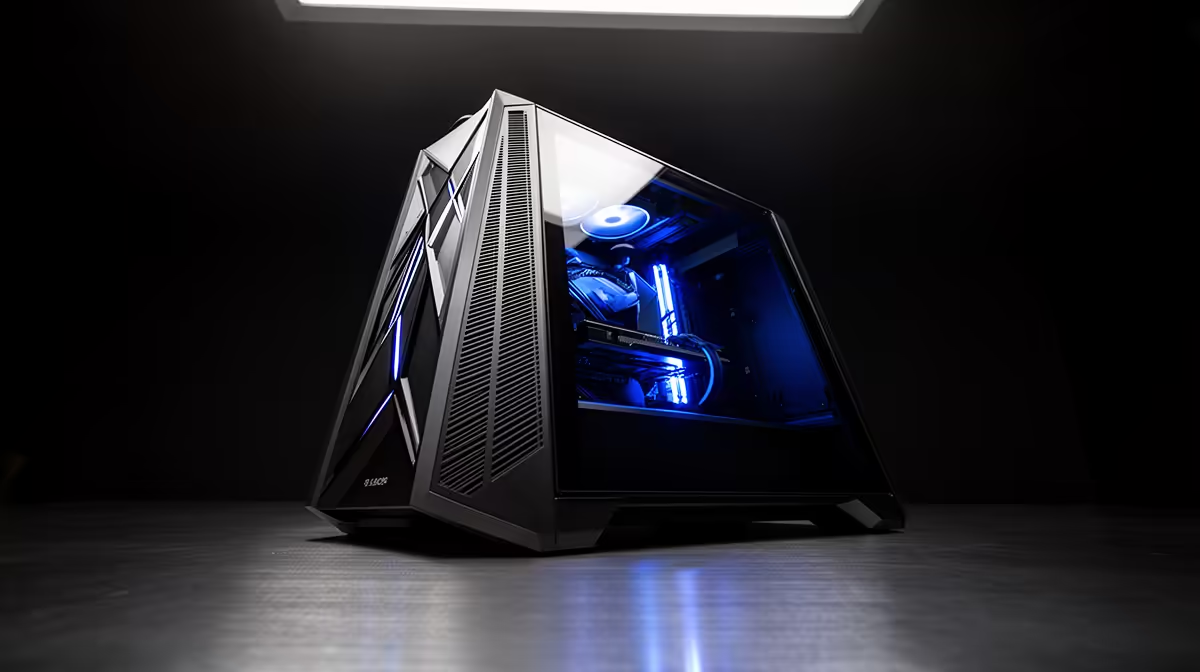
A premium E-ATX mid-tower case typically costs R3,000 to R5,500 in South Africa. In a Rand-conscious build, it makes sense if your motherboard is genuinely E-ATX (not just a large ATX board mislabelled), your GPU is a full-length flagship, and you plan to keep the case for two or three upgrade cycles.
Understanding Where the Case Budget Fits Overall 💰
For SA gaming PC budgets, a useful allocation framework places the GPU at 35 to 40 percent of total spend, the CPU and motherboard at 20 to 25 percent, RAM and storage at 10 to 15 percent, the PSU at 7 to 10 percent, and the case plus cooling at 8 to 12 percent. On a R50,000 build, the case and cooling budget is R4,000 to R6,000. A premium E-ATX mid-tower at R3,500 to R4,500 fits within that range while leaving R1,000 to R2,000 for a quality AIO or fan set.
On tighter builds of R25,000 to R35,000, the case budget compresses to R2,000 to R3,500. At this range, standard ATX mid-towers from quality brands outperform the value of E-ATX options unless the build genuinely requires E-ATX.
When the E-ATX Premium Is Justified 🔧
An E-ATX mid-tower case earns its premium when paired with platforms that require it: AMD Threadripper Pro, high-end Intel HEDT boards, or dual-channel DDR5 boards with eight DIMM slots. For a content creator running 3D rendering and video encoding alongside gaming, a Threadripper Pro build with 256GB DDR5 needs an E-ATX case simply because the board is physically too wide for standard ATX cases.
For pure gamers on AM5 or LGA1851, standard ATX covers every need. You lose nothing in thermal performance, GPU clearance, or upgrade flexibility by choosing a quality ATX mid-tower. The E-ATX premium on the case buys you space you will not use.
What a Premium E-ATX Mid-Tower Should Include at R3,500 to R5,500 📋
At this price in SA, expect: full E-ATX board support up to 330mm width, 380mm or greater GPU clearance, 420mm radiator support, integrated GPU sag bracket, at least five fan mount positions, 30mm or more of behind-tray depth for cable management, dual tempered glass or a glass plus mesh configuration, and USB 3.2 Gen 2 Type-C front panel IO. Build quality should be 1mm steel or aluminium frame with solid hinge mechanisms on the glass panels.
If a case at R4,000 does not include most of these features, it is not earning its price. Several brands stocked at Evetech hit this specification at R3,500 to R4,500 without compromise.
Future-Proof Your Case Investment ⚡
Choose an E-ATX case that supports 420mm radiators even if you currently run a 240mm or 360mm AIO. As CPU thermal demands increase with future platforms, having the option to upgrade to a 420mm cooler without changing the case saves R3,000 to R5,000 in a future upgrade cycle.
FAQ
Should I spend more on the case or the CPU cooler in an E-ATX build?
Prioritise the case first: it sets the physical constraints for everything else. A case that fits your board and GPU with adequate airflow is more fundamental than marginal CPU cooler improvements. Once the case is selected, invest the remaining cooling budget in an AIO that suits the platform.
Can I use a standard ATX case if my E-ATX board fits within the maximum board width?
Yes, if the ATX case spec sheet explicitly lists E-ATX board support and your board width falls within the stated maximum, it will work. Always verify board width in millimetres against the case maximum, not just the form factor label.
Is an E-ATX mid-tower case better than a full tower for a gaming build?
For gaming, an E-ATX mid-tower is generally preferable: it offers adequate space for large components while keeping the physical footprint manageable on a desk or under a desk. Full towers add volume you rarely need in gaming-only builds and cost R500 to R2,000 more for the extra height.
Planning an E-ATX build and want to spend Rands wisely?
Browse premium E-ATX mid-tower cases at Evetech, with specs covering board width, GPU clearance, and radiator support so you can match before you buy.