Quick Answer
A triple pack of reverse orientation fans costs between R950 and R1,800 in South Africa depending on the brand and LED spec, and it fits comfortably within a mid-to-upper cooling budget for a build where ARGB aesthetics and front-facing LED orientation matter. For pure airflow without a glass panel, standard fan packs at a lower price point make more sense.
ZAR Cooling Budget Framework for a Mid-Range Build 💰
A practical cooling budget for a mid-range SA gaming build (R15,000 to R25,000 total system) typically allocates R800 to R2,500 for all fans and cooling beyond the CPU cooler. If the CPU cooler (air or AIO) already consumes R800 to R2,000 of that, the remaining fan budget sits between R400 and R1,500. A triple pack of reverse fans at R1,100 to R1,500 lands squarely in the upper half of that remaining allocation, which is reasonable when the case includes tempered glass and the builder prioritises LED orientation consistency. Cheaper standard fan packs at R600 to R900 for three fans free up budget for a better AIO or a larger power supply, which is a valid trade-off for a first build.
Where Reverse Fans Fit in the Build Priority Order 📋
Cooling budget allocation should follow this priority sequence: CPU cooler first, case selection second (the case determines how many fans you need and where), then front intake fans, then exhaust fans, then aesthetics-driven upgrades like ARGB lighting controllers. Reverse fans sit at the crossover between intake performance and aesthetics. If you are already spending R1,400 on a 240mm AIO and R1,800 on a mid-tower with mesh front and glass side, a R1,200 reverse triple pack for the three front intakes is a natural fit. On a tighter overall build budget where the CPU cooler is a R500 air cooler and the case is a R700 entry-level option, standard R250 per fan alternatives serve better because the glass panel may not be present to display the LED orientation advantage.
What the Premium Actually Pays For 🔍
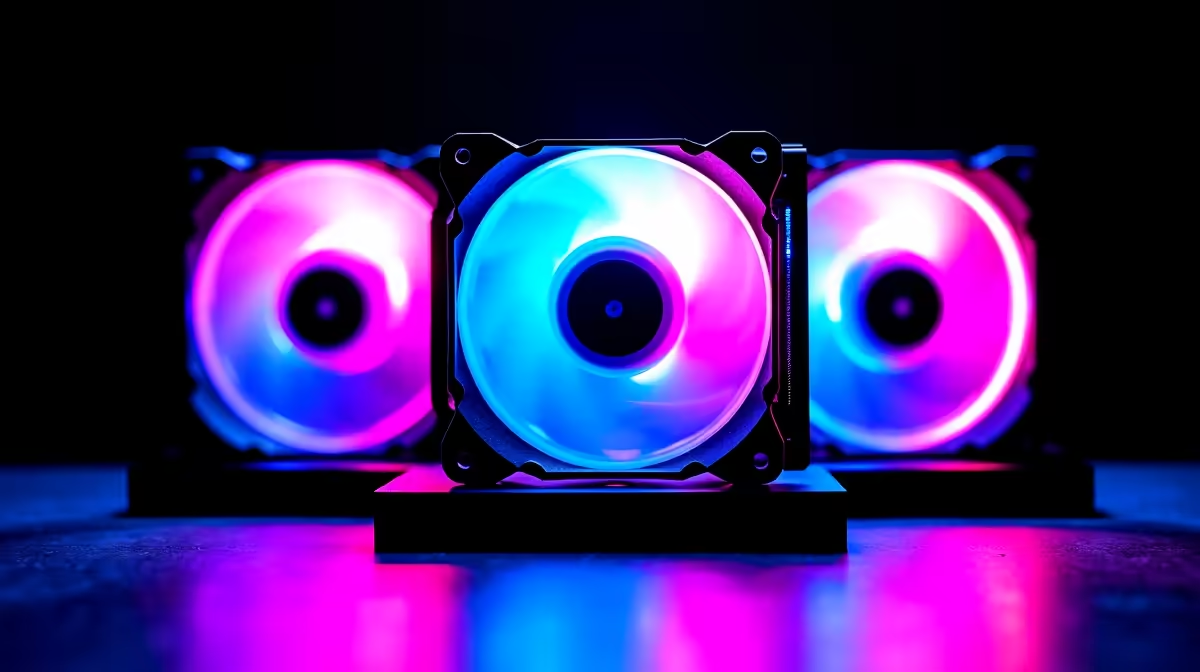
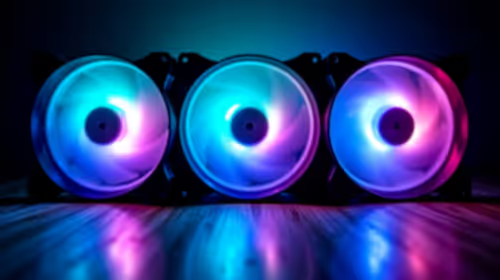
The blade geometry on a reverse fan is manufactured to push air in the reverse direction when mounted in the standard position with the sticker side facing out. This engineering adds a small production cost. Beyond that, premium reverse packs often include daisy-chain connectors (eliminating hub cables), matched ARGB controllers, and tested LED binning for colour consistency across the three fans. The visible benefit inside a glass case is clear: all three front fan LED rings face the interior and the viewer simultaneously, rather than having the LED ring hidden behind the blade cage as it would be on a standard fan mounted conventionally for intake.
Plan for Extra Controller Cables ⚡
Reverse fan packs that include a proprietary RGB controller add one more USB 2.0 header connection to your motherboard's header count. Check your board's available USB 2.0 internal headers before buying. Mid-range ASUS and MSI boards typically provide two to three internal USB 2.0 headers, enough for a fan controller, an AIO pump head, and a front panel USB hub.
FAQ
Can I mix reverse fans on the front and standard fans on the top and rear?
Yes. Reverse fans only on the front intake positions is the most common configuration. Rear and top exhaust positions use standard fans because LED orientation is less critical there.
Do reverse fan packs come with ARGB controllers included?
Some do and some do not. Check the box contents before purchase. Packs that include a controller or hub add R100 to R200 of value; those that do not require you to use a motherboard ARGB header directly.
Is the airflow from a reverse fan identical to a standard fan?
Yes, when used in the intended reverse-intake configuration the CFM and static pressure specs match an equivalent standard model. Blade geometry is mirrored but aerodynamically equivalent.
Budgeting for your next cooling upgrade?
Evetech stocks fan packs including reverse orientation designs for mid-tower and full-tower builds. Check the current range for options that fit your cooling layout and ZAR budget.