Quick Answer
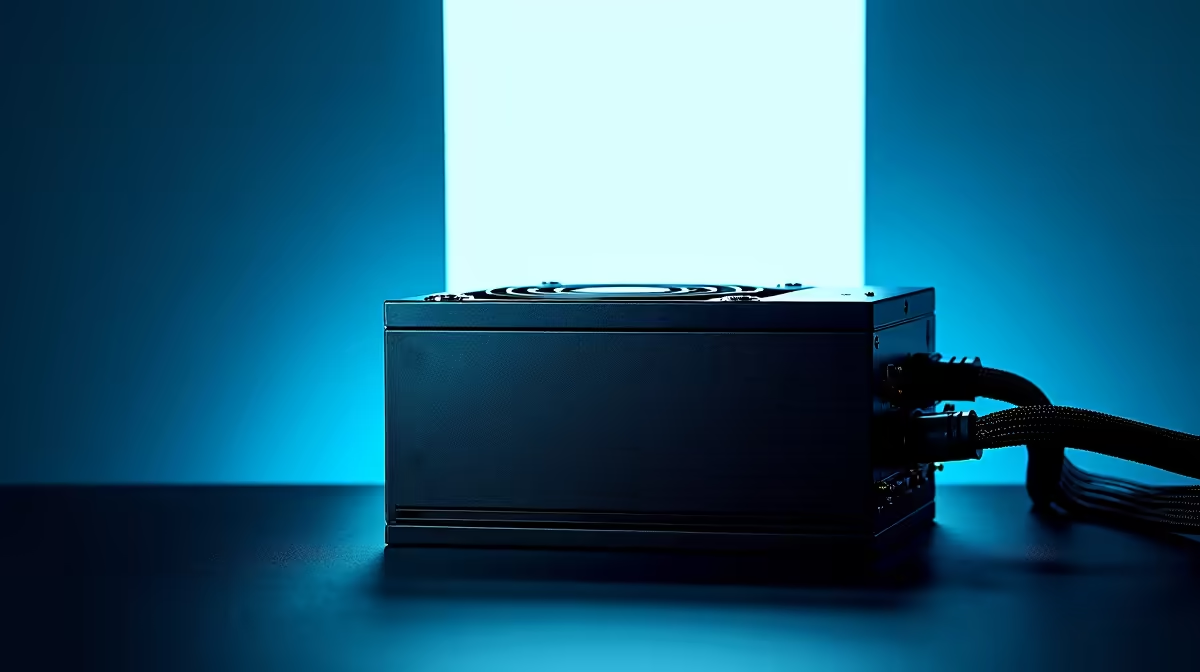
Among ATX 3.1 units currently stocked in South Africa, the Seasonic Prime Platinum series and Corsair AXi Titanium series consistently deliver the tightest 12V rail regulation under transient GPU load, typically holding within plus or minus 1% of 12V versus the ATX 3.1 spec's plus or minus 3% tolerance. For high-current GPUs like the RTX 5090 or RX 9080, these units provide the most robust spike absorption.
What Voltage Stability Means for High-Current GPUs 🔌
A GPU drawing 450W to 575W at 12V requires approximately 37 to 48 amps on the 12V rail. During rendering spike events, this can jump to 55 to 65 amps for microseconds. The ATX 3.1 specification requires the 12V rail to stay within plus or minus 3%, meaning between 11.64V and 12.36V, during these events. Lesser PSUs may comply on paper but ride the edge of the tolerance window, and in-game crashes often occur precisely because a spike pushes below 11.64V for longer than the GPU's voltage monitoring circuit tolerates. Premium units regulate well inside the specification, holding 11.88V to 12.12V even during sustained spike sequences. This tighter regulation is the real differentiator between a name-brand ATX 3.1 unit and a budget-labelled one claiming the same spec.
How to Compare Voltage Stability Before Buying 📊
Third-party reviews from channels like Gamers Nexus, Hardware Busters, and Tom's Hardware measure 12V rail voltage under standardised step-load tests that simulate GPU spike profiles. Look for crossload ripple and transient response graphs in these reviews, not just peak efficiency numbers. A PSU review that only reports efficiency and neglects ripple or transient response data is incomplete for evaluating high-current GPU compatibility. Ripple should be below 120mV at full load according to ATX spec; the best units from Seasonic and Corsair measure below 30mV in independent testing.
Top ATX 3.1 Options Available in SA by Voltage Performance 💡
Based on published third-party test data, the Seasonic Prime Platinum 1000W offers among the best ripple suppression in the consumer PSU market, consistently measuring under 25mV 12V ripple at full load. The Corsair AX1000i Titanium adds digital monitoring via iCUE and maintains comparable rail stability. ASUS ROG Thor III 1000W Platinum delivers tight regulation with the addition of the OLED display and magnetic module. All three are stocked at Evetech, priced from approximately R7,500 to R11,500 for the 1000W tier. For builders who cannot stretch to these price points, the Corsair RM1000e Gold, available around R4,500, provides adequate but less precise regulation for mid-range GPU builds up to the RTX 5080.
Use HWiNFO64 to Monitor 12V Rail in Real Time ⚡
HWiNFO64 reads 12V rail voltage from the motherboard's Super I O or ITE chip. The reading is not as accurate as a direct PSU sensor, expect plus or minus 2% to 5% error, but it is useful for catching persistent sag patterns during gaming. If you see consistent readings below 11.7V during GPU-intensive scenes, your PSU's 12V regulation is being stressed and an upgrade or overclock reduction is warranted.
FAQ
Does the brand of PSU matter more than the wattage rating for voltage stability?
Yes, significantly.
Can a voltage instability issue damage my GPU?
Sustained voltage sag below specification stresses GPU voltage regulation modules.
Is there a meaningful difference between Platinum and Titanium voltage regulation?
The efficiency difference is well-documented, but voltage regulation quality is more closely linked to the specific component quality and topology than to the efficiency certification tier alone. Some Platinum units outperform some Titanium units in ripple suppression. Review the third-party measurements for the specific model rather than inferring from the certification badge alone.
Need a PSU that holds steady voltage under RTX 50-series or RX 9000-series load?
Evetech stocks top-rated ATX 3.1 units from Seasonic, Corsair, and ASUS ROG with local warranty, covering 850W to 1600W for demanding builds.