A bowl printed in food-grade PETG can still grow a biofilm after a week of use, and the reason has almost nothing to do with the spool you bought. The deciding factor in food-safe 3D printing is what happens to the porous surface after the print comes off the bed. The polymer chemistry sets the ceiling, but the layer lines decide whether your part is genuinely safe for repeated food contact or just safe-on-paper.
Quick Answer
PETG and polypropylene are the two filaments worth printing food-contact parts in, but neither is safe out of the box. FDM layer lines create microscopic grooves that trap food residue and bacteria through ordinary washing, so any part meant for repeated food contact needs either a food-grade sealant or a smooth printing approach. For single-use or dry-contact items, a clean PETG print is usually fine.
The material only sets the ceiling
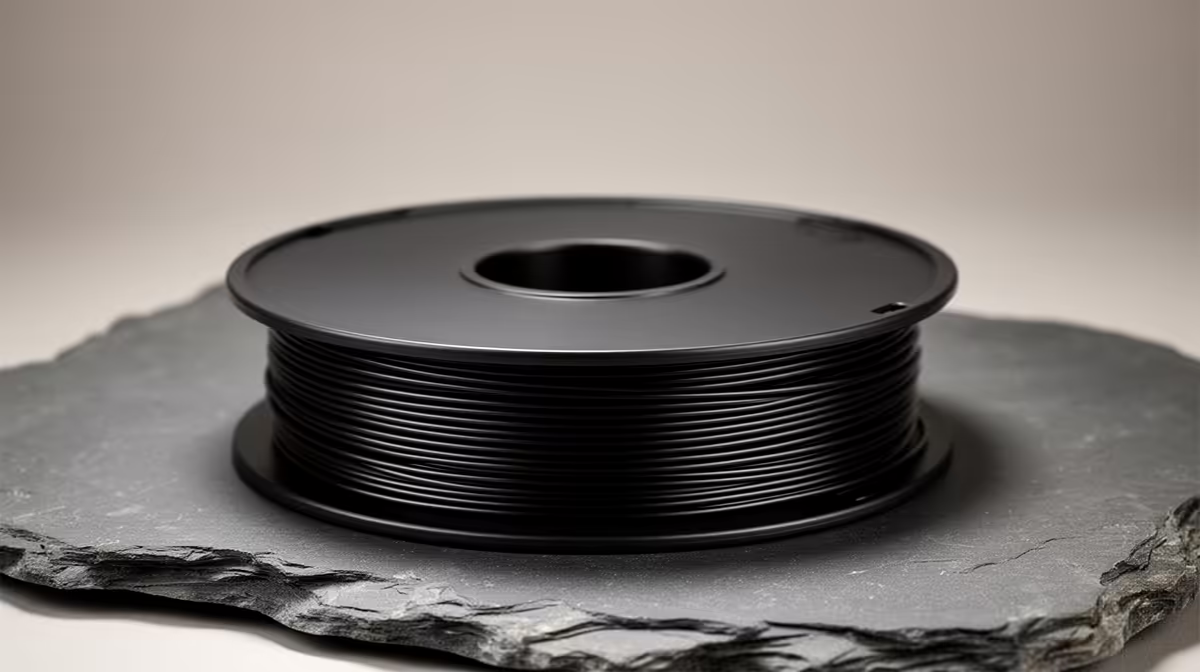
PETG starts from a base polymer that is FDA-recognised for food contact, which is why it shows up in drink bottles and packaging trays. Polypropylene goes a step further: it is the plastic used in yoghurt tubs and microwave-safe containers, it is naturally water-repelling so residue clings to it less, and it tolerates roughly 100 degrees Celsius before softening. On paper, both clear the chemistry bar.
The trap is assuming the spool's food-grade rating transfers to the finished print. It does not. A pellet of food-grade PETG melted and extruded through a brass nozzle, printed on a textured bed, and handled with bare hands is a very different object from an injection-moulded container. Additives, colourants, and nozzle wear all enter the picture once you actually print.
If you are choosing hardware to print these parts cleanly in the first place, the range of 3D printers stocked at Evetech covers the FDM machines most home users start with, and a printer with fine layer resolution genuinely reduces how aggressive your post-processing has to be.
Why layer lines are the real problem
Every FDM print is built from stacked beads of plastic, and the valleys between those beads are open channels. Under a microscope they look like a ploughed field. Food particles settle into those grooves, water cannot flush them out fully, and bacteria colonise the gaps and form biofilm that survives a normal wash and rinse.
This is not theory. Lab work comparing printed parts against smooth moulded controls has found printed surfaces hold onto far more bacterial contamination after cleaning, precisely because the layer texture shelters the cells from soap and scrubbing. The smoother the surface, the less there is to clean out, which is the whole game.
Where the risk actually lives
Dry, single-use, or brief-contact items carry the least risk: a cookie cutter that touches dough for seconds, a measuring scoop for dry coffee, a stencil. The danger climbs sharply with anything wet, warm, reused, and stored damp. A printed cup you refill daily, a spice grinder, or a funnel for liquids is exactly the scenario where trapped moisture and residue let bacteria settle in between uses.
The nozzle and additives nobody thinks about
Two more contamination paths sit upstream of the layer-line problem. The first is the nozzle. A standard brass nozzle can shed trace amounts of lead and other metals into the melt, which is a non-issue for a phone stand but a real one for something your food touches, which is why a hardened or stainless steel nozzle is the right call for food parts. The second is what is mixed into the filament itself. Colourants, flame retardants, and other additives are not always food-rated even when the base polymer is, and a brightly coloured spool is more likely to carry something you would not want leaching into a meal. A natural, uncoloured food-grade filament is the safer starting point before you even reach the printer.
Making a print food-contact-safe
The proven fix is sealing the porous surface so there are no grooves left to harbour anything. A food-grade epoxy or a certified food-safe sealant flows into the layer valleys and cures into a smooth, non-porous skin you can actually clean. Apply it in thin even coats, let it cure fully, and accept that you have now changed the surface the food touches, so the sealant itself must carry a food-contact rating, not just the filament.
A few build-side habits help before you ever reach the sealant:
- Print with a stainless steel nozzle rather than brass, since brass can leach trace metals into the melt.
- Use a fine layer height to shrink the grooves you will later have to fill.
- Keep the surface that touches food off the textured build plate where you can, so it is not embossed with bed texture.
- Dedicate a nozzle and spool to food parts to avoid cross-contamination from earlier prints in other materials.
Even with all of that, treat sealing as the step that makes a reused part genuinely safe rather than an optional extra. For the brushes, gloves, and finishing supplies that make sealing tidy, it is worth checking what sits in the accessories best sellers at Evetech before you start a batch.
Frequently Asked Questions
Is PLA food safe for printing kitchen items?
Pure PLA starts from a plant-based polymer that is generally regarded as non-toxic, but most spools contain colourants and additives that are not food-rated, and PLA softens at low temperatures so it warps with hot water or in a dishwasher. It carries the same layer-line porosity problem as every other FDM print.
Can I just wash a printed cup really well?
No amount of normal washing reliably clears bacteria from the layer-line grooves, which is the core finding behind the warnings. Scrubbing helps the surface but cannot reach into the micro-channels, so a reused wet-contact part still needs sealing.
Is polypropylene better than PETG for food parts?
For pure food safety PP has the edge: it is the plastic used in food tubs, it repels water, and it handles higher temperatures. The trade-off is that PP is harder to print well because it warps and needs the right bed surface, so many home users land on PETG plus a sealant instead.
Does a food-grade spool mean the print is food safe?
No. The rating describes the raw polymer, not the finished object. Printing introduces nozzle metals, the porous surface, and handling, all of which change the safety picture, so the spool rating is a starting point and not a guarantee.
What about hot food or drinks?
Heat raises the stakes. PLA deforms, and warmth speeds up bacterial growth in any trapped residue. If a part will hold anything hot, lean toward PP for its temperature tolerance and seal the surface regardless.
Planning a food-contact project? Start with the right machine and finishing kit. Browse the current lineup of 3D printers at Evetech and pair it with a fine nozzle and a food-grade sealant before your first batch, so your prints are safe to actually use, not just safe on the label.