


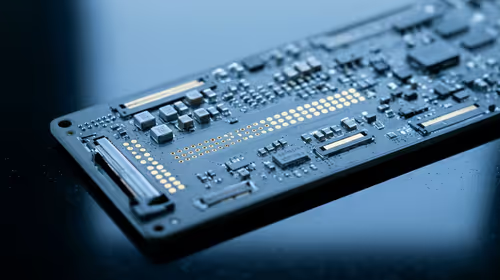
Hot-Swappable PCB Architecture in Modern Keyboards: Guide
Learn hot-swappable PCB architecture in modern keyboards—what it is, how sockets and traces work, and how to pick the right board. Speed up swaps, reduce risk, and upgrade faster 🔧⚡
Read moreWi-Fi 7 vs Thunderbolt 4: Uncover the fastest, most reliable connection 🔧📈 for gaming, 4K streaming, and power tasks. Upgrade smarter today!
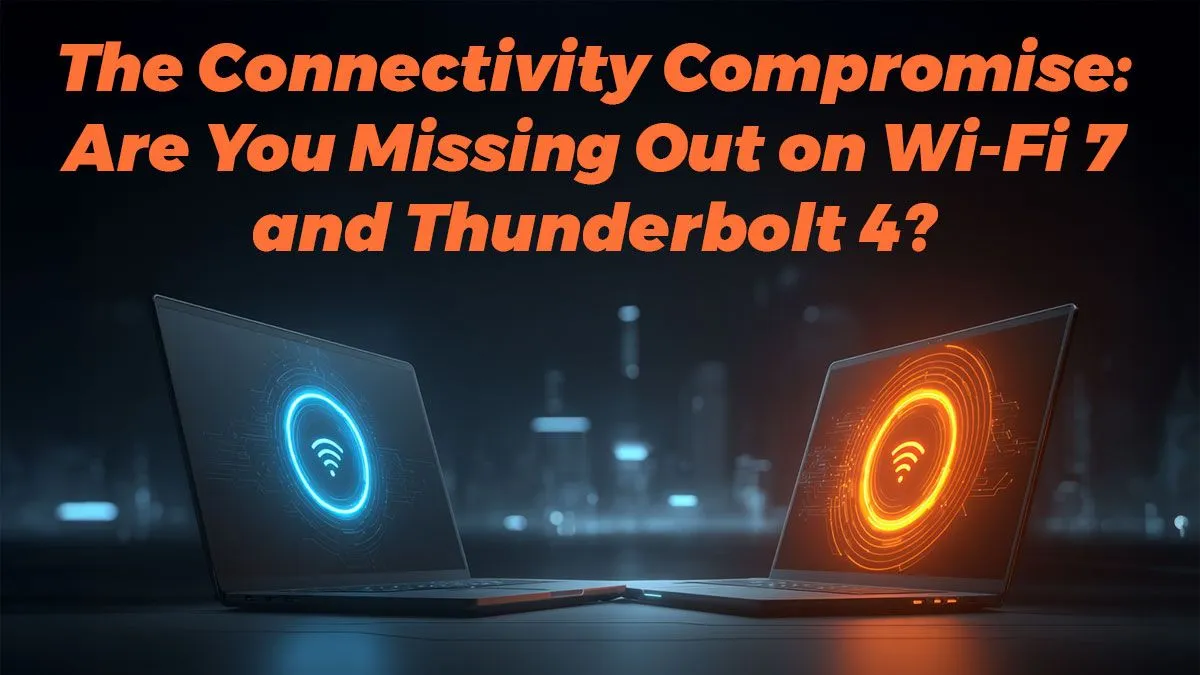
You're staring at two new laptops, the specs sheets glowing. Both promise face-melting speed, but one boasts "Wi-Fi 7" while the other screams "Thunderbolt 4". They sound impressive, but what do they actually mean for your gaming sessions in South Africa? Is one just marketing hype, or is it the key to unlocking next-level performance? Let's settle the Wi-Fi 7 vs Thunderbolt 4 debate and help you decide which tech you should really prioritise.
At its heart, this isn't a fair fight… because they solve different problems. Think of it less as a boxing match and more as choosing the right tool for the job. 🔧
Wi-Fi 7 (802.11be) is all about cutting the cord without compromise. It’s the next evolution of wireless networking, designed for a world cluttered with signals. Its main promise for gamers is ridiculously low latency and stable connections, even when your entire family is streaming 4K content. It’s the future of lag-free, untethered gaming.
Thunderbolt 4, on the other hand, is the undisputed king of physical connections. It’s a high-speed port that uses a USB-C connector to do… well, almost everything. It delivers a massive 40Gbps of bandwidth for lightning-fast data transfers, connecting multiple high-resolution monitors, and powering your entire setup through a single cable.
Prioritising Wi-Fi 7 makes sense if you value mobility and a clean, cable-free environment. For competitive gamers, its biggest feature is Multi-Link Operation (MLO), which allows a device to connect across multiple frequency bands simultaneously. This creates a more stable, lower-latency connection that’s less prone to interference… a huge plus for intense online matches.
Imagine you’re grabbing one of the latest top-tier gaming laptops to play anywhere in the house. With Wi-Fi 7 (and a compatible router), your connection remains rock-solid, delivering a near-wired experience without being chained to a network point. It’s about freedom and future-proofing your wireless performance.
A Wi-Fi 7 laptop is only half the puzzle. To unlock its true potential, you need a Wi-Fi 7 router. Without it, your new machine will just connect using older standards like Wi-Fi 6 6E. Plan your upgrade path accordingly!
You should prioritise Thunderbolt 4 if your laptop is the heart of a larger, more complex setup. Think content creators, programmers, or gamers who want a desktop-level experience from their portable machine.
With a single Thunderbolt 4 port, you can connect a docking station that drives two 4K monitors, an external GPU, a super-fast NVMe SSD for your game library, and your mechanical keyboard… all while charging your laptop. It’s the ultimate tool for productivity and building a powerful, versatile battle station. Many powerful Intel-based laptops make this port a standard feature for power users. This kind of setup is also a lifesaver during load shedding, allowing you to disconnect and reconnect your entire workstation with one plug.
While Thunderbolt has traditionally been an Intel technology, its underlying protocol now forms the basis of USB4, which is appearing on more high-performance AMD laptops and offering similar (though not always identical) capabilities.
So, in the Wi-Fi 7 vs Thunderbolt 4 battle, who wins? It completely depends on your use case.
Ideally, you wouldn't have to choose. The best modern laptops are equipped with both, giving you the ultimate flexibility. But if your budget forces a choice, weigh what's more important: untethered perfection or unparalleled wired expansion.
Find Your Perfect Tech Match Understanding the tech is the first step to a smarter purchase. Explore our massive range of laptops with the latest connectivity options to find the perfect fit for your needs and budget. Shop now at Evetech for performance that leaves lag in the dust.
Wi-Fi 7 is wireless, Thunderbolt 4 physical. Speeds: 5-10 Gbps vs 40 Gbps.
Thunderbolt 4 dominates latency-critical tasks like gaming at ~10μs vs Wi-Fi 7's 20-30μs.
No – Thunderbolt 4 excels in wired performance, Wi-Fi 7 handles wireless networks.
Video editing, daisy-chaining 4K monitors, and ultra-fast SSD storage transfers.
Yes – Wi-Fi 7 reaches 30m vs Thunderbolt 4's 2m cable limit for devices.
Both last 5+ years. Thunderbolt 4 has faster upgrade cycles for cutting-edge tasks.
Only if you do heavy data workflows. Casual users stick to Wi-Fi 7's wireless freedom.
Learn hot-swappable PCB architecture in modern keyboards—what it is, how sockets and traces work, and how to pick the right board. Speed up swaps, reduce risk, and upgrade faster 🔧⚡
Read more
Mechanical switch lifespan explained—what the 50 million keystroke rating really means, plus tips to extend switch life and reduce double-press issues 🔧⌨️
Read more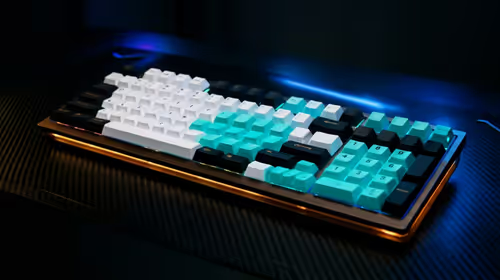
60-percent vs full-size mechanical keyboard layouts—learn what each layout includes, who it suits, and how to choose the right fit 🧩⌨️ for typing, gaming, and productivity.
Read more
Double injection keycaps last far longer than standard printed keycaps in most setups. Learn typical lifespan ranges, what shortens them, and how to maximize durability for smoother daily typing and gaming 😊⌨️
Read more
Full-key anti-ghosting: does it stop missed inputs during fast-paced gaming? We break down latency, polling, and key matrix limits so you can buy smarter 🎮⚡
Read more
Protect mechanical keyboard switches from South African dust and summer humidity with practical cleaning and storage habits. Keep your switches smooth, reduce failures, and extend lifespan. 🌬️💧
Read more
Wondering if a TKL wireless mechanical keyboard is worth it for everyday productivity? We break down latency, battery life, comfort, and workflow gains for real work. ⚡⌨️

Maximise battery life on a fanless 15-inch laptop using efficiency core architecture. Cut idle drain, tune power profiles, and improve thermals for longer runtime. 🔋⚙️
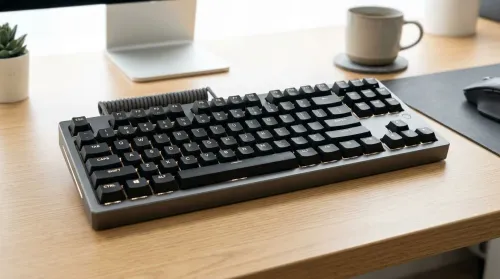
Learn how to reduce desk clutter with a TKL wireless keyboard using fewer cables, smart placement, and tidy essentials. Get a faster, calmer workspace with better ergonomics. ✅🧼
RGB keyboard lighting too distracting? Learn how to manage backlight modes, set brightness, and reduce distraction for focus and productivity 😌🖱️
Are themed gaming keyboards worth the extra cost? Compare build quality, switch options, features, and resale value to find the best fit for your setup 🎮⌨️
Full-Size vs Tenkeyless mechanical keyboards for gaming: find out if a smaller layout truly improves aim, speed, and comfort. We break down layout, desk space, latency-feel, and keybinds 🎮⌨️
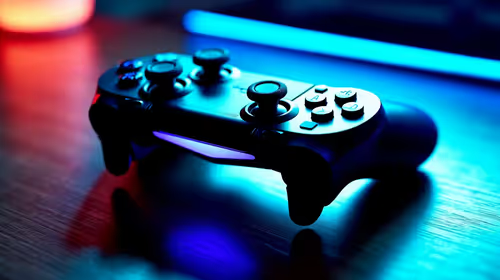
Dedicated media rollers vs function key shortcuts: learn which setup gives you better workflow control, faster media access, and fewer mistakes. 🖱️🎧
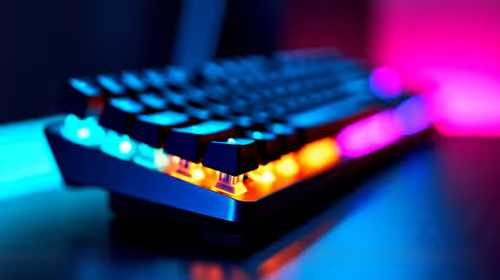
Best Mechanical Switch Type for Gaming: Clicky vs Linear vs Tactile. Find your feel, speed, and noise balance with practical guidance for FPS, MOBA, and productivity 😄🎮
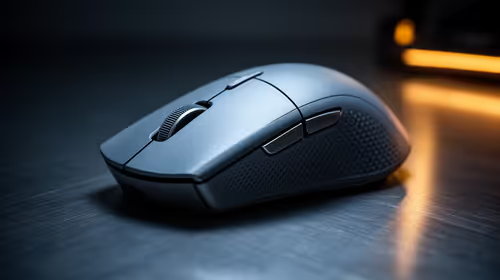
Direct mouse answer: Mouse not keeping up with your work? Everything that matters about dual-mode 2.4GHz + BT 5.0: DPI behaviour, channel switching, battery curves and per-app button mapping. Covers when 2.4GHz USB wins (low-latency desk) and when BT 5.0 wins (laptop, d
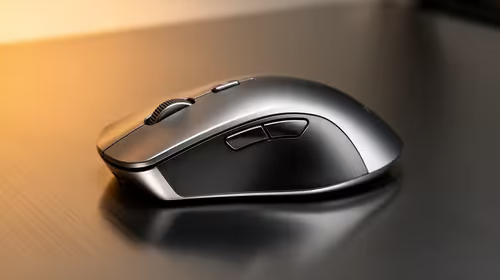
Plain wireless mouse guide: Mouse not keeping up with your work? Everything that matters about wireless productivity mouse: DPI behaviour, channel switching, battery curves and per-app button mapping. Includes DPI tuning tips, channel switch shortcuts, and ZAR-aware fea
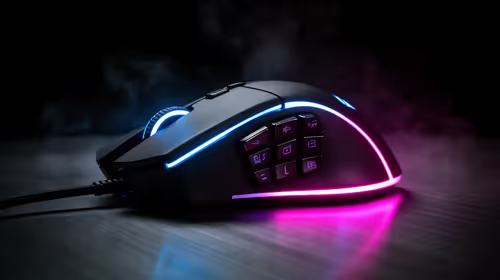
Real productivity numbers: Set up your wireless mouse in this order: everything that matters about wireless productivity mouse: DPI behaviour, channel switching, battery curves and per-app button mapping. Includes DPI tuning tips, channel switch shortcuts, and ZAR-aware
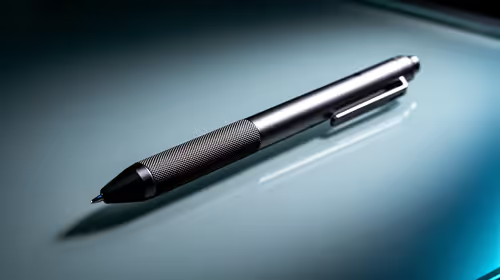
Pen not feeling like paper? Stylus lag and skipping usually trace to old drivers, dirty nibs, or display refresh mismatches, not the pen itself. Covers pressure curve tuning, tilt thresholds, nib swap timing, and SA pricing brackets.