Quick Answer
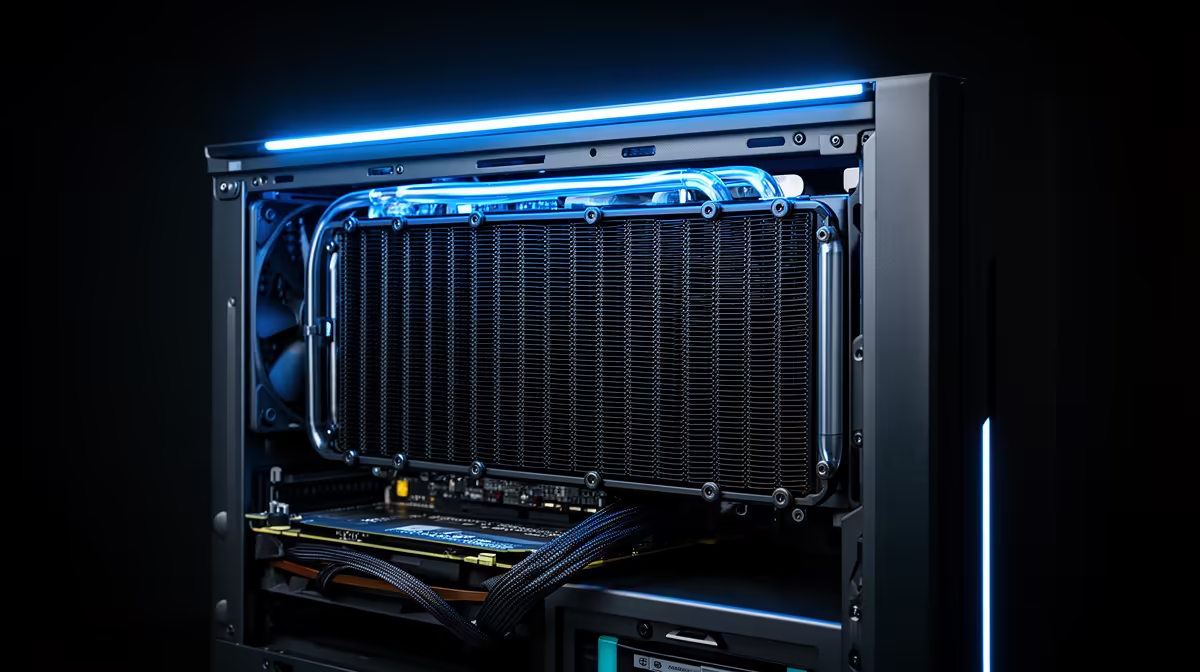
Nearly all compact mATX cases max out at 360mm to 380mm GPU length, so a 420mm card will not physically fit in most of them. Even in the rare mATX case that accepts 420mm, front intake clearance drops to zero, directly killing airflow to the GPU. A full-tower ATX case is the correct chassis for a 420mm GPU.
GPU Length vs Internal Case Depth 📐
An mATX case's internal depth from the front panel fan bracket to the rear I/O panel typically ranges from 360mm to 390mm. A 420mm GPU occupies this space entirely, leaving no gap for front intake fans or a front-mounted radiator. Even if the card physically fits, the GPU's heatsink intake vents will be within 0mm to 20mm of the front panel, creating a turbulent recirculation zone where hot exhaust air from the GPU blows forward, hits the restricted panel, and returns to the GPU intakes. In testing, this thermal scenario raises GPU temperatures by 15°C to 25°C versus a properly clearanced install, causing significant boost clock throttling. For reference, an RTX 5080 at 250W TDP with 20°C elevated temps will throttle its boost clock by 200MHz to 300MHz continuously.
What Compact Case Builders Should Do Instead 🔄
If you love the small footprint of an mATX build but need a high-end GPU, the practical approach is to choose a GPU under 360mm and direct the flagship GPU budget toward the chip itself rather than the cooler shroud size. The RTX 5080 in Founders Edition measures 336mm and fits comfortably in most mATX cases with documented 360mm clearance. The gaming performance difference between a 336mm-long RTX 5080 and a 420mm-long variant of the same GPU is zero: both use identical silicon, power limits, and VRAM. The longer card has a marginally quieter cooler at peak load, a benefit that is irrelevant when you are operating in a chassis that cannot provide adequate intake airflow regardless.
Choosing the Right Case if You Must Run a Large GPU 🗜️
If the 420mm card is non-negotiable, step up to a full-tower or large mid-tower ATX case. Designs like the Fractal Design Torrent or Lian Li O11 Dynamic EVO provide 420mm to 440mm GPU clearance while maintaining front intake fans independent of the GPU position. These cases cost R2,200 to R3,800 locally and will serve the build far better than forcing an oversized GPU into a chassis it was never designed to accommodate. The thermal, noise, and longevity benefits of correct fitment outweigh any desk space advantage of squeezing a 420mm card into a smaller box.
Measure Your GPU Before Buying a Case ⚡
Find the exact length specification for your GPU model on the manufacturer's product page, not the retailer listing. Retailer listings sometimes round down or omit the connector overhang. Add 30mm for the 12VHPWR cable connector protrusion to get the total internal clearance required. Compare this figure to the case spec, not the box marketing.
FAQ
Are there any mATX cases that officially support 420mm GPUs?
As of 2026, very few mATX cases list 420mm GPU support in their specifications. Those that do typically achieve this by using a highly vertical internal layout with no front-mounted radiator option, trading cooling flexibility for GPU length capacity.
Does GPU length affect PCIe bandwidth or performance?
No. PCIe bandwidth is determined by the slot version (4.0 or 5.0) and lane count (x16) on the motherboard and CPU. GPU card length is a physical cooling design choice by the card manufacturer and has no effect on data transfer rates or GPU compute performance.
Can I use a vertical GPU mount in an mATX case to fit a longer card?
Vertical mounting rotates the GPU 90 degrees but does not change its length along the motherboard plane. A 420mm GPU installed vertically still requires 420mm of horizontal case depth from the PCIe slot to the front panel, the same constraint as standard horizontal mounting.
Fitting a large GPU and need the right case for it?
Browse full-tower and large mid-tower cases at Evetech that officially confirm clearance for today's longest flagship graphics cards.