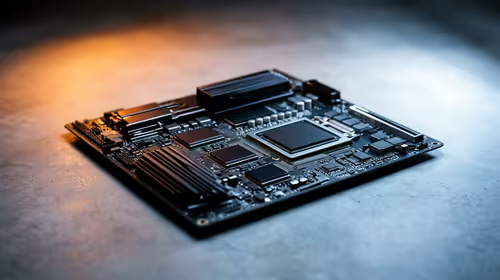
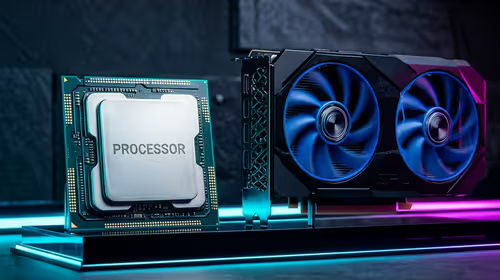
So, you’re staring at two graphics cards. One is an NVIDIA GeForce RTX, glowing with RGB and promising insane frame rates in Helldivers 2. The other is an NVIDIA RTX Ada or AMD Radeon Pro, looking… well, serious. And costing a whole lot more. You’re deep in the classic workstation vs gaming GPU debate, a crossroads for many South African creators and gamers. Which one do you actually need? Let's settle it. 🚀
The Core Difference: Drivers, Not Just Power
At first glance, the specs might look similar. Both types of cards have VRAM, CUDA cores (or Stream Processors), and massive coolers. The real difference isn't just the hardware; it's the software that runs it. The "driver" is the secret sauce, and it’s optimised for completely different tasks.
- Gaming GPUs (GeForce & Radeon): Their drivers are built for speed in a handful of popular graphics APIs like DirectX and Vulkan. They are fine-tuned to pump out the highest possible frames per second in the latest games. Think of them as specialised race cars, built to win on the track.
- Workstation GPUs (NVIDIA RTX Ada & AMD Radeon Pro): These cards have drivers certified for stability and accuracy in dozens of professional applications like SOLIDWORKS, AutoCAD, CATIA, and Maya. They excel at complex OpenGL tasks, high-precision calculations, and running for days without a single glitch. They are the reliable bakkies of the GPU world… built to haul heavy loads without breaking a sweat. 🔧
The choice between a gaming graphics card and a professional one often comes down to this core philosophy: raw, fast-paced performance versus rock-solid, certified reliability.
Gaming on a Workstation GPU... A Costly Experiment
Can you play Apex Legends on a multi-thousand-rand workstation card? Absolutely. Should you? Probably not. While a powerful workstation GPU can run games, it will almost always deliver lower frame rates than a gaming-focused card at a fraction of the price. The drivers simply aren't optimised for it.
You're paying a massive premium for features like ECC VRAM (error-correcting code memory) and double-precision compute performance that provide zero benefit in a game. For the price of a mid-range workstation card, you could build an entire high-end rig from our list of the best gaming PC deals and get a vastly superior gaming experience.
Professional Work on a Gaming GPU: The Smart Compromise?
This is where the lines get blurry, and for many South Africans, it’s the most important question. Can a GeForce RTX card handle your creative workload? For a huge number of users, the answer is a resounding yes.
Modern gaming GPUs are incredibly powerful and more than capable of handling tasks like:
- Video Editing: Apps like Adobe Premiere Pro and DaVinci Resolve lean heavily on gaming GPU architecture for encoding and timeline performance.
- 3D Rendering: For artists using Blender, V-Ray, or OctaneRender, a high-end gaming card often provides the best performance-per-rand.
- Graphic Design & Streaming: The entire Adobe Creative Cloud suite and streaming via OBS run beautifully on gaming hardware.
For a powerful creative machine that doesn't demolish your budget, a system from our PCs above R20k range, built around a strong gaming GPU, is often the smartest choice. Even many PCs under R20k offer a fantastic entry point for aspiring creators.
Unlock Your Gaming GPU's Potential ⚡
If you're using an NVIDIA GeForce card for creative work, ditch the Game Ready Driver. Instead, download and install their Studio Driver. It's specifically optimised for creative apps like Adobe Creative Cloud, Blender, and Autodesk, offering better stability and performance for your projects without sacrificing gaming prowess. It’s the best of both worlds.
The primary drawback is the lack of official software certification. If your engineering firm's software licence requires a certified GPU for technical support, a gaming card is a non-starter. For everyone else, it's a powerful and cost-effective option.
Why the Massive ZAR Difference?
So why does a workstation card with seemingly similar specs cost three or four times more?
- Certified Drivers: Companies spend millions working with software vendors like Autodesk and Dassault Systèmes to guarantee their cards work flawlessly. You're paying for that guarantee.
- Hardware & Features: Specialised features like ECC VRAM for error-free calculations, and better double-precision (FP64) performance are expensive to implement.
- Validation & Support: These cards undergo thousands of hours of testing and come with enterprise-level support. For a business, where downtime costs thousands per hour, this peace of mind is the main product.
Ultimately, you're investing in a tool designed for a specific, mission-critical job. Many of the best pre-built PC deals balance this equation perfectly, offering professional-grade performance without the workstation price tag.
The Final Verdict: Which Graphics Card is for You?
Let’s make it simple. The workstation vs gaming GPU choice comes down to your primary use case and budget.
You need a GAMING GPU if...
You are a gamer, streamer, video editor, or 3D artist whose main apps don't require certified drivers. You want the absolute best performance for your money, whether you're dropping into Verdansk or rendering a scene in Blender. The value is simply unbeatable, especially with today's budget gaming PCs. ✨
You need a WORKSTATION GPU if...
You are an engineer, architect, data scientist, or high-end animator. Your livelihood depends on software that requires certified drivers for stability and support. You cannot afford crashes, rendering errors, or inaccurate scientific calculations. The high cost is a business investment in reliability.
Ready to Power Your Passion?
The workstation vs gaming GPU debate is about finding the right tool for your job. Whether you're chasing high frame rates or pixel-perfect precision, we've got the hardware to make it happen. Explore our massive range of custom-built PCs and find the perfect machine to conquer your world.