


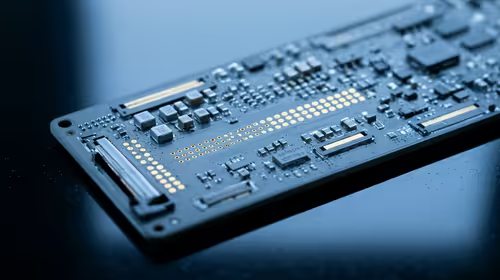
Hot-Swappable PCB Architecture in Modern Keyboards: Guide
Learn hot-swappable PCB architecture in modern keyboards—what it is, how sockets and traces work, and how to pick the right board. Speed up swaps, reduce risk, and upgrade faster 🔧⚡
Read moreOur complete gaming pc power supply guide helps you master power management for your upgraded rig. Learn to calculate wattage, understand 80 PLUS ratings, and choose the perfect PSU to prevent bottlenecks and ensure stable performance. Power up your game! ⚡️🖥️
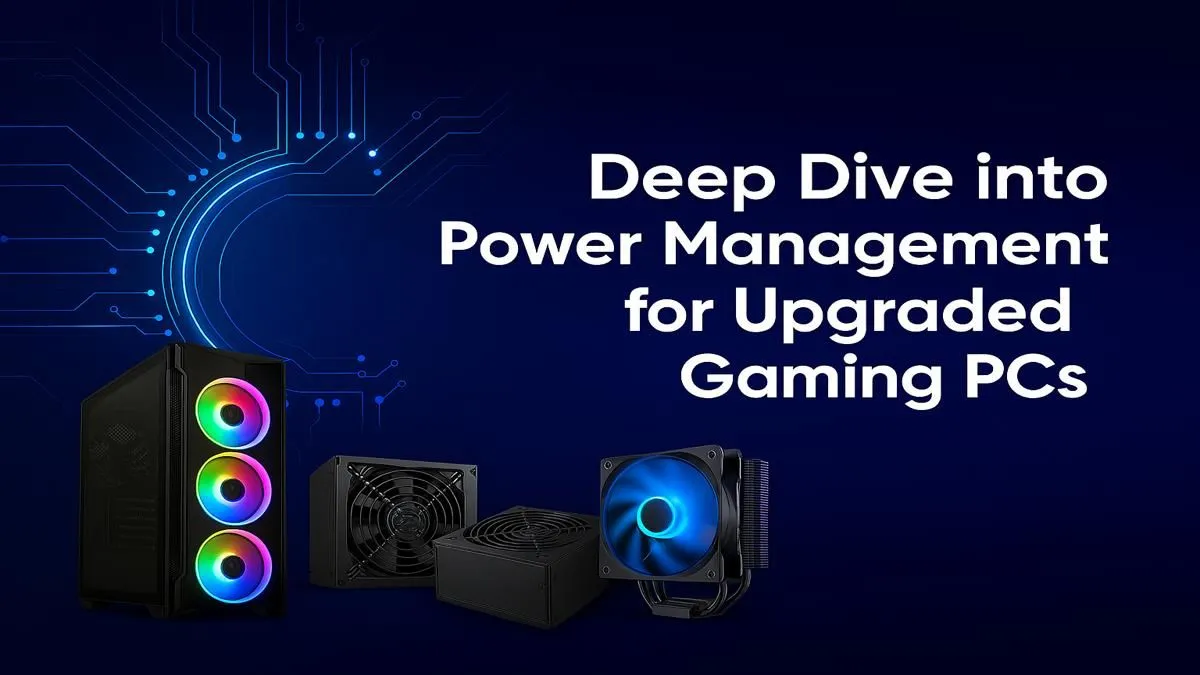
So, you’ve just scored a beastly new graphics card. Your rig is about to push some serious frames, but before you dive in, let's talk about the one component that can make or break your entire setup: the power supply. A shoddy PSU isn't just a risk... it's a ticking time bomb for your expensive hardware. This gaming PC power supply guide will help you choose the right one for your rig. 🚀
Think of your Power Supply Unit (PSU) as the heart of your PC. It doesn't just switch your computer on; it pumps clean, stable electricity to every single component, from the motherboard to your SSDs. Skimping on this critical part is a classic mistake. A cheap, unreliable unit can cause random crashes, system instability, and in the worst-case scenario, permanently fry your prized components.
Protecting your investment is key. A high-quality power supply provides over-voltage and short-circuit protection, acting as a shield for sensitive parts like your CPU processor. It’s the foundation of a stable and long-lasting gaming machine. Don't let a few hundred Rand of savings on a PSU put thousands of Rands worth of hardware at risk.
Navigating PSU specs can feel a bit technical, but it's simpler than it looks. Let's break down the three most important factors you need to consider when selecting a gaming PC power supply.
This is the most common question. While a 1000W PSU looks impressive, it might be overkill. The goal is to find a wattage that comfortably covers your system's peak power draw with some headroom for future upgrades. A good rule of thumb is to add up the power consumption of your main components (CPU and GPU are the biggest draws) and then add another 20-30% on top. This ensures the PSU runs in its most efficient range, saving you money on your electricity bill.
Modern gaming PCs draw most of their power from the +12V rail, especially the GPU. When comparing two 750W power supplies, check the amperage (A) rating on the +12V rail. A higher amperage here often indicates a better quality unit designed for demanding gaming loads.
You'll see labels like 80 Plus Bronze, Gold, Platinum, or Titanium. This isn't just marketing... it's a certification for efficiency. An 80 Plus Gold PSU, for example, is at least 87% efficient at converting AC power from your wall into DC power for your PC. The key benefit for South African gamers? Less wasted energy means less heat, a quieter system (as the fan doesn't have to work as hard), and a slightly lower Eskom bill. ✨
This choice is all about cable management.
The perfect gaming PC power supply always depends on the components it's fuelling. A mid-range build with a single GPU might only need a reliable 650W Gold unit. But if you're building a top-tier machine, you need to plan accordingly.
For example, high-end systems built around powerful hardware demand more juice. If you're starting with one of the latest Intel barebone kits and plan to add a flagship graphics card, a 750W or 850W PSU is a wise investment for stability and future-proofing. Similarly, enthusiasts building with top-of-the-line CPUs found in AMD barebone kits should aim for a high-quality power supply to ensure every component performs at its peak without being starved for power. A solid PSU is the cornerstone of any serious upgrade.
Ready to Find Your Perfect Match? Don't let a weak PSU bottleneck your performance. A reliable power supply is an investment in your entire gaming experience. Explore our huge range of PC power supplies and give your rig the stable, clean power it deserves.
Use an online PSU calculator for a baseline and add 20-30% headroom. For high-end GPUs like an RTX 4080/4090, a quality 850W to 1000W PSU is a safe starting point.
The 80 PLUS rating signifies power supply efficiency. A Bronze rating is 85% efficient at 50% load, while Titanium is over 94%. Higher efficiency means less wasted energy as heat.
A modular PSU is generally better. It improves cable management and case airflow since you only attach the cables you need, resulting in a cleaner and cooler-running system.
A quality PSU lasts 7-10 years. You should consider upgrading your PC power supply if you install a power-hungry new component (like a GPU) or if it's nearing its warranty end.
Common signs of a failing PSU include unexpected shutdowns, random system reboots, blue screens of death (BSOD), and unusual noises like whining or clicking from the unit.
Absolutely. A low-quality PSU can deliver unstable power, leading to system crashes and potentially causing permanent damage to your motherboard, CPU, or GPU. Always invest in a reputable brand.
Learn hot-swappable PCB architecture in modern keyboards—what it is, how sockets and traces work, and how to pick the right board. Speed up swaps, reduce risk, and upgrade faster 🔧⚡
Read more
Mechanical switch lifespan explained—what the 50 million keystroke rating really means, plus tips to extend switch life and reduce double-press issues 🔧⌨️
Read more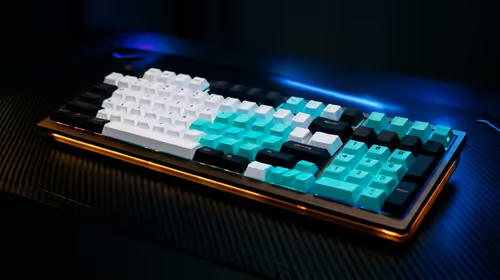
60-percent vs full-size mechanical keyboard layouts—learn what each layout includes, who it suits, and how to choose the right fit 🧩⌨️ for typing, gaming, and productivity.
Read more
Double injection keycaps last far longer than standard printed keycaps in most setups. Learn typical lifespan ranges, what shortens them, and how to maximize durability for smoother daily typing and gaming 😊⌨️
Read more
Full-key anti-ghosting: does it stop missed inputs during fast-paced gaming? We break down latency, polling, and key matrix limits so you can buy smarter 🎮⚡
Read more
Protect mechanical keyboard switches from South African dust and summer humidity with practical cleaning and storage habits. Keep your switches smooth, reduce failures, and extend lifespan. 🌬️💧
Read more
Wondering if a TKL wireless mechanical keyboard is worth it for everyday productivity? We break down latency, battery life, comfort, and workflow gains for real work. ⚡⌨️

Maximise battery life on a fanless 15-inch laptop using efficiency core architecture. Cut idle drain, tune power profiles, and improve thermals for longer runtime. 🔋⚙️
Learn how to reduce desk clutter with a TKL wireless keyboard using fewer cables, smart placement, and tidy essentials. Get a faster, calmer workspace with better ergonomics. ✅🧼
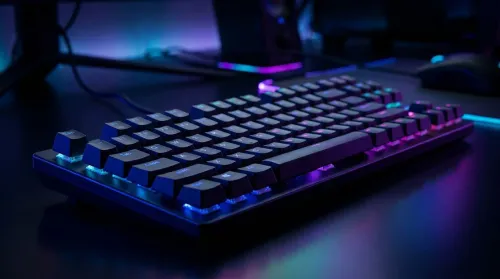
RGB keyboard lighting too distracting? Learn how to manage backlight modes, set brightness, and reduce distraction for focus and productivity 😌🖱️
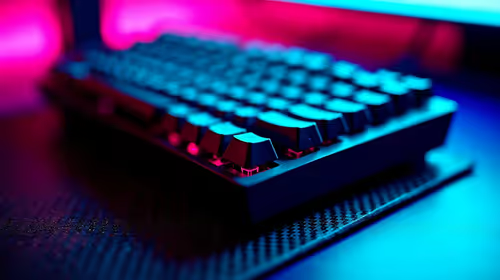
Are themed gaming keyboards worth the extra cost? Compare build quality, switch options, features, and resale value to find the best fit for your setup 🎮⌨️
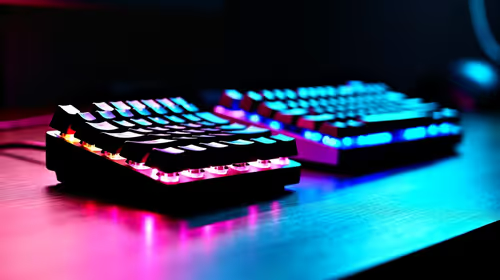
Full-Size vs Tenkeyless mechanical keyboards for gaming: find out if a smaller layout truly improves aim, speed, and comfort. We break down layout, desk space, latency-feel, and keybinds 🎮⌨️

Dedicated media rollers vs function key shortcuts: learn which setup gives you better workflow control, faster media access, and fewer mistakes. 🖱️🎧

Best Mechanical Switch Type for Gaming: Clicky vs Linear vs Tactile. Find your feel, speed, and noise balance with practical guidance for FPS, MOBA, and productivity 😄🎮
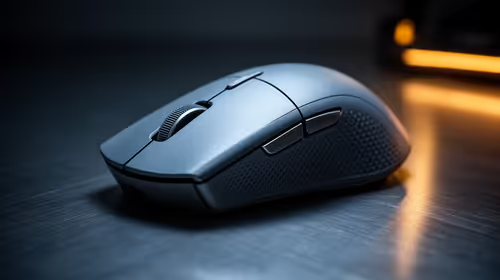
Direct mouse answer: Mouse not keeping up with your work? Everything that matters about dual-mode 2.4GHz + BT 5.0: DPI behaviour, channel switching, battery curves and per-app button mapping. Covers when 2.4GHz USB wins (low-latency desk) and when BT 5.0 wins (laptop, d
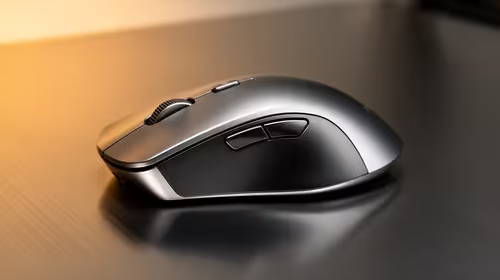
Plain wireless mouse guide: Mouse not keeping up with your work? Everything that matters about wireless productivity mouse: DPI behaviour, channel switching, battery curves and per-app button mapping. Includes DPI tuning tips, channel switch shortcuts, and ZAR-aware fea
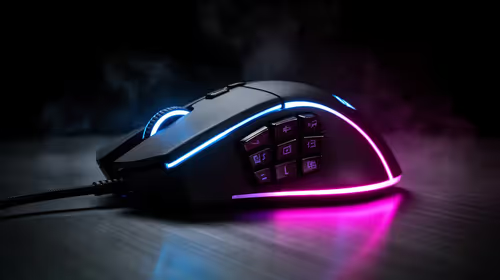
Real productivity numbers: Set up your wireless mouse in this order: everything that matters about wireless productivity mouse: DPI behaviour, channel switching, battery curves and per-app button mapping. Includes DPI tuning tips, channel switch shortcuts, and ZAR-aware
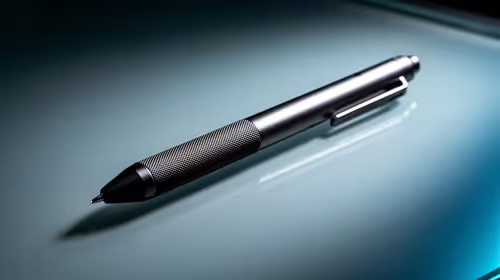
Pen not feeling like paper? Stylus lag and skipping usually trace to old drivers, dirty nibs, or display refresh mismatches, not the pen itself. Covers pressure curve tuning, tilt thresholds, nib swap timing, and SA pricing brackets.