Staring at a render bar that moves slower than rush hour traffic on the N1? For South African content creators, from bustling Jozi studios to remote Karoo offices, that lag is a creativity killer. Choosing the best graphics card for content creators in 2026 isn't just about faster exports... it's about reclaiming your time and unlocking your vision. Let's dive into the hardware that will power your next masterpiece. 🚀
Why Your GPU is Your Most Valuable Creative Partner
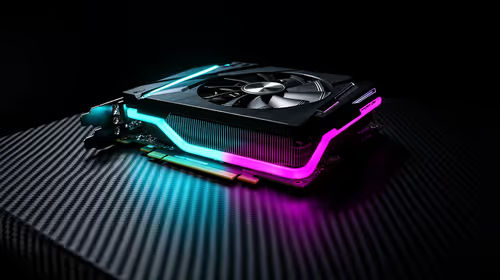
Gone are the days when a powerful CPU did all the heavy lifting. Today, from video editing in DaVinci Resolve to 3D modelling in Blender, your workflow is accelerated by your Graphics Processing Unit (GPU). Modern creative software leans heavily on the parallel processing power of GPUs for real-time previews, AI-powered effects, and drastically reduced render times. The right graphics card for content creation can literally save you hours every week. Before you buy, it's worth exploring the latest GPUs to see how far the technology has come.
Decoding the Specs: What Truly Matters for Creators
Navigating GPU specs can feel like learning a new language. Let's cut through the noise and focus on what impacts your creative output.
VRAM: Your Creative Canvas
Video RAM, or VRAM, is high-speed memory on the graphics card itself. Think of it as your digital canvas. Editing 4K or 6K footage, working with complex 3D scenes, or using high-resolution textures all consume large amounts of VRAM. For 2026, 12GB should be your baseline, but for serious 4K+ work, aiming for 16GB or more is a wise investment. The premium cards that deliver this level of performance are built for these demanding tasks.
Cores and Encoders: The Engine Room
- CUDA Cores (NVIDIA) / Stream Processors (AMD): These are the individual processors doing the work. More cores generally mean better performance for tasks like rendering.
- Tensor & RT Cores (NVIDIA): These specialised cores are crucial. Tensor Cores accelerate AI tasks (like Adobe Sensei features or DaVinci's Magic Mask), while RT Cores handle real-time ray tracing in 3D applications.
- Media Encoders (NVENC/AMF/Quick Sync): A dedicated media engine on your GPU handles video encoding and decoding. This is vital for smooth playback and lightning-fast exports, especially with modern codecs like AV1.
Studio vs. Game Ready Drivers 🔧
NVIDIA offers two driver tracks. Game Ready drivers are optimised for the latest game releases. Studio Drivers, however, are specifically tested and optimised for creative applications like Adobe Premiere Pro, DaVinci Resolve, and Blender. For maximum stability and performance in your creative workflow, always choose the Studio Driver.
Our Top Picks for the Best Graphics Card for Content Creators in 2026
Predicting the future is tricky, but based on current trends, here’s what the landscape will likely look like for South African creators.
The Ultimate Powerhouse: For 8K Video and Complex 3D
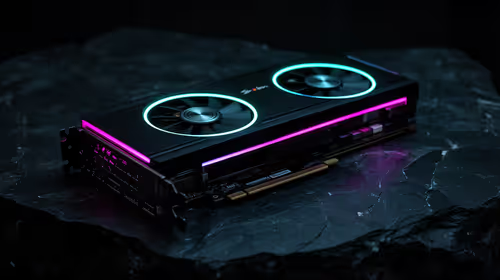
For professionals pushing the boundaries, nothing but the best will do. We expect the top-tier cards of 2026 (think a future NVIDIA RTX 5090 or AMD's best) to offer 24GB+ of VRAM and unmatched AI performance. These GPUs will handle multi-layer 8K timelines and complex architectural visualisations without breaking a sweat. They represent a significant investment, but for a busy studio, the time saved translates directly into Rands. You can already see the calibre of these cards in the current flagship models from NVIDIA.
The Balanced Performer: The Prosumer Sweet Spot ✨
This is where most serious creators and freelancers will find their perfect match. Cards in the R15,000 – R25,000 price bracket (in today's terms) will offer the best performance-per-Rand. A future RTX 5070 or a high-end AMD card will provide ample VRAM (around 16GB) and enough power for smooth 4K editing and advanced motion graphics. This tier is the workhorse of the creator economy, and NVIDIA's excellent mid-range has historically dominated this space.
The Smart Starter: High-Quality 1080p/1440p Editing
You don't need to break the bank to get a fantastic creative experience. By 2026, even entry-level GPUs will be incredibly capable. These are perfect for YouTubers, graphic designers, and photographers. With solid media encoders and enough VRAM for 1440p workflows, these cards offer incredible value. Keep an eye on Intel's Arc series, which continues to impress with its media handling capabilities at a competitive price.
The Specialist's Choice: CAD, Science, and Data
For some, raw gaming power isn't the priority. If your work involves certified drivers for applications like SOLIDWORKS, CATIA, or complex scientific simulations, then specialised workstation GPUs are the only answer. These cards are built for rock-solid stability and precision above all else.
Team Green, Red, or Blue? The Creator's Dilemma
Which brand should you choose? Each has its strengths.
- NVIDIA (Green): Still the top choice for most creators due to the maturity of its CUDA platform and superior AI/ray-tracing performance. Its Studio Drivers offer unparalleled stability.
- AMD (Red): Offers fierce competition with excellent raw performance for tasks like video editing and rendering. If your workflow doesn't rely heavily on CUDA-specific features, AMD Radeon™ graphics cards can provide incredible value.
- Intel (Blue): The newcomer is making waves, particularly with its AV1 encoding prowess, making it a compelling option for streamers and video editors on a budget.
Ultimately, the best graphics card for content creators is the one that best accelerates your specific software and workflow.
Ready to Power Up Your Creativity? ⚡
Choosing the right GPU is a big step towards a faster, smoother creative workflow. Stop waiting for renders and start making. Explore our massive range of graphics cards and find the perfect engine to bring your vision to life in South Africa.