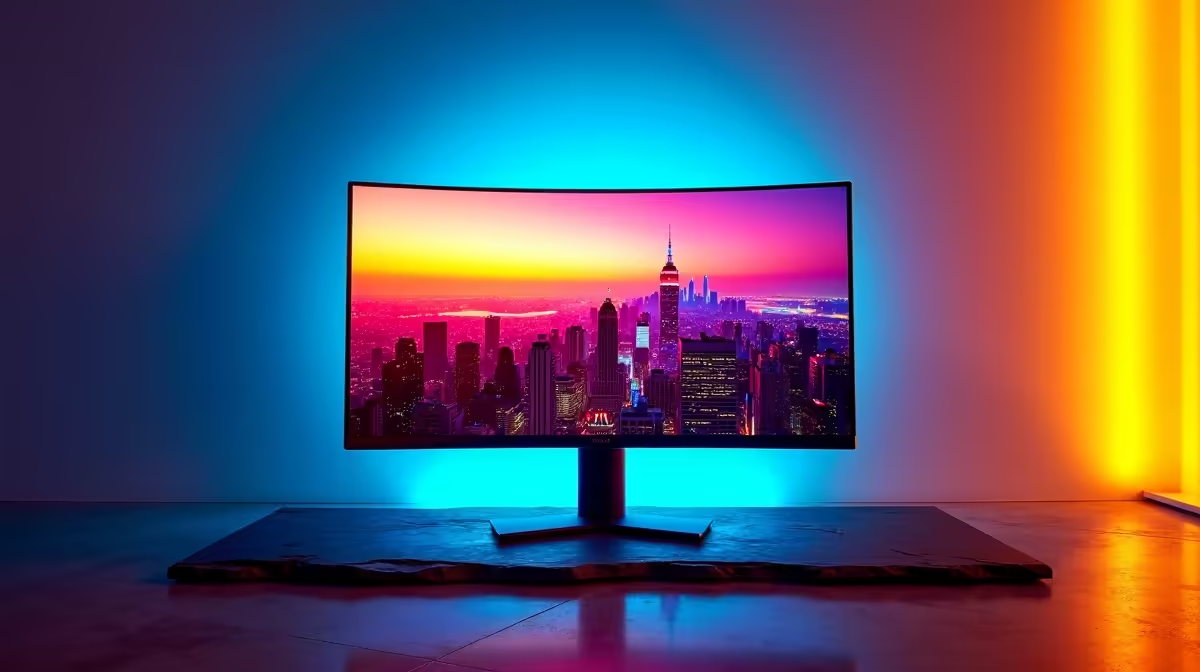
You’ve dropped some serious ZAR on a beastly RTX or Radeon GPU. You fire up Cyberpunk 2077, flick on path tracing, and… wow. The realistic lighting, the reflections, the shadows—it’s breathtaking. But if your monitor can’t keep up, you’re only seeing half the magic. A washed-out, slow panel will bottleneck that graphical power. This guide will help you find the best monitors for ray tracing in 2025, ensuring every glorious photon hits your eyeballs perfectly. 🚀
What Makes a Monitor Great for Ray Tracing?
It’s not just about one flashy spec. The ultimate display for ray-traced gaming is a careful blend of several key technologies working in harmony. Your graphics card renders the complex light bounces, but the monitor is what translates that data into a visual punch. To get the most out of your hardware, you need to look at the full picture, from panel type to pixel response. The good news is, there are fantastic PC monitors available in South Africa to suit every setup.
Contrast is King: OLED vs. Mini-LED
Ray tracing is all about the dramatic interplay between light and shadow. To truly appreciate it, you need a monitor with incredible contrast.
- OLED: These panels are the undisputed champions of contrast. Because each pixel generates its own light, they can achieve perfect, inky blacks right next to brilliant highlights. This makes neon-drenched streets in sci-fi games or deep, dark dungeons feel incredibly immersive.
- Mini-LED: A brilliant alternative, Mini-LED displays use thousands of tiny LEDs for their backlight, creating hundreds of local dimming zones. While not quite at OLED's per-pixel level, they get incredibly close, offering stunning HDR performance with a lower risk of burn-in and often at a sharper price point.
Resolution and Refresh Rate: The Sweet Spot
Chasing frames with ray tracing enabled is demanding. You need to find the right balance between visual clarity and buttery-smooth gameplay. For most gamers in 2025, the sweet spot is 1440p (QHD) at 144Hz or higher. This resolution is a significant step up from 1080p without demanding the god-tier GPU that 4K ray tracing requires. A high refresh rate ensures that the stunning visuals remain fluid and responsive.
Tearing-Free Visuals: Why Sync Tech Matters
There's nothing worse than a beautiful scene ruined by screen tearing. This happens when your GPU's frame output is out of sync with your monitor's refresh rate. That's where adaptive sync technology comes in. ✨
If you’re running an NVIDIA card, a certified G-Sync (NVIDIA) monitor is your best bet for a flawless, tear-free experience. For Team Red, a display with FreeSync (AMD) support will synchronise frames perfectly with your Radeon GPU. Many modern screens also feature VESA Adaptive Sync, offering a great, often more affordable, baseline that works with both camps.
Unlock True HDR Brilliance 💡
Don't just enable HDR in your game's settings. First, turn it on in Windows Display Settings, then download and run the free 'Windows HDR Calibration' app from the Microsoft Store. This tool helps you tune the display's peak brightness and colour saturation specifically for your panel, ensuring you see ray-traced scenes exactly as the developers intended.
Top Monitor Brands to Watch in 2025
When searching for the best monitors for ray tracing, certain brands consistently deliver performance and value.
AOC monitors, for example, are a favourite in the South African gaming community for their aggressive pricing and high-refresh-rate panels. Meanwhile, brands like Dahua are making waves by offering impressive specs, like Fast IPS and high resolutions, at competitive price points. And of course, you can never go wrong with the reliability and premium build quality of HP screens, especially their OMEN lineup which is purpose-built for serious gaming.
Finding Your Perfect Ray Tracing Monitor
Ultimately, the best ray tracing monitor for you is one that complements your GPU, fits your desk, and suits your budget. Prioritise a high-contrast panel like an OLED or Mini-LED to make those realistic shadows pop. Aim for the 1440p resolution and 144Hz+ refresh rate sweet spot for a blend of clarity and smoothness. And finally, ensure it has the right adaptive sync technology for your graphics card. Get those three things right, and you're ready for a truly next-gen visual experience.
Ready to Unleash True Visual Fidelity?
Your powerful GPU is only half the story. The best monitors for ray tracing bring virtual worlds to life with breathtaking contrast and clarity. To truly experience the beauty of modern games, you need a display that can do it justice. Explore our massive range of PC monitors and find the perfect screen to conquer your world.