You're in a tense 1v3 clutch in Valorant. You peek, you flick, you fire... but you're a millisecond too late. Sound familiar? For competitive South African gamers, every frame counts. The question on everyone's mind is whether upgrading to a 360Hz monitor for eSports is the secret weapon you need to climb the ranks, or just a pricey luxury. Let's break down the tech and see if it’s truly worth your hard-earned Rands.
Understanding Refresh Rate: From Lag to Liquid-Smooth
Before we dive into the numbers, what exactly is a refresh rate? Measured in Hertz (Hz), it’s simply how many times your monitor updates the image on screen every second. A standard 60Hz screen refreshes 60 times, while a 144Hz monitor does it 144 times. This higher refresh rate creates a noticeably smoother, more responsive experience.
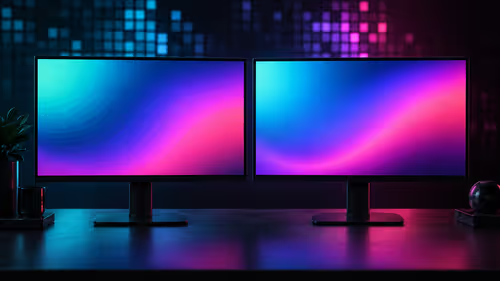
The jump from 60Hz to 144Hz was massive for gamers. It reduced motion blur, improved tracking, and made gameplay feel incredibly fluid. Many players then moved to 240Hz for an even finer competitive edge. A 360Hz monitor takes this to the absolute pinnacle, refreshing the screen a staggering 360 times per second. It's the current gold standard for professional eSports, but is the difference as dramatic? To get a feel for the options out there, you can browse a wide variety of PC monitors to see how specs and prices vary.
The 360Hz Edge: Is It Noticeable?
Here’s the honest truth: the law of diminishing returns is very real. While the leap from 60Hz to 144Hz is night and day, the jump from 240Hz to 360Hz is far more subtle. ⚡
So, who actually benefits from a 360Hz monitor for eSports?
- Aspiring & Pro Players: In games like CS:GO, Valorant, and Apex Legends, where split-second reactions decide matches, the fractional advantage in clarity and input lag can be the difference between winning and losing a round.
- Hardware Enthusiasts: If you have a top-tier PC and simply want the best, most responsive experience money can buy, a 360Hz monitor delivers that.
For the average gamer, a 144Hz or 240Hz monitor still offers a phenomenal competitive experience. You can explore all our gaming monitors to find the sweet spot for your budget and skill level.
Optimise for Peak Performance 🔧
To get the most out of any high-refresh-rate monitor, ensure your PC can consistently produce high frame rates (FPS). In your game's settings, lower graphically intense options like shadows, anti-aliasing, and textures. Enable NVIDIA Reflex or AMD Anti-Lag if available. Your goal is to have your FPS consistently at or above your monitor's refresh rate for the smoothest experience.
Can Your PC Even Power a 360Hz Monitor?
This is the most crucial question. A 360Hz monitor is only as good as the PC powering it. To take advantage of that refresh rate, your graphics card needs to consistently push 360 frames per second (or more) in your chosen game.
A high-end GPU like an NVIDIA GeForce RTX 4070 or better is practically a requirement. In less demanding eSports titles, this is achievable. However, in graphically rich, story-driven games, you're better off investing in visual fidelity with stunning 4K monitors, where the breathtaking detail is more impactful than an ultra-high refresh rate.
What About Other Monitor Types?
While flat, high-refresh-rate panels dominate the eSports scene, they aren't the only option. Many gamers love the wraparound feeling of curved monitors for deeper immersion in RPGs and racing sims. For those who work and game on the go, portable monitors offer incredible flexibility. Finally, don't forget that the right monitor accessories, like a quality VESA mount, can perfect any setup. ✨
The Verdict: Is a 360Hz Monitor Worth It in South Africa?
So, should you buy a 360Hz monitor for eSports? It depends entirely on you.
- YES, if: You are a highly competitive player in fast-paced shooters, you already have a powerful PC that can push 360+ FPS, and you want every possible advantage.
- PROBABLY NOT, if: You're a casual gamer, play a variety of game genres, or your PC is more mid-range.
For many South African gamers, the sweet spot for performance and value lies in the 144Hz to 240Hz range. You get a massive upgrade over 60Hz without the extreme cost and hardware demands of 360Hz. You can often find incredible value by checking out the best PC monitor deals available. 🚀
Ultimately, the choice is yours. A 360Hz monitor is an elite piece of kit for those at the peak of their game, but it's not a magic bullet that will instantly make you a pro.
Ready to Find Your Perfect Match? Whether you're chasing professional glory with a 360Hz beast or seeking the perfect balance of price and performance, the right display makes all the difference. Explore our massive range of gaming monitors and find the perfect screen to conquer your world.