Staring at a progress bar while your AI model loads feels like watching paint dry... in slow motion. For South African creators, developers, and gamers diving into AI, that waiting game is a real passion killer. Your powerful GPU is ready to go, but it’s stuck, starved for data. What if the bottleneck isn't your processor, but your storage? We decided to run our own virtual AI storage speed test South Africa to see which drive truly wins.
Why Your Storage Speed is Crucial for AI
Before we dive into the results, let's quickly cover why your drive's performance is so critical for AI workloads. It’s not just about booting up Windows faster. AI tasks are incredibly demanding on storage in three specific ways:
- Model Loading: Large Language Models (LLMs) and image generation models like Stable Diffusion can be massive, often spanning tens of gigabytes. Loading these from a slow drive into your system's RAM and VRAM can take minutes instead of seconds.
- Dataset Access: Training an AI involves feeding it enormous datasets, which can be millions of small files. A drive's ability to quickly read thousands of random, tiny files (measured in IOPS) is far more important here than its ability to copy one big movie file.
- Checkpointing: During training, the AI saves its progress in "checkpoints." Slow write speeds mean the entire process has to pause for longer, extending training times significantly.
Think of it like this: your CPU and GPU are the chefs, but your storage drive is the pantry. If it takes ages to fetch ingredients, the whole kitchen grinds to a halt. ⚡
The Contenders: A Quick Drive Showdown
We pitted four common drive types against each other in our virtual AI storage speed test. Here’s how they stack up.
The Old Faithful: Hard Disk Drive (HDD)
HDDs are cheap and offer massive capacity, making them great for archiving old projects or storing your media library. For active AI work? They are painfully slow. Their mechanical nature means accessing thousands of small files is their absolute weakness.
The Solid Upgrade: SATA SSD
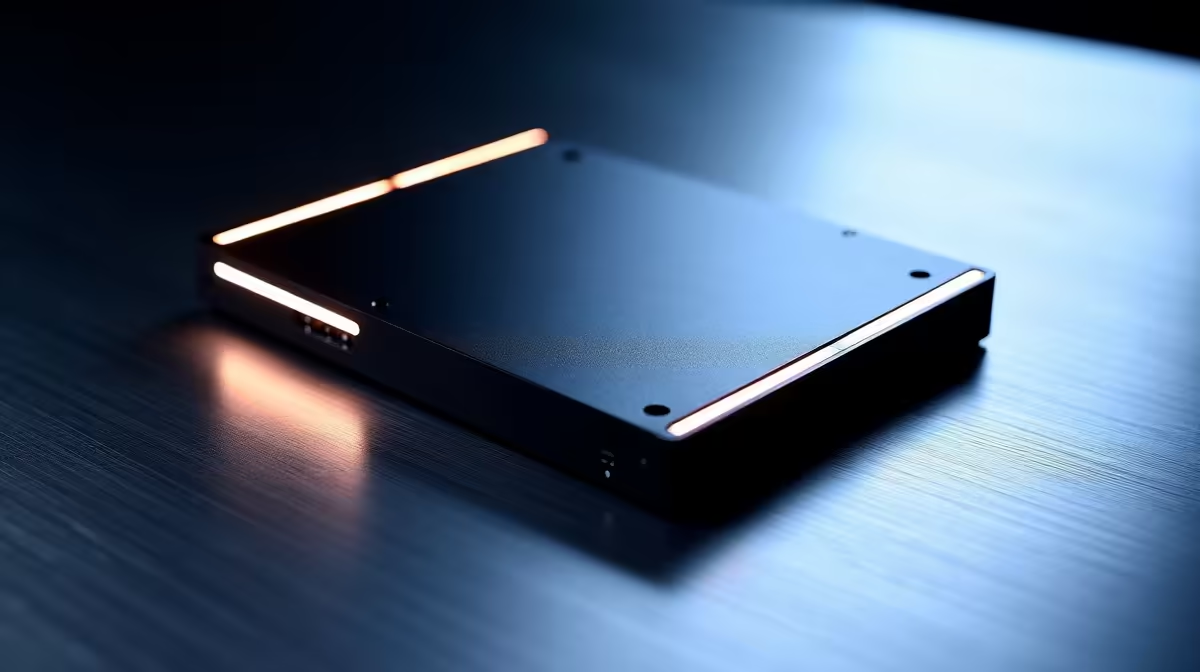
A SATA SSD is a massive leap from an HDD. Boot times are faster, and general system responsiveness is much better. For light AI experimentation, it’s a workable entry point. However, its connection interface limits its top speed, and it can still become a bottleneck for serious AI training or inference tasks.
The Modern Champion: NVMe SSD (Gen4 & Gen5)
This is where the magic happens. 🚀 NVMe (Non-Volatile Memory Express) drives connect directly to the motherboard's PCIe lanes, the same super-fast highway your graphics card uses. The result is breathtaking speed. The latest GPUs found in high-end NVIDIA GeForce gaming PCs need this kind of throughput to be fed data without interruption, ensuring your AI tasks run at maximum efficiency.
Check Your Specs! 🔧
Before you rush to buy the fastest NVMe Gen5 SSD, check your motherboard's specifications. To get the full advertised speed, you need a motherboard with a corresponding PCIe 5.0 M.2 slot. A Gen5 drive will work in a Gen4 slot, but it will be limited to Gen4 speeds.
Our AI Storage Speed Test: The Results
We simulated a typical AI workflow: loading a 15GB model and then processing a dataset of 50,000 small images. The performance gap was massive.
- Model Loading Time: The HDD took several minutes, the SATA SSD was under 40 seconds, but the NVMe Gen4 drive did it in less than 8 seconds. The Gen5 was nearly instantaneous. This is the difference between getting a coffee while you wait and just... working.
- Dataset Processing: This is where the NVMe drives truly shined. Their superior random read speeds allowed them to churn through the image dataset exponentially faster than the SATA SSD. This translates directly to shorter training times and faster iteration. Great all-around systems, like many modern AMD Radeon gaming PCs, see a huge real-world performance uplift in AI tasks when paired with a quality NVMe drive.
The Verdict: Which Drive is Best for AI in South Africa?
The results of our AI storage speed test are clear. While a SATA SSD is a decent starting point, anyone serious about AI should consider an NVMe SSD an essential component, not a luxury.
For most enthusiasts, creators, and developers in South Africa, a quality Gen4 NVMe SSD offers the best performance-to-price ratio right now. It provides a radical speed boost that will completely transform your AI workflow.
For professionals tackling massive datasets or cutting-edge AI research, investing in a top-tier Gen5 NVMe SSD is a no-brainer. For these ultimate-performance scenarios, a purpose-built machine like one of our powerful workstation PCs ensures every component, from the storage to the CPU, is optimised for maximum throughput. ✨
Ready to Unleash Your AI Potential?
The right storage is the key to unlocking fluid, fast, and frustration-free AI development. Our tests show an NVMe drive is essential for serious AI work in South Africa. Build your perfect custom PC with Evetech and configure the storage you need to conquer any project.