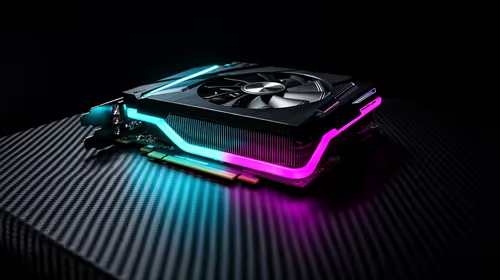
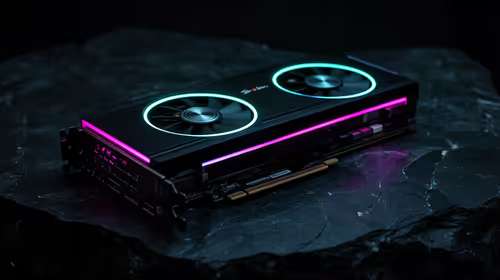
Stuttering frame rates killing your vibe in the latest titles? We've all been there. You want silky-smooth gameplay without forking out a fortune for a top-tier GPU. Enter AI upscaling. The battle between NVIDIA's DLSS and AMD's FSR is heating up, but which one gives you the best performance boost for your buck here in South Africa? Let's break it down so you can make the smart choice for your rig.
What is AI Upscaling, Anyway?
Before we dive into the DLSS vs FSR showdown, let's quickly cover what this tech actually does. In simple terms, AI upscaling allows your graphics card to render a game at a lower resolution (like 1080p) and then uses sophisticated algorithms to intelligently scale the image up to your monitor's native resolution (like 1440p or 4K).
The result? A massive boost in frames per second (FPS) with a minimal impact on visual quality. It's like getting a free hardware upgrade, letting you crank up those settings without turning your game into a slideshow. 🚀
Team Green: NVIDIA DLSS Explained
NVIDIA's Deep Learning Super Sampling (DLSS) was the first to properly crack the code on AI upscaling. Its secret weapon is machine learning, trained on supercomputers to reconstruct images that are incredibly sharp and detailed.
The catch? DLSS relies on dedicated Tensor Core hardware, which means it only works on NVIDIA GeForce RTX graphics cards. This exclusivity is both its biggest strength—leading to often superior image quality—and its main limitation. With features like Frame Generation in DLSS 3, NVIDIA can literally create new frames, pushing performance to incredible new heights.
Team Red: AMD FSR's Open Approach
AMD's FidelityFX Super Resolution (FSR) is the people's champion. Unlike DLSS, FSR is an open-source technology. This means it doesn't require specialised hardware and works across a huge range of GPUs. This includes not only AMD Radeon graphics cards but also older NVIDIA cards and even Intel's new Arc GPUs.
While early versions of FSR traded a bit more image quality for this wide compatibility, the latest iterations (FSR 2 and 3) have closed the gap significantly. FSR 3 even includes its own frame generation tech, called Fluid Motion Frames, making it a direct competitor to DLSS 3.
Check Before You Buy! 🔧
Game support is key. Before you commit to a new GPU, check the official support lists for your favourite games. A game's specific implementation of DLSS or FSR can make a huge difference. Websites like PCGamingWiki are fantastic resources for checking compatibility at a glance.
The Big Showdown: DLSS vs FSR Head-to-Head
So, when the pixels settle, which one is better? The honest answer is... it depends on your hardware and priorities.
Image Quality
Generally, the consensus is that DLSS holds a slight edge in image reconstruction. Thanks to its AI training on Tensor Cores, it often does a better job of handling fine details, transparency, and reducing visual artifacts. FSR has improved immensely and looks fantastic in motion, but can sometimes appear slightly softer on close inspection.
Performance Boost
Both technologies provide a phenomenal FPS boost, often turning unplayable frame rates into a smooth 60+ FPS experience. DLSS 3's Frame Generation is incredibly effective, but it's only for the 40-series cards. FSR's gains are universally accessible, which is a massive win for gamers on a budget.
Compatibility
FSR wins this category, no contest. Its open-source nature means far more gamers can benefit from it. If you're not running a recent RTX card, FSR is your go-to solution for upscaling. This flexibility makes finding a compatible card among the best graphics card deals much easier.
The Verdict: Which AI Upscaling Tech is for You? ✨
Choosing between DLSS and FSR isn't about picking an absolute winner; it's about what's right for your gaming setup.
- Choose DLSS if: You own or plan to buy an NVIDIA RTX card (20-series or newer) and prioritise the absolute best image quality possible. For 40-series owners, DLSS 3 is a must-have feature.
- Choose FSR if: You have an AMD GPU, an older NVIDIA card, or simply value open standards. It delivers fantastic performance boosts to a much wider audience.
Ultimately, the real winner in the DLSS vs FSR war is the South African gamer. We now have incredible tools to maximise performance without needing the most expensive hardware on the market.
Ready to Boost Your FPS?
The DLSS vs FSR debate ultimately guides your next GPU choice. Whether you're after the AI-powered precision of NVIDIA or the open compatibility of AMD, the right card is waiting to transform your gaming experience. Explore our massive range of graphics cards and find the perfect hardware to conquer your world.