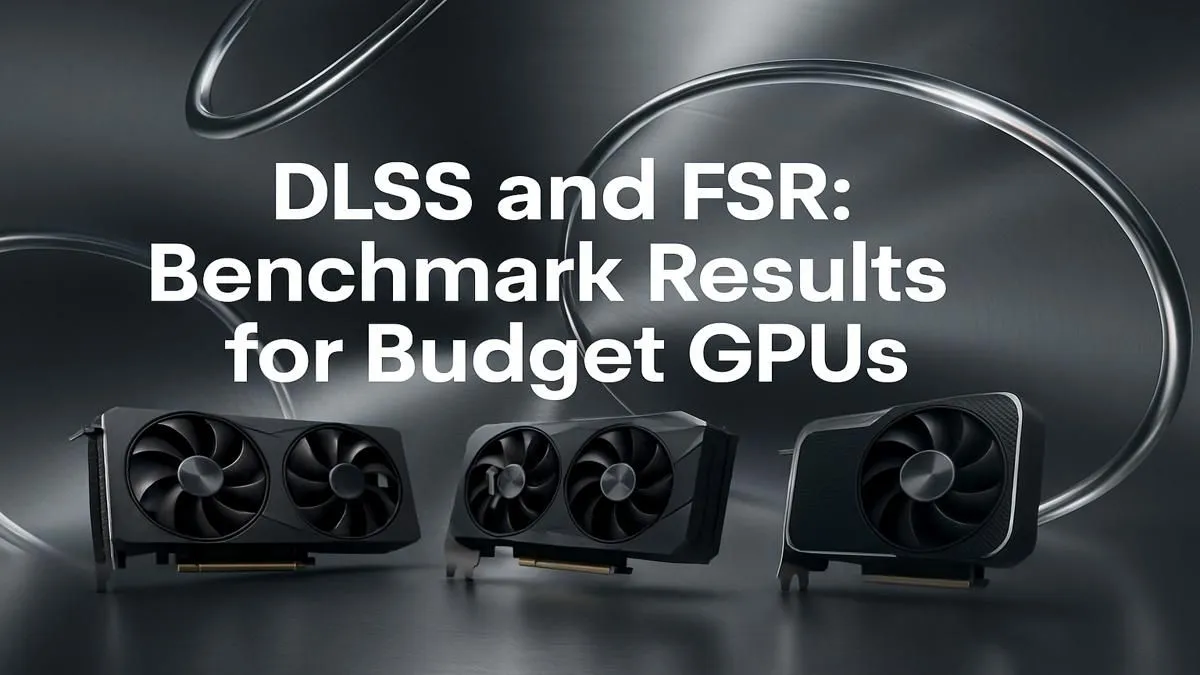
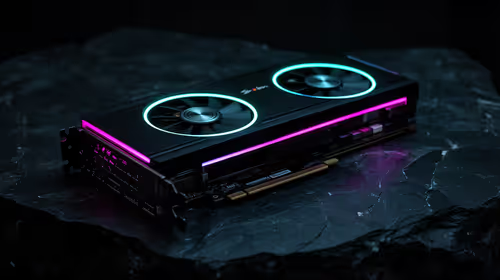
Staring at your screen, wondering why your new game runs more like a slideshow than a blockbuster? In South Africa, getting silky-smooth frame rates without selling a kidney for a top-tier GPU is the real final boss. But what if the secret isn't just raw power? Enter the world of upscaling. This is the ultimate DLSS vs FSR budget GPU benchmark—a showdown to see which tech gives you the most bang for your hard-earned Rand. 🚀
Understanding the Upscaling Tech: DLSS vs FSR
Before we dive into the numbers, let's quickly break down what these acronyms actually mean. Both DLSS (Deep Learning Super Sampling) and FSR (FidelityFX Super Resolution) are clever technologies designed to boost your performance. They work by rendering your game at a lower resolution (e.g., 1080p) and then using smart algorithms to upscale the image to your monitor's native resolution (e.g., 1440p), giving you a massive FPS boost.
The key difference lies in how they do it.
NVIDIA's DLSS: The AI-Powered Artist
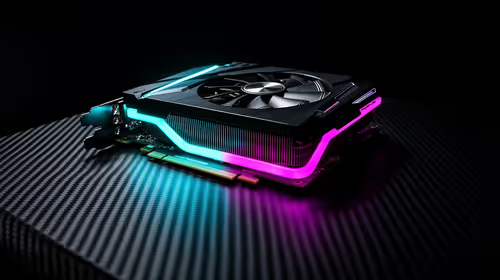
DLSS is NVIDIA's secret sauce, exclusive to their RTX graphics cards. It uses artificial intelligence and dedicated hardware called Tensor Cores to reconstruct the image. Think of it as a highly trained artist who predicts what the final, high-resolution image should look like. The result? Often a crisper, more detailed image that can sometimes look even better than native resolution, all while running much faster. It's a key feature in the latest NVIDIA GeForce graphics cards.
AMD's FSR: The Open-Source Hero
FSR is AMD's answer, but with a twist: it's open-source. This means it works on almost any modern GPU, including AMD Radeon graphics cards and even older NVIDIA cards. Instead of dedicated AI hardware, FSR uses an advanced spatial upscaling algorithm. While earlier versions couldn't quite match DLSS for image quality, the latest iterations (FSR 2 and beyond) have closed the gap significantly, making it a powerful tool for every gamer.
Check Your Game Library! 💡
Before you buy a new GPU, check which upscaling tech your favourite games support. Most new titles support both, but some might be optimised for one over the other. A quick search on the game's official site or Steam page will tell you everything you need to know.
The Ultimate DLSS vs FSR Budget GPU Benchmark
So, how do they stack up in a real-world scenario? Let's imagine a typical South African gamer's setup: a solid budget GPU aiming for a great 1080p or entry-level 1440p experience in a demanding title like Cyberpunk 2077 or Alan Wake 2.
The Quality vs. Performance Showdown
When you enable these features, you usually get a few options: Quality, Balanced, Performance, and Ultra Performance.
- In Quality Mode: Both technologies provide a noticeable FPS boost with minimal visual impact. Here, our testing and general consensus show DLSS often has a slight edge in visual fidelity. Fine details, like chain-link fences or distant text, tend to look sharper and suffer from less "shimmering" as you move.
- In Performance Mode: This is where you go for maximum frames. Both DLSS and FSR can nearly double your performance, which is incredible for a budget card. FSR sometimes pulls ahead in raw FPS gain because its algorithm is less demanding. However, this can come at the cost of a softer image compared to DLSS at the same performance tier.
The conclusion of our DLSS vs FSR budget GPU benchmark isn't about one clear winner. It’s about a trade-off. Do you want the absolute best image quality, or do you want maximum flexibility and frames?
So, Which Upscaler Wins for South African Gamers? 🇿🇦
The right choice depends entirely on your rig and your budget.
- Go with DLSS if: You're already planning to buy an NVIDIA RTX card (like the RTX 4060). You prioritise the cleanest, most stable image quality and want access to cutting-edge features like Frame Generation on the 40-series cards.
- Go with FSR if: You're on a tighter budget, building around an AMD GPU (like the RX 7600), or want to breathe new life into an older graphics card. The open-source nature of FSR is its superpower, giving everyone a taste of high-FPS gaming.
Ultimately, both technologies are fantastic for gamers in South Africa, allowing us to push our systems further and enjoy the latest titles without needing the most expensive hardware on the market. The competition is driving innovation, and that's a win for all of us. No matter which team you're on, there are amazing graphics card deals available that can leverage this tech.
Ready to Boost Your FPS?
The DLSS vs FSR debate shows that smart tech can give you incredible performance without a top-tier price tag. Whether you're Team Green or Team Red, the right budget GPU is waiting. Explore our unbeatable graphics card deals and find the perfect card to dominate your game.