Staring at your screen, wondering why your new rig is chugging on Cyberpunk 2077 at 1440p? You're not alone. In the quest for buttery-smooth frame rates, two technologies have become every South African gamer's best friend: NVIDIA's DLSS and AMD's FSR. But the DLSS vs FSR South Africa debate can be confusing. Which one gives you the best performance boost without turning your game into a blurry mess? Let's dive in and find out. 🚀
Understanding the Upscaling Showdown
At its core, both DLSS (Deep Learning Super Sampling) and FSR (FidelityFX Super Resolution) do the same thing: they render your game at a lower resolution and then cleverly use algorithms to scale it up to your monitor's native resolution. The result? A massive boost in frames per second (FPS). The magic is in how they do it.
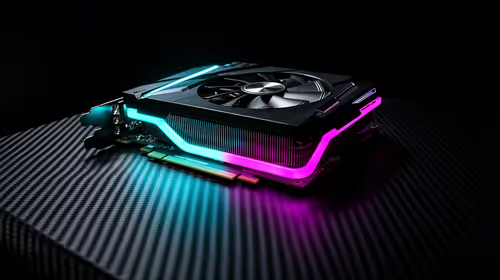
DLSS is the exclusive tech for users with NVIDIA GeForce RTX graphics cards. It uses dedicated AI hardware (Tensor Cores) on the GPU and a deep learning network to reconstruct the image. Think of it as a highly trained artist painting in the missing details with incredible accuracy.
FSR, on the other hand, is AMD's open-source solution. It doesn't require specialised hardware, which means it works on a huge variety of GPUs, including many older NVIDIA models and, of course, the latest AMD Radeon graphics cards. It uses an advanced spatial upscaling algorithm, which is less complex than DLSS's AI approach but has become incredibly effective, especially with the release of FSR 2 and beyond.
DLSS vs FSR South Africa: A Real-World Performance Test
So, which one should you be using? The answer depends on your hardware, the games you play, and your personal preference for image quality versus raw performance.
Image Quality
In a side-by-side comparison, DLSS often has a slight edge in preserving fine details and maintaining a sharper image, especially at its "Quality" preset. This is thanks to its AI training. However, the latest versions of FSR have closed this gap significantly. For most gamers, the visual difference between DLSS Quality and FSR Quality in the middle of a chaotic firefight is practically zero. ✨
Performance Gains
Both technologies offer huge FPS boosts that can turn an unplayable slideshow into a fluid experience. In our testing across titles like Baldur's Gate 3 and Call of Duty, both can easily provide a 50-70% performance uplift, sometimes even more. The latest DLSS 3 with "Frame Generation" takes this even further, but it's exclusive to the newest RTX 40-series cards.
Quick Settings Tip ⚡
In your game's graphics settings, always start with the "Quality" preset for either DLSS or FSR. This offers the best balance of visual fidelity and performance. Only drop to "Balanced" or "Performance" if you're still not hitting your target frame rate, like a stable 60 or 144 FPS.
The Verdict: Which is for You?
The FSR vs DLSS debate in South Africa often comes down to one simple factor: what GPU is in your PC?
- If you own or are buying a modern NVIDIA RTX card (20, 30, or 40-series): DLSS is your go-to. It's tailored for your hardware and generally provides a slightly more polished image.
- If you have an AMD graphics card, an older NVIDIA card, or are building on a tighter budget: FSR is a fantastic technology that opens up high-FPS gaming to everyone. Its performance is incredible, and its open-source nature is a big win for the gaming community.
Ultimately, both are brilliant tools. The real winner is the South African gamer, who can now achieve amazing performance without needing to splash out tens of thousands of Rands on the absolute top-end card. Before making a final choice, it's always smart to check out the latest graphics card deals to see where you can get the best value for your money.
Ready for a Frame Rate Revolution?
The DLSS vs FSR choice is easier when you have the right hardware. Whether you're Team Green or Team Red, the perfect GPU is waiting to unlock your PC's true potential. Explore Evetech's massive range of graphics cards and find the perfect upgrade for your rig today.